Enneagram? Meh.

“Do you know your Enneagram number?”

Me: “I’m whichever number thinks the Enneagram is [nonsense].”

I know there are some people (none of whom likely read my blog, or will continue to in any case) who feel the Enneagram saved their life or marriage or whatever and might be hurt by my opinion. In such cases, I recommend assigning me a number and attributing my behavior to that.

Seriously, though, I’m not trying to be hurtful. Just saying what I think.

A while ago a friend who is very excited about the Enneagram and finds my recalcitrance irritating asked me whose recommendation I would trust. My answer: Richard Beck (experimental psychologist, critical thinker, theologically astute).

So naturally, first thing this morning, my wife sent me the link to Beck’s interview on the Typology podcast (https://typologypodcast.com/podcast/2018/05/04/episode38/richardbeck).

Having listened to a number of Typology interviews, I’m not surprised that I found Beck’s the most palatable.

He was initially skeptical about the Enneagram. When the host, Ian Morgan Cron, asks whether Beck has changed his mind, he describes himself as “more open, definitely so.” And the episode as a whole suggests that that moderate endorsement is about the limit of Beck’s appreciation from a critical viewpoint. My starting point was deep skepticism as well, and at this point I can go so far as to say, meh. I’m not against it, but I don’t find it especially compelling.

Furthermore, Beck’s way of thinking through what is at stake overlaps with my own to a great extent. I share Beck’s pragmatism. The mystical is real. It matters what works, and the Enneagram seems to work for a lot of people (whatever that means in any given case). Then again, Joel Osteen and Scientology and Oprahism seem to work for a lot of people too. So, there’s that.

Unlike Beck, my skepticism is not ultimately about empiricism. I’m not an experimental psychologist, nor do I think the scientific methods that underpin psychometrics have a privileged place in judging what is true about human beings. I do value those methods as data points, so to speak, but I don’t consider the Enneagram suspect just because it doesn’t measure up to the Big Five’s way of knowing, etc.

There is, nonetheless, a lot to be said for the nuance of the variability and scaling that the Big Five model, for example, allows. As Beck states, the result of that nuance is precisely not types but unique mixtures. He is optimistic about correlating standard psychometrics with the Enneagram, but “not types” is the key phrase, and it weighs heavily against his optimism. In other words, one of the things that annoys me about the way Enneagram experts talk about people is the incessant stereotyping. For instance, Beck says something about himself, and Cron responds, “Sure, because 5s. . . . ” But when Beck doesn’t fit the 5, it’s Beck’s “4 wing” causing the exception. In effect, this means you should recognize yourself in a number, unless you don’t, in which case another number explains the discrepancy, but we’ll still refer to your number. At the end of the day, the generalization of the Enneagram has very limited explanatory power, and Cron knows it. But when he talks about the problem of stereotyping he says the Enneagram is, “wrong, but it’s useful. . . . It’s true enough.” But is it? True enough for what? We return to the pragmatic question. What is the Enneagram doing, or what do people think it’s doing?

The apparent answer to that question is where my fundamental concern arises, and (surprise!) it is a theological concern. The title of Cron’s book goes a long way toward putting the problem into words: The Road Back to You: An Enneagram Journey to Self-Discovery. Speaking for myself, I’m confident that taking the road back to me is a terrible idea. Speaking generally from a theological standpoint, why would a Christian think that sounds like a good idea? How about, instead, the road back to God: a journey of dying to self?

I am asking this question as someone whose research is, in large part, focused on the human self, so I can’t be taken to dismiss the importance of the topic offhandedly. But a primary reason the topic is important is because of the malformation of the self in postmodern Western culture—a malformation due in large part to self-obsession. In my view, the constitution of the self outside or beyond the self, in the other, and ultimately in the Holy Other, is the great concern. But the contemporary Enneagram fad seems to be playing right into the self-centeredness of the selfie world. And, I have to say, brazenly so. Consider the marketing on the Amazon page for The Road Back to You:

raodbacktoyou

I mean, really? My true self? By focusing on myself? I’m forced to make the counter claim: my true self is not to be found by turning back into myself, something theologians call homo incurvatus in se (the human turned in on him/herself). Rather, the true self is constituted and found extra se, in Christo (outside oneself, in Christ). I have a boatload to say about this idea, but there’s the barebones claim. It is a conviction that makes my gut clench when I hear the rhetoric in which the popular use of the Enneagram is steeped, which sounds very like spiritual self-helpism.

This concern has everything to do with Cron and Beck’s discussion of character and personality. As a matter of spiritual growth (character development), I’m an advocate of both self-awareness and spiritual direction. To the extent that the Enneagram was developed and is used for spiritual direction that leads to self-awareness, I’m interested and open. And I suspect that much of what is happening in the positive experience of the Enneagram is not that it provides uniquely true insight but that, more basically, it is a tool that provides a missing opportunity for self-assessment and spiritual growth, especially among those who are not being discipled actively or spiritually directed. And much of the time, the valuable result is not the revelation that I’m this number or she’s that number but rather the fact that I’m actually taking the time to reflect on my sin in relation to her.

Basically, we need to grow up, bear spiritual fruit, develop character. Whether I “know my number” is of relatively little importance. Which is why I love it when Beck says (starting about 33:50): “A lot of those descriptions of just kind of a straight 5 maybe doesn’t seem to fit me if somebody’s looking at it from the outside in because I seem so relational and involved in my church. But all of that to say those social things that people observe about me are probably not natural, like, they were acquired intentional disciplines, because I felt like the way of Jesus was calling me into those practices.” Yes! It’s not his “4 wing” that explains why the stereotype fails. It fails because he’s a disciple of Jesus who has grown beyond himself in Christ. The way (road!) of Jesus is calling us to that kind of self-awareness, growth beyond ourselves, and, indeed, death to self. If the Enneagram serves that end, great. If it serves to lead you back to yourself, run the other direction.

In the context of my research, I find myself wondering what makes the Enneagram so fascinating among my American friends today. To refer back to Beck’s point, why does it work so well? If your inclination is to say it works because it’s true—because it is somehow universal—then you need a reality check. Yes, it does really work for a lot of people in the US (the West?) right now. It is actually intuitive and helpful. But intuition is contextual, and the help it provides makes a difference for a socially determined problem, namely, the postmodern disintegration of the self and the generalized identity crisis of a people turned desperately in on themselves. In this context, the Enneagram seems to have teeth, and although the marketing of The Road Back to You betrays why that is generally, I think there are still good questions to ask about what makes this model of self-reflection incisive specifically.

So, my position is not final. This is the beginning of a conversation, and I’m “open.” But that’s about the most I can say.

I’ll end on a light note from another friend who appreciated Cron’s book. He (who will remain anonymous unless he wants to own his genius in the comments) said, “The Enneagram is like your blood pressure. It’s probably a good idea to know your number, but no one wants to hear you talk about it.”

Let that be a reminder to the Enneagram enthusiasts.

Progress Report

I’m at the halfway point in my PhD program.

I’ve completed seven quarters of coursework. These included (1) a directed reading (guided independent study) in philosophical hermeneutics, (2) a seminar on theological method, (3) a seminar on biblical theology and theological hermeneutics, (4) a seminar on research methods in New Testament study, (5) a seminar on theological anthropology, (6) a seminar on methods for observing and interpreting culture, (7) a seminar on the doctrine of the atonement. If  you can’t see the common thread, no worries; I can.

Fuller is unlike most US programs both in the quarter (instead of semester) system and in that a second round of coursework follows comprehensive exams—seven more quarters. The latter courses aim at the dissertation specifically, so Fuller’s is effectively a more guided writing process than those programs that cut candidates loose to write after comps.

I passed comprehensive exams. The name “comprehensive exam” is absurd. But two things became clear during my preparation for these tests. One, though I didn’t expect to have any new learning experiences at this point in my student career, I had in fact never attempted to absorb so much information at once and hold it all in short-term memory. It did indeed produce a more comprehensive view of things than I had experienced before. But, that’s of limited value since very little made it into long-term memory. Still, the experience was interesting, and I spotted some worthwhile problems that I wouldn’t have seen otherwise (fodder for later research). Two, I realized that the point of comprehensive exams was to make me finally and definitively conclude that comprehensive knowledge of even one subject area is impossible and that even those things about which I know the most are still far beyond my ability to capture with a “view from above.” I guess they let you become a doctoral candidate once you give up delusions of grandeur and accept the role of a researcher working on limited problems from a limited perspective. That’s what I got from it anyway.

Before comps, I had to finish my research languages. I did German and Latin at the same time last summer. Learning two new languages in ten weeks helped me discover the ragged edge of my ability (read: I was overconfident). I can’t say I crushed those two exams, but I passed, which means I can adequately read theological Latin and German for scholarly purposes. Since Spanish is my third research language, I got to pass one exam with relative ease.

Another requirement of the program is that I submit three demo syllabuses, so I’m working on those between quarters. It’s sort of just an additional hoop, but the exercise is helpful at the halfway point, because it forces me to organize what I’ve learned so far from a disciplinary and pedagogical viewpoint, identify gaps to fill in during the remainder of the program, and think about job applications in the near future. I’m enjoying it, but choosing what to include and exclude in a given course at a given level is just another way to realize how challenging it is to represent a field of study comprehensively or even just fairly, much less to lead students profitably through it.

My next course will be a directed reading on the notion of “participation” in God, which has become the keystone of my dissertation idea. I’ll be working over the next couple of quarters to draft a dissertation proposal. After that is approved, drafting chapters becomes the main focus of my coursework.

Ever on and on.

Sermon Prep. for John 16:16–33

The text this week is John 16:16–33, assigned as part of a series on the “very truly” sayings in John. These are initial notes and reflections on the text, co-text, and intertext before recourse to contextual materials and commentaries.

What does the assignment of a text do to the process of delimiting the interpretive boundaries of a passage? In this situation, an exegetical question is answered to some extent ahead of time. This is an interesting phenomenon of some ecclesial hermeneutics. Similarly, the thematic focus of the sermon series can serve as a unique lens. In this case, the “very truly” sayings of the passage shift the reader’s perspective.

16:20 Very truly, I tell you, you will weep and mourn, but the world will rejoice; you will have pain, but your pain will turn into joy.

16:23 Very truly, I tell you, if you ask anything of the Father in my name, he will give it to you.

At this stage, I am staining to hear. What would the Spirit say to the church about pain and joy and prayer? Jesus calls for our attention. What truth does he speak?

Text

Statement: 16 “A little while, and you will no longer see me, and again a little while, and you will see me.”

Misunderstanding: 17 Then some of his disciples said to one another, “What does he mean by saying to us, ‘A little while, and you will no longer see me, and again a little while, and you will see me’; and Because I am going to the Father?”  18 They said, “What does he mean by this ‘a little while’? We do not know what he is talking about.”  19 Jesus knew that they wanted to ask him, so he said to them, “Are you discussing among yourselves what I meant when I said, ‘A little while, and you will no longer see me, and again a little while, and you will see me’?  

Response: 20 Very truly, I tell you, you will weep and mourn, but the world will rejoice; you will have pain, but your pain will turn into joy [χαρὰν].

Clarification 1: 21 When a woman is in labor, she has pain, because her hour has come. But when her child is born, she no longer remembers the anguish because of the joy [τὴν χαρὰν] of having brought a human being into the world.  22 So you have pain now; but I will see you again, and your hearts will rejoice [χαρήσεται], and no one will take your joy [τὴν χαρὰν] from you.  23 On that day [ἐν ἐκείνῃ τῇ ἡμέρᾳ] you will ask nothing of me.

Clarification 2: Very truly, I tell you, if you ask anything of the Father in my name [ἐν τῷ ὀνόματί μου], he will give it to you.  24 Until now you have not asked for anything in my name [ἐν τῷ ὀνόματί μου]. Ask and you will receive, so that your joy [ἡ χαρὰ] may be complete.

Further clarification: 25 “I have said these things to you in figures of speech. The hour is coming when I will no longer speak to you in figures, but will tell you plainly of the Father.  26 On that day [ἐν ἐκείνῃ τῇ ἡμέρᾳ] you will ask in my name [ἐν τῷ ὀνόματί μου]. I do not say to you that I will ask the Father on your behalf;  27 for the Father himself loves [φιλεῖ] you, because you have loved [πεφιλήκατε] me and have believed [πεπιστεύκατε] that I came from God.  28 I came from the Father and have come into the world; again, I am leaving the world and am going to the Father.”

Further Misunderstanding: 29 His disciples said, “Yes, now you are speaking plainly, not in any figure of speech! 30 Now we know that you know all things, and do not need to have anyone question you; by this we believe [πιστεύομεν] that you came from God.”

Clarification 3: 31 Jesus answered them, “Do you now believe [πιστεύετε]?  32 The hour is coming, indeed it has come, when you will be scattered, each one to his home, and you will leave me alone. Yet I am not alone because the Father is with me.  33 I have said this to you, so that in me you may have peace [εἰρήνην]. In the world you face persecution. But take courage; I have conquered the world!”

Co-Text

The passage is part of the farewell discourse, so the co-text is fairly easy to delimit. We can expect substantial connections to the aboutness of the whole discourse. In this case, though, the discourse is extraordinarily recursive, so the thematic links are even more important.

14:18   “I will not leave you orphaned; I am coming to you.  19 In a little while the world will no longer see me, but you will see me; because I live, you also will live.  20 On that day [ἐν ἐκείνῃ τῇ ἡμέρᾳ] you will know that I am in my Father, and you in me, and I in you.

14:27 Peace [Εἰρήνην] I leave with you; my peace [εἰρήνην] I give to you. I do not give to you as the world gives. Do not let your hearts be troubled, and do not let them be afraid.  28 You heard me say to you, ‘I am going away, and I am coming to you.’ If you loved [ἠγαπᾶτέ] me, you would rejoice [ἐχάρητε] that I am going to the Father, because the Father is greater than I.  29 And now I have told you this before it occurs, so that when it does occur, you may believe [πιστεύσητε].

15:8 My Father is glorified by this, that you bear much fruit and become my disciples.  9 As the Father has loved [ἠγάπησέν] me, so I have loved [ἠγάπησα] you; abide in my love [τῇ ἀγάπῃ].  10 If you keep my commandments, you will abide in my love [τῇ ἀγάπῃ], just as I have kept my Father’s commandments and abide in his love [τῇ ἀγάπῃ].  11 I have said these things to you so that my joy [ἡ χαρὰ] may be in you, and that your joy [ἡ χαρὰ] may be complete.

15:16 You did not choose me but I chose you. And I appointed you to go and bear fruit, fruit that will last, so that the Father will give you whatever you ask him in my name [ἐν τῷ ὀνόματί μου].  17 I am giving you these commands so that you may love [ἀγαπᾶτε] one another.

———

17:6   “I have made your name [σου τὸ ὄνομα] known to those whom you gave me from the world. They were yours, and you gave them to me, and they have kept your word.

17:11 And now I am no longer in the world, but they are in the world, and I am coming to you. Holy Father, protect them in your name [ἐν τῷ ὀνόματί σου] that you have given me, so that they may be one, as we are one.  12 While I was with them, I protected them in your name [ἐν τῷ ὀνόματί σου] that you have given me. I guarded them, and not one of them was lost except the one destined to be lost, so that the scripture might be fulfilled. 13 But now I am coming to you, and I speak these things in the world so that they may have my joy [τὴν χαρὰν] made complete in themselves.  14 I have given them your word, and the world has hated them because they do not belong to the world, just as I do not belong to the world.  15 I am not asking you to take them out of the world, but I ask you to protect them from the evil one.  16 They do not belong to the world, just as I do not belong to the world.  17 Sanctify them in the truth; your word is truth.  18 As you have sent me into the world, so I have sent them into the world.

17:25   “Righteous Father, the world does not know you, but I know you; and these know that you have sent me.  26 I made your name [ὸ ὄνομά σου] known to them, and I will make it known, so that the love [ἡ ἀγάπη] with which you have loved [ἠγάπησάς] me may be in them, and I in them.”

Intertext

The pattern of reversal, from despair to joy, reminds me of many of the psalms. In particular, Ps 126 resonates.

1 When the LORD restored the fortunes of Zion,
     we were like those who dream.
2 Then our mouth was filled with laughter [χαρᾶς],
     and our tongue with shouts of joy;
then it was said among the nations,
     “The LORD has done great things for them.”
3 The LORD has done great things for us,
     and we rejoiced.
4   Restore our fortunes, O LORD,
     like the watercourses in the Negeb.
5 May those who sow in tears
     reap with shouts of joy.
6 Those who go out weeping,
     bearing the seed for sowing,
shall come home with shouts of joy,
     carrying their sheaves.

The creeds of the Great Tradition already guide my reading, but the Son’s explicit discussion of his relationship with the Father brings a strong intertextual relationship into view. In particular, the soteriological clause of the Nicene creed comes to mind.

who for us men, and for our salvation, came down and was incarnate and was made man; τὸν δι’ ἡμᾶς τοὺς ἀνθρώπους καὶ διὰ τὴν ἡμετέραν σωτηρίαν κατελθόντα καὶ σαρκωθέντα και ενανθρωπήσαντα, Qui propter nos homines et propter nostram salutem descendit de caelis. Et incarnatus est de Spiritu Sancto ex Maria Virgine, et homo factus est.

How does John’s “so that” fill out the creed’s “for us men” with peace, love, and joy in the midst of suffering? How does the creed guide our understanding of the Son’s relation to the Father in our prayer?

Discipleship Leads to Mission?

Mike Breen is wrong about missional ecclesiology. Here’s his claim:

Now one of the buzzwords around today is the word “missional.” People want to create missional churches or missional programs or missional small groups. The problem is that we don’t have a “missional” problem or a leadership problem in the Western church. We have a discipleship problem. If you know how to disciple people well, you will always get mission. Always. You see, somewhere along the way we started separating being “missional” from being a disciple, as if somehow the two could be separated. Pastors started saying they didn’t want to be inwardly-focused so they stopped investing in the people in their churches so they could focus on people outside their churches. Granted, we should focus on people who don’t know Jesus yet, but Jesus himself gave us the model for doing that: Disciple people. If you know how to actually make disciples, you’ll reach people who don’t know Jesus. Because that’s simply what disciples do. That was Jesus’ whole plan. If you disciple people, as these people do mission in their everyday comings and goings, with the work and shaping of the Spirit, the future of the church will emerge.[1.  Mike Breen, Building a Discipling Culture: How to Release a Missional Movement by Discipling People like Jesus Did (Pawleys Island, SC: 3DM), Kindle locs. 84–94.]

He is wrong for six reasons.

  1. The equation of missional ecclesiology with “missional programs or missional small groups” is simply a theological misunderstanding on the part of both those who would do such a thing and on the part of Breen who assumes it for his argument. Not only is it evident at face value that ecclesiology is a different category than programs and meeting sizes or styles, the meaning of missional in the great number of publications by the theological movement’s thought leaders and practitioners is quite specifically not what Breen suggests.
  2. I’ve never read anyone writing on missional ecclesiology who separates “being ‘missional’ from being a disciple.” This is patently caricature. Undoubtedly there are church leaders excited about missional ecclesiology who lack discipleship practices. That scenario seems obviously not to be a valid basis for a critique of missional ecclesiology’s weaknesses.
  3. In the Christendom ecclesiology that missional ecclesiology attempts to correct, “inwardly-focused” does not mean “investing in the people in their churches so they could focus on people outside their churches.” As if, before this missional “buzzword” came along, churches were just equipping members for mission! Inward focus—and I suggest that most readers know this very personally—has for most Western churches demonstrably entailed neither a concomitant second “focus on people outside” nor even a purposive investment. In my tradition, which is not unique, there are certainly many churches that hope and even expect that an inward focus on growth necessarily or naturally results in outward service, witness, etc. This is not a purposive “so that” but rather a mistaken “therefore”—trickle-down mission. Clearly, inward focus, which is very often called “discipleship,” does not necessarily entail equipping for outward focus (I’ll leave aside the basic problem of two simultaneous foci, with its implication of being cross-eyed).
  4. Moreover, the reduction of mission to “focus on people who don’t know Jesus yet” is wrong. But Breen would only acknowledge this if he had, in the first place, understood the theological affirmations that underlie missional ecclesiology.
  5. Discipleship only necessarily leads to mission in one sense: The assumed meaning of the word discipleship has to be broad enough to substantiate the claim, “That was Jesus’ whole plan” (an astonishing assertion!). And at the same time, it has to be specific enough to designate not the “discipleship” that Western churches have been doing for decades upon decades but rather the practices Breen advocates, which ostensibly lead, at a minimum, to “focus on people who don’t know Jesus yet.” The fact is, however, not even Breen’s discipleship “huddles” necessarily become “missional communities” (Breen’s phase later in the book, apparently interchangeable with “huddles”). He claims pretty strongly that they do: “What we have found, over and over again, is that if you disciple people it will always lead to mission. We’ve seen this in Europe. In Africa and South America, in Asia and yes . . . in the United States. Jesus’ model for seeing heaven colliding into earth, for seeing the Kingdom of God advance in community, for seeing the world put to rights and people becoming Christians, was discipleship. Period. That was his whole deal. So if you’re counting converts, budget or buildings first and foremost, you’re not counting the things that Jesus counted, and you’re not counting the thing that will change the world: Disciples.”[2. Ibid., Kindle locs. 101–5.] His experience is a compelling argument. And I would agree to a great extent—of course it makes sense to say that making Jesus followers results in them following Jesus in mission. The difficulty here is that Breen is actually implicitly affirming missional ecclesiology (this is evident later in the book).[3. E.g., “Every disciple is missional. It’s part of the deal! Most of us simply don’t live that way” (Ibid., Kindle locs. 2531–32). The buzzword lives!] Instead of admitting that his paradigm of discipleship is missional (in the correct sense), he wants to present it as discipleship plain and simple. The result is a failure to clarify the theological framework necessary to make sense of the claim that “mission is the point of all of this.”[4. Ibid., Kindle loc. 2722.] This brings me to reason six.
  6. To say that we don’t have a missional problem but rather a discipleship problem is wrong on the most basic level because it fails to recognize that we have both a discipleship problem and a theological problem. Fixing one without the other—or worse, fixing one by dismissing the other—is disturbingly wrong. To be frank, though, Breen’s argument is basically nontheological and at times emits a whiff of antitheological disdain. Here are the seven times he discusses theology (search term: theolog*) explicitly:
  • “There are endless things that divide us: theologically, philosophically, practically. Some of those divisions are very real and quite important. For all of the things that divide us, we cannot deny that we are sensing and watching some pretty seismic shifts happening in the world in which we live. And for all that separates us, we are sharing that common experience. Recently, we commissioned a study to get to the heart of this. Our goal wasn’t to figure out what divided us. We wanted to figure out what we are all experiencing together as orthodox Christian leaders. What are the questions that unite us? More specifically, apart from denomination, biblical hermeneutic, theological framework or practical application, what are the things that are keeping all orthodox Christian leaders awake at night?”[5. Ibid., Kindle locs. 44–51.]
  • A quotation from Eric Metaxas’s book on Bonhoeffer, which mentions “students of theology.”[6. Ibid., Kindle loc. 273.]
  • “Teaching is incredibly important. Theology is incredibly important. Doctrine is incredibly important. But Jesus wasn’t able to compartmentalize teaching, theology, and doctrine into ethereal, cognitive realities. Teaching and theology were ways of describing reality, and then he showed his disciples how to live in that reality. ‘What is reality? The Kingdom of God! And if you do what I do, you can live fully in that reality.'” [7. Ibid., Kindle locs. 396–401.]
  • “Remember, you may be someone who has advanced training or theological education, but most of the people in our churches do not. These simple shapes that form a discipling language give people handles for their own life, as well as the ability to remember and teach them to the people Jesus is calling them to disciple. It’s never just about us. Are we giving the people in our communities (laity) the tools they need to disciple people and lead out into mission? Those are whom this language is for.” [8. Ibid., Kindle locs. 663–66.]
  • “We need leaders who will step out of ‘managing church’ and make discipling others their primary objective. The time has come to humbly acknowledge before God that we have failed to train men and women to lead in the style of Jesus. Whether through ignorance or fear, we have taken the safe option, training pastors to be theologically sound and effective managers of institutions rather than equipping them with the tools they need to disciple others.” [9. Ibid., Kindle locs. 1400–3.]
  • “Developers look to put down roots while pioneers are hacking through dense jungle growth in the search for new territory. Many churches split, not because of theology, but because they don’t understand the interplay between pioneers and developers.”[10. Ibid., Kindle locs. 1882–84.]
  • “Our eighth shape, the Octagon, is about sharing the Good News in the same way that Jesus did and as he taught his disciples to do. Don’t let the fact that our Octagon has eight sides put you off. We are not going to load you down with eight major theological lessons or eight principles you need to memorize. The Octagon has one key message: find the Person of Peace.”[11. Ibid., Kindle locs. 2234–37.]

I think the tenor of these comments makes it clear that, despite saying “theology is incredibly important,” Breen basically sees “theological framework” as “apart” from what leaders are really worried about (discipleship), sees “theological education” as too complicated in comparison with the tools people really need for discipleship and mission, and sees training pastors to be “theologically sound” in contrast with “equipping them with the tools they need to disciple others.” Beyond how he talks about theology explicitly, however, there is the fact that neither a theological framework nor theological formation figures in his account of discipleship—in practice, theology is secondary.

The result is that the “shared language in which we can create a discipling culture” that Breen advocates is divorced from the grammar and internal systems that stipulate the coherent usage of the language.[12. Ibid., Kindle loc. 588.] Perhaps the best way to state the issue, since Breen appeals to a sociological basis for his core claim that “language creates culture,” is that this claim, stated baldly, is anthropologically erroneous.[13. Ibid., ch. 5 and passim.] He is onto something vital with this approach—it is right to think about ecclesiology, including discipleship practices, in terms of culture. Yet, shared language both facilitates culture creation and is itself a cultural product. Moreover, shared culture (including language) is a function of other anthropological phenomena. Theology plays an indispensable role in the formation of the evaluative and interpretive systems on which a discipling culture should depend. And so missional theology plays an indispensable role in the formation of the worldview according to which the language game of discipleship can proceed in actually missional terms.

I’m a fan of Building a Discipling Culture. I’m using it presently in ministry, and it is very useful. I recommend it. I cannot, however, affirm the way Breen positions his practices in relation to missional ecclesiology or theology more broadly. It is counterproductive. Make use of Breen’s work, but put it always explicitly in the framework of a Trinitarian theology of God’s mission, and make robust theological formation a nonnegotiable aspect of discipleship.


Notes

Listening to Joe Rogan

The Joe Rogan Experience podcast is one of my guilty pleasures. I don’t really know why guilty. That just feels like the right way to say it. Probably because my inner workaholic is ranting about how much time I’m not spending on more productive things. I don’t really spend much time on social media, and even my Netflix consumption is pretty moderate. So, aside from the boatload of fiction I listen to while doing mindless things like dishes and cooking, the JRE is my main time sink. And presumably I should be listening to theology podcasts or something. Which I try to do. I really do. But then I just get bored and think I would rather read a book about the topic.

Anyway, Rogan is fun. I’ve got into watching MMA a bit in recent years, so he always has interesting things to say about that. But the more interesting stuff, the really fascinating stuff, is when he has on guests that get a chance in casual conversation to express opinions that are not PC or mainstream or whatever. I don’t have a dog in the hunt as far as the liberal/conservative divide and the whole PC/not PC platform they sometime peddle from, so I hesitate to put it that way. But Rogan’s deal is open conversation and giving reasons for what you think, and he pretty consistently pushes back on guests that don’t give good reasons regardless of where they are coming from. There are other podcasts that offer unpopular or “offensive” opinions space, but I usually find those pretty boring too. I guess Rogan is just a better conversationalist and a more interesting host. And he’s not trying to do like a formal interview, which most news programs have turned into the most pointless, stilted exercise ever. In any case, I dig his refusal to be automatically offended or scandalized, so the conversation can proceed. I think we need more of that in general and, specifically, in the church. In fact, I heard Nancy Ortberg say at the SheLeads conference recently that Christians should be the hardest people to offend and just about jumped out of my seat to amen.

I don’t much want to post a clip, since it will probably create responses that I won’t want to engage with. But, oh well. This conversation, from 1:16:12 to 2:05:55, is a perfect example of what I enjoy about the podcast. (Note you can increase the speed in the video settings so it takes less time.) Again, the point isn’t whether you agree with everything either of them says (and they grapple with each other quite a bit) but that the openness of the discussion is enjoyable.

An Aside on the Post-Everything Context

A Missional Method for Constructive Theology (Part 6)

Many theological methods are concerned with relevance and, as a matter of academic legitimacy, current ideas. Relevance and currency are valid interests, but missional theology assumes that more is at stake in attending to context. Being teleological and participatory, missional theology understands the viability (livability) of theology to be a matter of coherence with God’s ongoing mission in particular contexts. Furthermore, attention to context is not merely a matter of method; method itself must be a product of contextualization. Prolegomena too is the result of some method.[1. If falling into infinite regress in the pursuit of the method of method seems fruitless, it is still at least necessary to admit that theological method is not the preserve of objectivist naïveté. A method does well to realize theology is inevitably contextual and seek to understand such dynamics; it does better to consider itself contextual and, therefore, contingent and provisional.] Missional theology is, therefore, in search of a way to understand the contexts of theology but also a way to understand the context in which that search takes place. Its method must be recursive like the hermeneutical circle, and, like the hermeneutical circle, it assumes that inquiry breaks in at one point or another in order to proceed with the circulation. Accordingly, the following description serves only to initiate an ongoing exploration of the context of missional theology’s methodological formulation.

Veli-Matti Kärkkäinen aptly characterizes the post-everything context: “Postmodern, postfoundationalist, poststructuralist, postcolonial, postmetaphysical, postpropositional, postliberal, postconservative, postsecular, post-Christian, post-? While contemporary theologians and philosophers share the deep desire of attempting to go beyond the old, they also are confused and ignorant about what that ‘beyond’ might be!”[2. Veli-Matti Kärkkäinen, A Constructive Christian Theology for the Pluralistic World, vol. 1, Christ and Reconciliation, Kindle ed. (Grand Rapids: Eerdmans, 2013), 1; emphasis added.] Post-everything, therefore, stands for the Western church’s locus theologicus and bespeaks the disorientation of knowing where it has come from but not where it is going. The church shares this context with many others who feel far surer about what is behind than what it ahead. Disorientation has become so intrinsic to the cultural discourse (on both scholarly and popular levels) that terms like post-postmodern have appeared in the frustrated attempt to describe what comes next. Aside from being less than lovely as neologisms go, the word expresses the same contextual reality that Kärkkäinen’s litany does: an overwhelming sense that we can only say where we have been and why we left, not where we are or where we are going, much less for what purpose we journey except to leave past failures behind. The sense of disorientation does not correspond to a particular set of issues, whether epistemological, political, cultural, or religious. Instead, all of these and more cohere to a narrative about running away and getting lost in the process. My concern here is not to find the path, though there are already many signs of more constructive work than the proliferation of post-postmodern might suggest.[3. One recent anthology suggests that the work is well under way: David Rudrum and Nicholas Stavris, eds., Supplanting the Postmodern: An Anthology of Writings on the Arts and Culture of the Early 21st Century (New York: Bloomsbury Academic, 2015).] Rather, a method for missional theology should, in the contemporary context, take this complex disorientation with utmost seriousness and attend to theological methods that do the same.


Notes

Why the Society for Ricoeur Studies?

For two years, I’ve been a member of the Society for Ricoeur Studies and traveled to our annual conference to present papers. I don’t think I would have ever ventured to dive into these unfamiliar waters if I hadn’t been invited by my professor—a founding member of the society but probably the only other conservative Christian involved.

In some ways, Ricoeur is a natural dialogue partner in my hermeneutical explorations. Indeed, that is why I was reading and writing on him in the first place. Some notable Christian hermeneutical theorists (I’m thinking especially of Thiselton and Vanhoozer) have long been engaging Ricoeur’s work, and in the course of my studies I’ve found him popping up in footnote after footnote. Having plunged into the deep end, I can say that there is every justification for working through this great philosopher’s thought. He has astoundingly insightful and useful things to teach Christian theology, many of which remain to be examined in depth.

For a taste, here is Anthony Thiselton discussing some of Ricoeur’s books:

But given that time and money are limited, and I can currently only attend one conference a year, why return to the Society for Ricoeur Studies annual meeting? Why not SBL or ASM, both of which seem to make more sense career-wise? I’d love to be at all of them, but I have to choose. And the truth is, I find SRS most compelling for a few reasons.

First, it takes me out of my element and puts me in a position of real humility. I am able to engage in some conversations meaningfully, but often I am reminded that I am well and truly out of my depth. Which I oddly find enjoyable. It is also a chance to get away from the assumptions of theological discourse and really listen to others engage profound questions of human life, truth, and understanding. (Comically, when I showed up at the mixer my first year with “Fuller Theological Seminary” on my name tag, one long-standing member was concerned that I didn’t realize where I was. It’s pure fun to be the supposedly conservative Christian crashing the party, only to surprise everyone that I’m comfortable with uncertainty and welcome divergent viewpoints.)

Two, I find engaging (as far as I’m able) the society’s rigor of thought and discussion tremendously challenging and beneficial as a personal discipline. While I might be missing networking opportunities elsewhere, I have no doubt that the process of engaging with Ricoeur experts is benefitting me academically in unparalleled ways. It seems to me that I may have something to offer theologically because I’ve spent time in this world.

Three, the annual meeting is intimate and enjoyable. It was so much fun the first year that I invited my homie Bryan Tarpley to cowrite with me this year, which was equally a blast. At this point, I’m thinking about membership in SRS in the long term. Ricoeur is fast becoming a boon companion on the journey, and I’m deeply grateful for his guidance.

Reformation Day 2017

I was going to say “happy Reformation Day,” but then I read Stanley Hauerwas’s Washington Post article. He’s right: division is not to be celebrated. Reform is, though, even if it’s not usually a happy process.

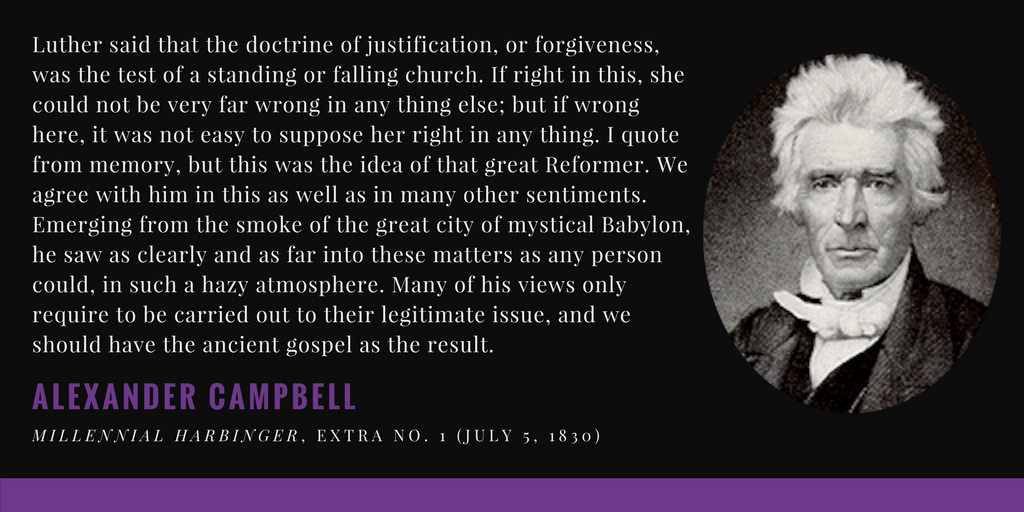
As a member of the Stone-Campbell Movement, I stand in a tradition of reformers. As a student of Scripture, I stand in admiration of Luther’s audacity. As Campbell said: “The Bible was brought out of prison, and Luther bid it march. He made it speak in German, and thus obtained for it a respectful hearing.”[1. Alexander Campbell, “Prefatory Remarks,” Millennial Harbinger 1, no. 1 (January 1830): 3.] Furthermore:

(See more about the relationship between the SCM and the Reformation from John Mark Hicks.)

This post is for the enjoyment of my friends who do not often think about historical matters such as Martin Luther and the Reformation. If there is a good time to take a moment, the 500th anniversary of the Reformation’s beginning seems like it.

If you don’t get this joke, see https://en.wikipedia.org/wiki/Law_of_the_instrument.

Luther nailed the 95 Theses on the door of the the Castle Church in Wittenberg (which was basically like a town bulletin board) on October 31, 1517. After that, things got a little tense for a while.

Click pic for bigification

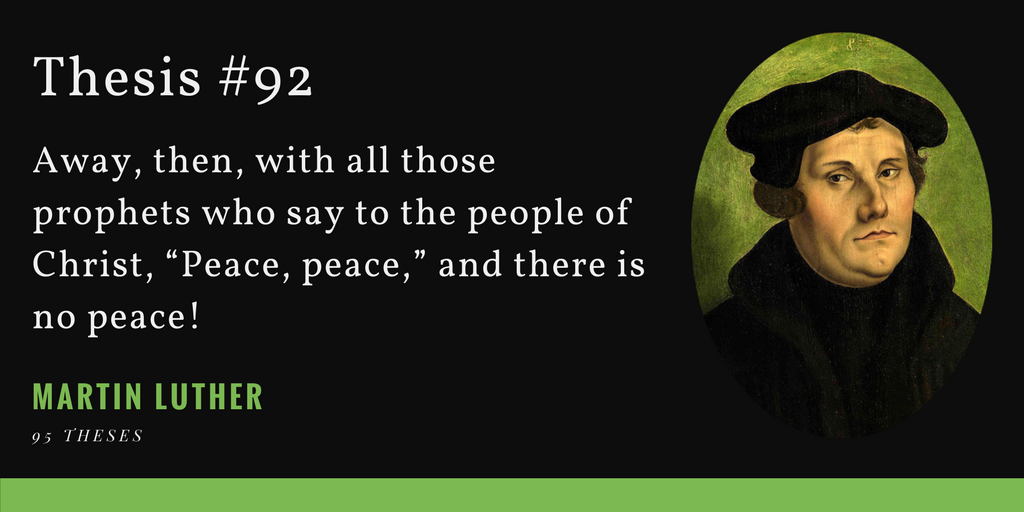
If you’ve never read the theses, you should, to be like, you know, informed. (There are lots of not-so-readable versions online. This one is easy on the eyes.) Just think of them as consecutive tweets. Now that I think about it, I’ll be shocked if someone isn’t already tweeting them. In any case, I’ll add a few tweetable theses at the end of the post.

One of the things I love about Luther is his flamboyant rhetoric. Not just because it’s surprising or entertaining but because his personality and style would be rejected outright by most Protestant churches today, not because of his unconventional theology but because of his impious manner. And in this there is an important lesson for the pious despisers of both unvarnished forthrightness and devious good humor.

Bodily functions played a significant role in Luther’s rhetoric, not least when talking back to his accusers. This imaginary repartee from his late work Against the Roman Papacy, an Institution of the Devil is representative:

“Silence, you heretic! What comes out of our mouth must be kept!” I hear it—which mouth do you mean? The one from which the farts come? (You can keep that yourself!) Or the one into which the good Corsican wine flows? (Let a dog shit into that!) “Oh, you abominable Luther, should you talk to the pope like this?” Shame on you too, you blasphemous, desperate rogues and crude asses—and should you talk to an emperor and empire like this? Yes, should you malign and desecrate four such high councils with the four greatest Christian emperors, just for the sake of your farts and decretals? Why do you let yourselves imagine that you are better than crass, crude, ignorant asses and fools, who neither know nor wish to know what councils, bishops, churches, emperors indeed, what God and his wordage? You are a crude ass, you ass pope, and an ass you will remain!

Luther also said some cheeky things because he reveled in his freedom, so to speak. He preferred to throw sin in the devil’s face than to let it be more than “trifles” in light of God’s grace.

Whenever the devil harasses you thus, seek the company of men, or drink more, or joke and talk nonsense, or do some other merry thing. Sometimes we must drink more, sport, recreate ourselves, aye, and even sin a little to spite the devil, so that we leave him no place for troubling our consciences with trifles. We are conquered if we try too conscientiously not to sin at all. So when the devil says to you, “Do not drink,” answer him, “I will drink, and right freely, just because you tell me not to.”[2. Preserved Smith, The Life and Letters of Martin Luther (New York: Houghton Mifflin, 1914), 324–25.]

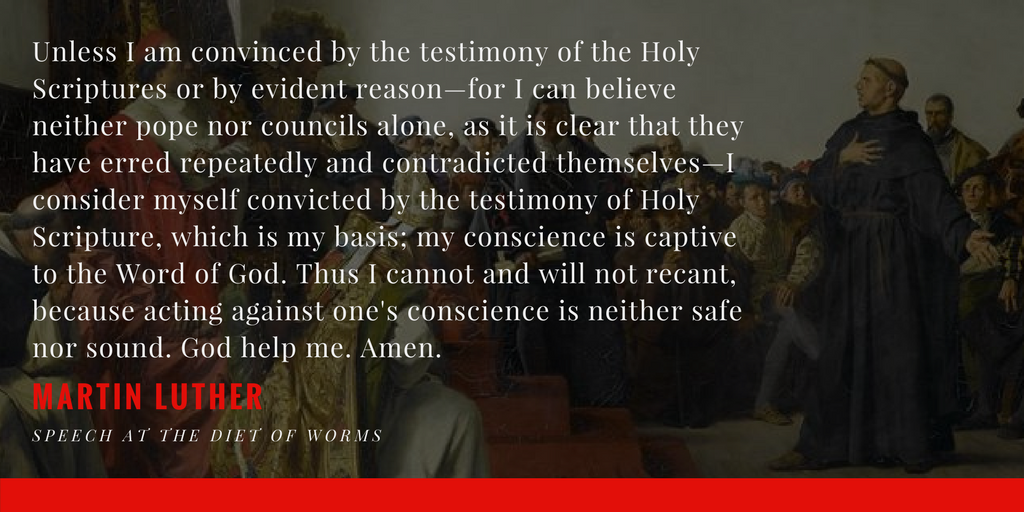
And of course, he also thought and said and did a lot of things that were wrong. Let these be thrown in the devil’s face too. In any case, I celebrate him and all those like him whose consciences were taken captive by the Word of God. So I’m going to raise a pint of German beer tonight to the continual reformation of the church. Prost!


Notes

The Two Captivities of Missiology

The field (I do not say “discipline”) of missiology is liable to two kinds of captivity, and this liability entails overcompensation on both sides, especially in the US cultural milieu of polarizing discourse. At the same time, the call for a middle ground or for balance makes my entire brain roll its eyes, because such calls always feel like a failure to deal with each side’s substantial concerns.

The first captivity is to resultism (my word for it). Whereas many people tend to use the word pragmatism here, I think that is a mistake, about which more below. Resultism is actually captivity to the supreme value of results, effectiveness, planned outcomes. In evangelical missiology, resultism comes to expression in various ways, a large category of which could be labeled growth—focusing on numbers of conversions, of members, of attendance, of programs, and so on.

The second captivity is to cognitivism. This captivity is to the supreme prioritization of right thinking. In evangelical missiology, it comes to expression most frequently in the critique of resultism, often (erroneously) using the word pragmatic as a kind of slander. When right thinking is the priority over against (i.e., in reaction to) resultism, we tend to get a pendulum swing, with the result that, what really matters is the prioritization of right thinking. Then practices and their effects follow from right thinking, naturally and necessarily.

Reading the introduction of Scott Sunquist’s Understanding Christian Mission: Participation in Suffering and Glory has me thinking about this. It provides a case study in the rhetoric of captivity. He writes:

Mission, like liturgy, pastoral care, or preaching, is rooted in right thinking about the task, but it must also involve a practice. Although there are practical outcomes and specific practices that will be encouraged or discouraged, what the individual, church, or society actually does is rooted in what they think about God, humanity, the church, and the world. Therefore, as an introduction, this book is primarily concerned with right thinking about Christian mission, right thinking about the church, and pointing toward faithful practices.

This is a theological inquiry rooted in an understanding of God that is informed by most other areas of theological studies: biblical studies, hermeneutics, history, practical theology, ecclesiology, and ethics. Other supportive areas such as cultural anthropology, sociology of religion, history of religions, and psychology feed into the study, but part of the argument of this book is that missiology must resist being taken captive by the social sciences. Missiology is first concerned with thinking correctly about the Triune God— the God who by his very nature is a sending God— rather than with particular practices or programs. In fact, until fairly recently in Christian history, the word “mission” (sending) was used in theological discourse of the Trinity, not of missionary practices. The Father sending the Son and the Father and Son sending the Holy Spirit was a “mission” discussion. It was not until late in the sixteenth century that the early Jesuits first used the word missio to speak of Christian people being sent to non-Christian people. It has been commonly accepted since the late eighteenth century that “mission” primarily refers to the church’s task to carry out the will of the Father in the world. Again, my point is that such work must be grounded in right thinking. Good practice flows out of good thinking in context.[1.  Scott W. Sunquist, Understanding Christian Mission: Participation in Suffering and Glory (Grand Rapids: Baker, 2013), 1–2.]

As a theologian, of course I’m sympathetic with prioritizing theology. And considering the particular conversation in which I’m engaged academically—theological hermeneutics—there is a great deal of similarity between the desire to prioritize theology in missiology and the desire to prioritize theology in hermeneutics. I understand that the social sciences can and have set non-theological and sometimes anti-theological criteria for the theological curricula.

Nonetheless, Sunquist’s way of putting it strikes me as problematic, because the fear of captivity motivates a cognitivist overcorrection. Furthermore, a footnote specifies what Sunquist means by captivity:  “The captivity of missiology to the social sciences is not determined by one’s theology. Conservative, fundamentalist, Pentecostal, and liberal theologians are equally prone to such captivity. When missiology turns into sociological studies of what “works,” then we have turned away from proper missiological centeredness on the knowledge of God and the missio Dei as revealed in the life of Jesus Christ.”[2. Ibid., 2n4.] Captivity to the social sciences figures here as resultism (what “works”).

Two points give me pause. One, participation in mission is theologically productive. To a significant extent, right thinking follows and cannot be separated from right action (regardless of results, I should add). This is a virtuous circle that makes strange the claim that “missiology is first concerned with thinking correctly.” Two, among contemporary missiology’s great contributions to theology is precisely its sociological and anthropological acuity. While captivity—whatever that might mean—would presumably be bad, that is a far cry from recognizing that the social sciences make their own contribution to right thinking. This is where my insistence on the validity of pragmatism comes in.

Pragmatism is not resultism (bowing to what “works”) but a concern with the truth revealed by effects. In other words, it is primarily epistemological. For example, the sociological analysis of churches planted in a mode of resultism might indicate that members have not been transformed or converted in any sense that Christian theology would recognize. In this case, a pragmatic sociology is itself the most useful critique of the thing that Sunquist rejects. Likewise, a theological account of “right thinking” might be greatly served by a pragmatic understanding of what “right thinking” actually does in the world. This is a crucial point in missiology, which is concerned with the radical differences in theological reasoning and justification across cultures. Missiology’s ability to account for what actually happens in theological contextualization (including Sunquist’s contextual claims about what counts as right thinking about the Trinity!) and what that reveals about theological truth is a vital gift to Christian theology. I worry that the abstract prioritization of “right thinking” over against “captivity to the social sciences” in missiology undermines the pragmatism that is the field’s distinctive strength.

Additionally, this priority seems to entail the Western church once again predetermining the “rightness” of thinking—at just the moment when the fruit of Western mission has become the arrival of Majority World missionaries to the West, who stand to lead the development of a new missiology precisely because their thinking is differently right.

I may return to this post as I read Sunquist further and find clarifications.

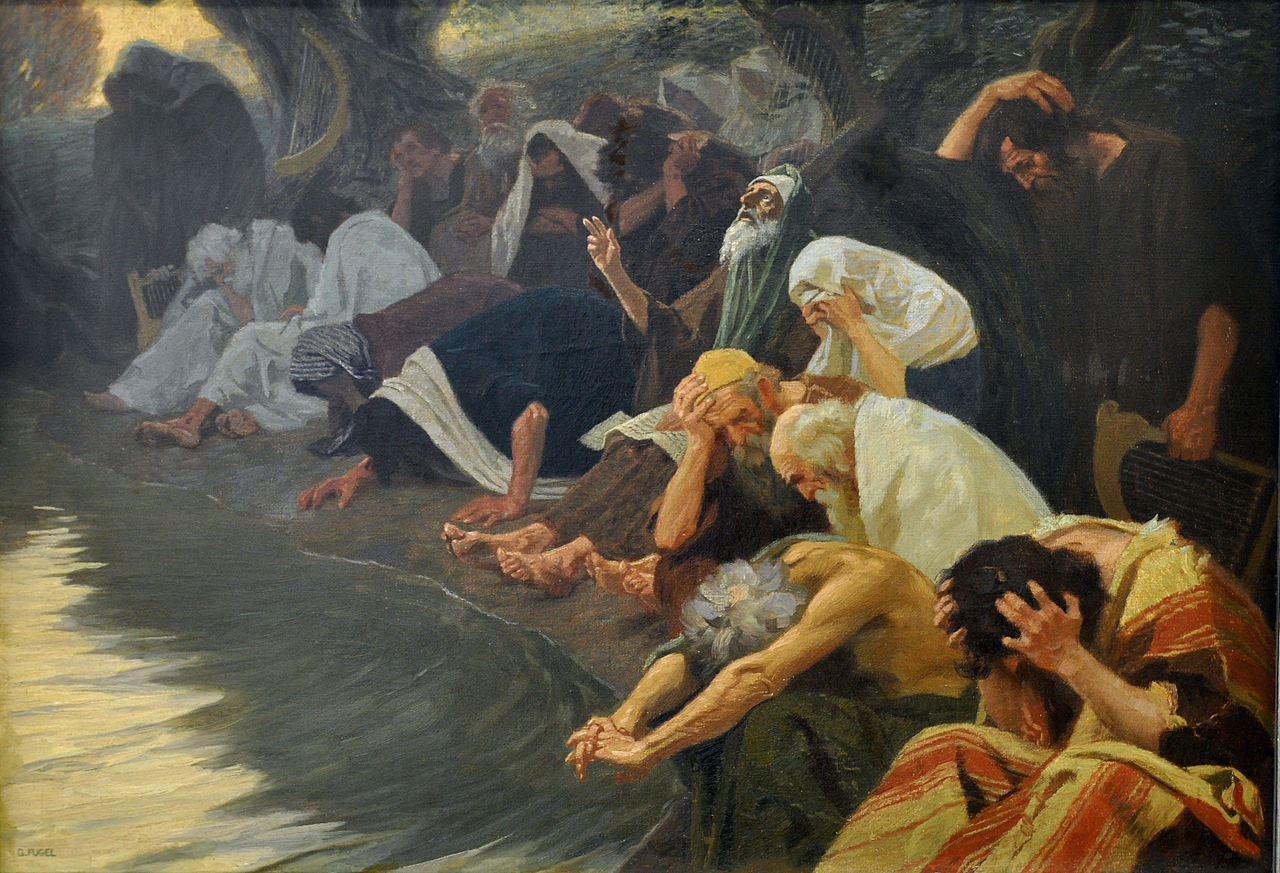
[Painting: Gebhard Fugel, “An den Wassern Babylons” (1920)]


Notes