A Missional Method?

A Missional Method for Constructive Theology (Part 1)

Constructive theology inevitably involves a method. Even theologians like Jürgen Moltmann, who said of his own method, “The road emerged only as I walked it,” operate with an “implicit method.”[1. Jürgen Moltmann, Experiences in Theology: Ways and Forms of Christian Theology, trans. Margaret Kohl (Minneapolis: Fortress, 2000), xv.] In reduced terms, theological reflection just does entail decisions that are inherently methodological, whether explicit or implicit, prolegomenal or postlegomenal. In the postmodern context, it has become necessary to point out the inevitability of method because of its association with modern epistemology. For many, method reeks of foundationalism and objectivism. The modern prolegomena was seemingly a mechanistic device meant to ensure theological certainty and uniformity, and in this light “theological method” is necessarily compromised. Still, the theologian makes decisions about which sources to privilege, how to construct arguments, and which criteria justify conclusions—among many others.

Method is neither avoidable nor synonymous with universal, mechanistic, or totalizing tendencies. Dan Stiver is right: “A need still exists for prolegomena. In a time of transition in philosophy and in a time of flux in theology, being clear about one’s epistemological commitments and presuppositions continue[sic] to be desirable. The point is that methodology should be seen in this clarifying role, not as a foundation or as a proof.”[2. Dan R. Stiver, “Theological Method,” in The Cambridge Companion to Postmodern Theology, Cambridge Companions to Religion, Kindle ed., ed. Kevin J. Vanhoozer (New York: Cambridge University Press, 2003), 172.] Is there, then, a method that might play this clarifying role for the theologies loosely identified as missional?

Subsequent posts in the series will sketch my reflections on this question. What do you think? 


Notes

Death Throes of Christendom

Right, right—we’re already in “postChristendom.” In the same sense that we’re already in postmodernity, sure. The institutions of Christendom and modernity have hardly evaporated. They’re just in obvious transition. And by transition I mean death. Gasping, grasping, clinging-to-life death.

The ugliest part of Christendom’s demise is the institutional Western church’s denial as it tries diagnose its death throes as something else. We’re used to extraordinary life-sustaining measures. Death is just a problem to be managed until we engineer a solution.

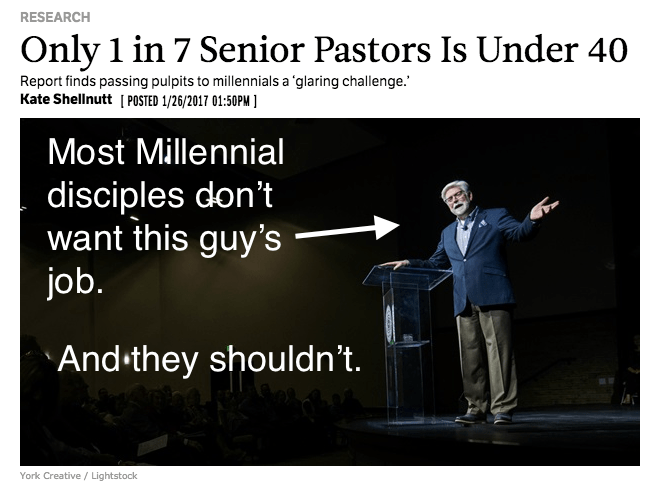
Christianity Today reports that “now, just 1 in 7 pastors leading congregations is under 40, according to Barna Group’s 2017 State of Pastors project.” Fascinatingly—bizarrely—the church itself does not figure in the “nine overarching factors contributing to this generational disconnect” between Millennials and church leadership positions. The fact that most of us simply have no interest in keeping the institution on life-support is somehow lost in the data.

Look, this is not a problem that somehow inculcating a “robust theology of vocational discipleship” can solve.

Adapted screenshot of CT article

This is not a spiritual problem. It’s a spiritual solution. I agree with David Kinnaman’s statement quoted in the article: “The Holy Spirit has sustained the church for a couple thousand years now and shows no sign of calling it a day. . . .  Let’s trust the Spirit’s sustaining power not to quit, and prepare for the future.” It seems, however, that the institutional church has not come to terms with what the Spirit is doing in that regard.

“Very truly, I tell you, unless a grain of wheat falls into the earth and dies, it remains just a single grain; but if it dies, it bears much fruit” (John 12:24).

On Satire

satire

noun • sat·ire • ˈsa-ˌtī(-ə)r

1 : a literary work holding up human vices and follies to ridicule or scorn
2: trenchant wit, irony, or sarcasm used to expose and discredit vice or folly

Malcolm Gladwell’s Revisionist History podcast, “The Satire Paradox,” is my jumping-off point. It’s fascinating—have a listen.

I’m a member of the defunct Colbert Nation. I stood in line to get in the show. I (well, my beloved wife) caught the WristStrong bracelet. I’m a fanboy. So there.

More importantly, I’m a believer in political and religious satire. I believe Jon Stewart and Stephen Colbert were the most honest pundits on television. The issue Gladwell raises, however, is whether their honesty made a difference. Does satire work?

The answer, as always, depends on one’s measure of effectiveness. For many of us, the most important thing is the very act of speaking truth, the consequences of which are beyond a truth speaker’s control. This is where Gladwell slightly misses the point.

I take it for granted that “people bind themselves into political teams that share moral narratives. Once they accept a particular narrative, they become blind to alternative moral worlds” (Haidt, xxiii). But I would say blind and deaf—and tone deaf. So it’s no surprise to me that many conservatives experience The Rev. Sir Dr. Stephen T. Mos Def Colbert, D.F.A., Heavyweight Champion of the World, as actually skewering liberals with tough questions.

People who have become deaf and blind are deaf and blind to both carefully reasoned discourse and jokes.

Emily Dickinson’s poem “Tell All the Truth, But Tell it Slant” is one of my favorites:

Tell all the Truth but tell it slant —
Success in Circuit lies
Too bright for our infirm Delight
The Truth’s superb surprise

As Lightning to the Children eased
With explanation kind
The Truth must dazzle gradually
Or every man be blind —

Satire is a way of telling truth slant. But if every man is already blind, dazzling gradually is a futile exercise.

What is the point of satire, then? Is it just to make some of us laugh? Is it merely a last resort for those who have to either laugh or cry? This is the question that makes Gladwell’s podcast so interesting. If satire doesn’t make people switch teams, and if it even feeds the narratives that set those teams, is its attempt to speak truth pointless?

I think there is big difference between satire failing to overcome our tribal narratives and satire making no difference at all. I see at least four ways that satire makes an important difference.

1. Satire helps true believers take themselves less seriously.

And most of us need to take ourselves way less seriously. The way satire modulates the tone of political or religious discourse is no small contribution. Of course, the most serious often can’t take a joke, but that is the point: they then become the joke, and everyone pays attention to the fact that how we talk about things is as significant as what we say. And in fact, we’re often allowed to say nothing meaningful as long as we say it with all propriety. Or we’re allowed to filter important issues provided that our negligence is decorous.

A great example is “Shoot Christians Say.”

There are a number of things going on here: indecipherable Christianese, annoying and/or lame ways of speaking, and an avoidance of “bad” words that is already pretty comical without satire. And the thing is, if you know us, you know we say these kinds of things in all seriousness. These are serious matters for a serious faith in a serious God. Hence the last line: “I find that offensive.” I know a lot of Christians for whom being offended is the needed first step on a long road of getting over themselves.

2. Satire is a safer space to air dirty laundry.

It’s not safe, necessarily, because those really serious people are often the ones with the power to make you pay for honesty. But it’s safer, because it’s disarming. It is truth told slant, so it is sometimes the only place a truth gets spoken. For those who are part of a team but questioning from the inside, satire is a way to voice dissent. By making our nonsense funny, satirists engage everyone who laughs in a discussion about it being nonsense. It may not ultimately change minds, but it becomes a forum in which more people can say, “That’s funny, because it’s both true and ridiculous.”

Airing dirty laundry is not really about changing minds or policy. Unlike a liberal comedian satirizing conservative politics or atheists making fun of believers, this is about turning the funhouse mirror on one’s own team (Colbert did this a lot with his own Christian faith). In Christian circles, The Babylon Bee is playing this game well (following The Onion‘s lead on a broader cultural level).

3. Satire is a wise way to speak truth to people who haven’t picked a team.

When you are satirizing on behalf of your team, you may not change the narrative of those who are already dug in, but lots of people are “independents,” so to speak. This is especially the case for younger generations, and it would be naive to think Stewart and Colbert didn’t shape the political dispositions of young viewers who weren’t already identified with a narrative.

4. Satire is the strongest way to perform a particular kind of truth telling: calling bullshit.

Here is Stewart’s last rant. My best friend and authenticity guru, Bryan Tarpley, and I had already been discussing the idea of bullshit detection in relation to the postmodern cultural value of authenticity, and I had brought up Stewart and Colbert in our conversation before this aired. It could not have been a more fitting finale.


The thing is, calling bullshit just demands a certain kind of dramatic wit. One may simply point out inaccuracies or observe problems. But when it comes time to expose insidious inauthenticity, it’s often best to say “bullshit” with flair.

And this, I’m convinced, is why Stewart and Colbert were so popular with Millennials. Authenticity is a deeply held cultural value, and their shows were a tutorial in tuning our political bullshit detectors. As much as particular political positions, they satirized the form of media—political spin and talking-head punditry—that peddles political bullshit in the package of honest, unbiased reporting.

The claim that Millennials got their news from Comedy Central was not about which way they leaned politically but how supposedly trustworthy news sources failed to pass their bullshit detector test and how Stewart and Colbert made that very problem their bread and butter. Whose headlines are more valid: the “real” news show loaded with bullshit or the “fake” news show whose primary schtick is point out that bullshit?

Regardless, naming falsehood, inauthenticity, and hypocrisy often calls for the cutting edge that satire achieves. Whether or not it wins hearts and minds, whether or not everyone gets it, it is the right art form for the message.

Maybe in another post I’ll think about some of my favorite biblical satire.

On Practicing Theological Interpretation in Churches of Christ

I began a sermon a few Sundays ago with the Apostles’ Creed. Well, with Rich Mullins’s rendition anyway.

I’ve been in a cappella Churches of Christ worship services for close to every Sunday of my life (if I count the churches we planted in Peru, which perhaps I shouldn’t). I’ve been in rural and urban churches, large and small churches, progressive and conservative churches. And I have never heard any of the ecumenical creeds recited in worship.

This is no surprise, for anti-creedalism was near the heart of the Restoration plea. I knew of the creeds growing up only as the “traditions of men” opposed to Bible-only Christianity. The expectation that Christianity could be reunited by refusing to make creeds and confessions normative has long since mellowed and morphed in the Stone-Campbell traditions, even in the a cappella Churches of Christ for whom anti-denominational sectarianism and the ideal of “Bible words for Bible things” lingered long. In my lifetime, many Churches of Christ seem to have overcome the suspicion of “theology” and the disdain for careful, contextual statements of faith. Yet, our tradition has left us in an essentially acreedal place—no longer anticreedal but far from having the liturgical instincts necessary to recite “extrabiblical” words regularly as a natural part of worship, much less as an essential practice of theological formation.

Instincts is a good word for it. Or maybe reflexes. Being cognitively quite compelled by the historical and theological significance of the ecumenical creeds, I still reflexively think, Why shouldn’t we just use the words of Scripture as liturgical confessions? Isn’t that enough? And, in fact, we often do. I have been in many worship services in which the collective reading of a text was our confession. More, since the creed will not contradict the canon, can’t we expect to find in Scripture’s own words anything we might confess through the creed? My instincts tell me the creed is acceptable but not indispensable. I’m not against it—actually I’m for it—but it still feels unnatural to argue in the context of my tradition that the creed is necessary. Trust in the sufficiency of Scripture is in my bones.

This makes my study of theological hermeneutics particularly interesting. The practice of theological interpretation of Scripture is not monolithic, and the debate about what it is in the first place is ongoing. Some broad strokes are clear enough, however. My mentor, Joel Green, identifies four key concerns:[1. See Joel B. Green, Practicing Theological Interpretation: Engaging Biblical Texts for Faith and Formation (Grand Rapids: Baker Academic, 2011), “Introduction.”]

  1. “The relationship between theological exegesis and Christian formation.”
  2. “The role of history and historical criticism in theological interpretation.”
  3. “The relationship between exegesis and the Rule of Faith.”
  4. The influence of locatedness in “particular faith communities and theological traditions” on theological interpretation.

I’m reflecting here on the relationship between the last two. What happens when the particular tradition in which one wishes to practice theological interpretation makes no space for the formal hermeneutical role of the Rule of Faith? Despite the diversity among theological interpreters, there is little doubt that the Rule is a given. “Theological interpretation in any tradition cannot escape the question of the relationship between those ecumenical creeds that define the faith of the church and this canonical collection that we embrace as Scripture.”[2. Ibid.]

I won’t venture into an explanation of why the Rule is hermeneutically necessary for the church catholic—the issues are complex. But assuming this necessity, what are the options for Churches of Christ? How do we proceed? This is a practical question to which a tradition committed to congregational autonomy cannot expect a single answer. Nonetheless, I ask the question on behalf of a tradition whose coherence has been largely hermeneutical.

I wish I had an answer! In the mean time, I suppose the burden is on discrete enactments of theological interpretation within the tradition. As it happens, we’re preaching through Ephesians at Hollywood Church of Christ, and the book of Ephesians is itself a sort of invitation to see through the faith stated in the creed. Particularly, the interpretation of the latter half of the book depends on having learned to see God’s eternal purposes fulfilled in Christ. In my assigned passage, the household code of 5:21–6:9, I think it is impossible to understand how God would transform our family lives apart from this christological vision. In one sense, this is what the Rule is meant to do for all of the church’s interpretation: give us the eyes that Paul prayed the Ephesians would have.


Family in the Upside Down Kingdom
(Eph 5:21–6:9)

Hollywood Church of Christ

Lens

Acts 17:1   After Paul and Silas had passed through Amphipolis and Apollonia, they came to Thessalonica, where there was a synagogue of the Jews.  2 And Paul went in, as was his custom, and on three sabbath days argued with them from the scriptures,  3 explaining and proving that it was necessary for the Messiah to suffer and to rise from the dead, and saying, “This is the Messiah, Jesus whom I am proclaiming to you.”  4 Some of them were persuaded and joined Paul and Silas, as did a great many of the devout Greeks and not a few of the leading women.  5 But the Jews became jealous, and with the help of some ruffians in the marketplaces they formed a mob and set the city in an uproar. While they were searching for Paul and Silas to bring them out to the assembly, they attacked Jason’s house.  6 When they could not find them, they dragged Jason and some believers before the city authorities, shouting, “These people who have been turning the world upside down have come here also,  7 and Jason has entertained them as guests. They are all acting contrary to the decrees of the emperor, saying that there is another king named Jesus.”  8 The people and the city officials were disturbed when they heard this,  9 and after they had taken bail from Jason and the others, they let them go.

Apostles’ Creed

Traditional Version

I believe in God, the Father Almighty,

maker of heaven and earth;

And in Jesus Christ his only Son,

our Lord;

who was conceived by the Holy Spirit,

born of the Virgin Mary,

suffered under Pontius Pilate,

was crucified, dead, and buried;


he descended into hell;

the third day he rose from the dead;

he ascended into heaven,

and sitteth at the right hand of God the Father Almighty;

from thence he shall come to judge the quick and the dead.

I believe in the Holy Spirit,

the holy catholic church,

the communion of saints,

the forgiveness of sins,

the resurrection of the body,

and the life everlasting. Amen.

Adapted from Rich Mullins, “Creed”

I believe in God the Father

Almighty maker of heaven and maker of earth

And in Jesus Christ his only begotten son,

our Lord

He was conceived by the Holy Spirit

Born of the virgin Mary

Suffered under Pontius Pilate

I believe that he who suffered was crucified, buried, and dead

He descended into hell

and on the third day, rose again

He ascended into heaven

where he sits at God’s mighty right hand

I believe that he’s returning

To judge the quick and the dead of the sons of men

I believe in the Holy Spirit

One holy church

The communion of saints

The forgiveness of sin

I believe in the resurrection

I believe in a life that never ends

Seeing and Being

I believe. This morning, like so many Sunday mornings, is about living into this belief. I believe that Jesus Christ, the only Son of God the Father, was crucified, and dead, and buried, and rose. But so what? Does it matter? What does it change? I believe. Lord help my unbelief.

Listen now to Scripture: 5:21–6:9.

We have been thinking through Ephesians about how to be a church family, so as we focus our attention on 5:21–6:9, we are challenged to imagine specifically what the shape of our personal family lives has to do with the shape of our church family life. In the context of our homes—as wives and husbands, children and parents—I ask the question: why does it matter that we believe? Does Ephesians pivot suddenly to this concrete code of conduct to tell us God’s will for the family? Is that why our belief matters: we believe, therefore we know how to organize our households, so that husbands, wives, children, and slaves know their place?

Yes, the mention of slaves is supposed to make you uncomfortable. Because we are not allowed to answer the question this morning by ignoring the last third of these instructions. I’ll be blunt: if the Christian confession leaves slavery intact—if it doesn’t change anything substantial about relationships in which some people own other people—then it isn’t the kind of thing I want to shape my marriage or my parenting. So I ask again: what difference does it make for my most entrenched, most disturbing relationships that I believe Jesus Christ, the only Son of God the Father, was crucified, and dead, and buried, and rose? What does that mean for the broken way that I learned how to be a husband and a father from a husband who cheated and a father who left? Or from a rural south Texas culture in which husbands are authoritarian and fathers are harsh. Or a Peruvian culture in which husbands are machista and fathers are absent, or an urban California culture in which—well, I’ll let you fill in the blank. Regardless, we know how broken our relationships are because of the twisted ways we’ve learned to treat each other, which is often the inheritance of generations. (Connect “inheritance” to 1:11, 14, 18.)

Now, if you had an amazing father or have grown into a really healthy marriage, great. I’m not trying to make a point by convincing you that you’re actually terrible. I just know that there is enough dysfunction represented in this room—and, I will wager, in the lives of every single one of us—that I have to ask in all seriousness this morning, What difference does it make in all those dark corners of our lives, in the day-to-day dysfunction of our relationships, that Jesus is the crucified and risen Lord?

And this passage puts the question as sharply as possible, because it has seemed to many that here we have proof nothing changes. This household code is recognizable alongside others of the ancient Greco-Roman world. Patriarchy and slavery are apparently intact. It’s as though Paul says, “Believe in Jesus and carry on as you were, just be nicer to each other.” But is that it?! Do we come here, confess that Jesus is Lord, read this text of Scripture, and come away with nothing more than a bland sense that I should try to be a better person this week? Is Christlikeness nothing more than a bandaid of personal virtue on relationships that are well and truly broken? Does nothing change except I’m nicer or more “spiritual”?

Of course, for many who read the New Testament as though it were an instruction manual, it is not only that we have here the certainty of the divinely ordained family structure but also that, if we are obedient to it, then we will be blessed. In this case, Ephesians tells us how to have the ideal marriage, the most well-behaved children, and, apparently, a blessed owner-slave relationship. And here as well, the expectation is not that there is some kind of essential difference from other families but that, since we’re doing it “God’s way,” our family is bound to be the kind that prospers with financial peace, great sex lives, guaranteed conflict resolution, respectful teenagers, and—well, we still don’t know what to do with slavery, so we’ll pretend like it’s not a part of the instruction manual. Is that it? Our faith matters for our family life because it compels us to take Scripture as the manual for the marriage we always wanted?

Or perhaps, if we reject the marriage-and-parenting prosperity gospel, we at least have instructions for pleasing a God who wants our households ordered just so. In which case our faith in the Lord Jesus matters because pleasing God is what matters: God said it, I believe it, that settles it. It makes a difference because truth is truth, and the truth is that husbands are supposed to be the head of the household, women and children are supposed to be obedient, and slaves are supposed to be enthusiastic. When that is the case, all is well, because our families are “biblical.” Is that really it?

This is one of those passages that triggers untransformed habits of mind in so many of us. We’re reading along, soaking in everything that Paul has to say about our adoption, reconciliation, and the unity of the body. We might start to read the morality stuff a bit legalistically, maybe not, but then we hit “wives, be subject to your husbands,” and it’s like a switch flips. Suddenly, we are in cut-and-dried legal code territory: This is how God ordained the institution of the family to be organized, and that ordinance is what the passage is meant to provide us. But the problem is that reading it this way cuts the household code off from what Paul has been arguing since the beginning of the letter, which is definitely not that God saved you so that you will be obedient when God tells you who is at the top of the family hierarchy. Nor, for that matter, that God has saved you so you can have your best family life now. Paul’s claim is far more audacious, far more breathtaking, far more challenging than that.

Ephesians is like a bus with no brakes, gaining momentum as it builds to an almost unbelievable vision of what wives, husbands, parents, children, slave owners, and slaves will do to the world if their family life gets filled up with the love of God. Paul’s vision is not about what happens in the private lives of a handful of Christians in the provincial city of Roman Ephesus or in the private lives of a few dozen households in twenty-first century Hollywood—that is not why it matters that we believe Jesus is king. Paul’s vision is cosmic, it is about the transformation of everything—“a plan for the fullness of time, to gather up all things in [Christ], things in heaven and things on earth” (1:10). We are indeed blessed, adopted, and redeemed—so that we “might live for the praise of his glory” (1:12). “To the praise of his glory” is in fact the refrain of the opening prayer, but it doesn’t mean simply “so that we might praise God.” Rather, his peculiar glory—the “glorious grace” (1:6) lavished on us through the inglorious cross—is praised not merely by us but because of our existence.

This is why Paul is so concerned that the eyes of our heart be enlightened (1:18) with the result that the power of the resurrection be at work in “us who believe” (1:19). Specifically, the same power of God at work in us was at work in raising the crucified Christ and seating him at God’s “right hand in the heavenly places, far above all rule and authority and power and dominion, and above every name that is named, not only in this age but also in the age to come. And he has put all things under his feet and has made him the head over all things for the church, which is his body, the fullness of him who fills all in all.” (1:20–23). You don’t have to understand what the heavenly places are, but pay attention to what this means for those of us in whom the power of God is at work: God “raised us up with him and seated us with him in the heavenly places in Christ Jesus” (2:1).

Okay, so we’re saved by grace, and in some mind-boggling way we, in Christ, are seated at the right hand of God where as head over all things, Christ has dominion over all rule and authority. Why? “So that in the ages to come he might show the immeasurable riches of his grace in kindness toward us in Christ Jesus” (2:7). God puts on display the reconciliation of all humankind in Christ according to this boundless grace, which Paul calls “the mystery of Christ” (3:4). But there is more: he puts this mystery on display “so that through the church the wisdom of God in its rich variety might now be made known to the rulers and authorities in the heavenly places” (3:1).

In summary, by the grace of God, the wisdom of the cross is manifest through the church so that rulers and authorities in the heavenly places might witness that wisdom in the ages to come.

Perhaps you see why I would say that Paul’s vision is cosmic in scope. And for the same reason, perhaps you’re stuck wondering what in the world to do with these claims. The thing is, Paul thinks that understanding this mystery is how we see things as they truly are—grasping this is how the eyes of our heart are illumined. And only if we come to see will we then have the power to be the church that puts the wisdom of God on display. So he circles back at the end of chapter three to his prayer: “I pray that you may have the power to comprehend, with all the saints, what is the breadth and length and height and depth, and to know the love of Christ that surpasses knowledge, so that you may be filled with all the fullness of God” (3:18–19).

The fullness of God in the church is what Paul already mentioned in 1:22–23: “And he has put all things under his feet and has made him the head over all things for the church, which is his body, the fullness of him who fills all in all.” And this same theme pulls us forward, for it is the body of Christ that is built up for the work of ministry in 4:13, “until all of us come to the unity of the faith and of the knowledge of the Son of God, to maturity, to the measure of the [stature of the fullness] of Christ.” And picking up the other idea from 1:23, 4:15–16 says, “We must grow up in every way into him who is the head, into Christ, from whom the whole body, joined and knit together by every ligament with which it is equipped, as each part is working properly, promotes the body’s growth in building itself up in love.” Thus the “likeness of God” (4:17) is restored in us, and Paul declares in 5:1–2, “Therefore be imitators of God, as beloved children, and live in love, as Christ loved us and gave himself up for us.”

Paul, in other words, will not talk about the specifics of conduct apart from this cosmic vision of God’s grace and love that, once it becomes the way we see, is itself the wisdom of God at work in the church. So he says, “Be careful then how you live, not as unwise people but as wise,” and we recall that the “power to comprehend” the love of God in 3:19 results in our being filled with the fullness of God, or the maturity that is the fullness of Christ, and likewise, the wisdom of God is on display in the church.

So the book reaches a crescendo—or the bus crashes home—as the wisdom of God, the imitation of Christ’s sacrificial love, is put on display in a concrete context: the family. And the transition is clear. What has been called the fullness of God in the church and the fullness of the stature of Christ is a wise way of life he now identifies by saying “be filled by the Spirit” (5:18). Your translation probably says “with the Spirit,” but the more likely gist is “by the Spirit”—be filled with all the fullness of God, be filled according to the measure of the fullness of Christ, be filled by the Spirit. Be imitators of God. Put the cross-shaped wisdom of God on display in your lives and prove that it is wise, to the praise of his glory. Because that is what is at stake. You see, we too easily diminish godliness to that morality bandaid. I’m supposed to be godly because that’s what I’m supposed to do. My family is supposed to follow these rules because these are the rules.

No: if we read the household code in Ephesians and fail to realize how fundamentally Paul challenges the typical way of being family, it is because our confession of Christ has not yet given us eyes to see.

Does it matter that the crucified Christ is the risen Lord? The question is, what could possibly matter more?

The death and resurrection of the Messiah has turned the world upside down! When we say the Crucified One is king, the meaning of authority can never be the same. When we say that this Christ is the head of the church, our concept of headship gets blown up. When we see how the Father adopted us, parenthood changes. And when we see the glory of the one who took the form of a slave for our sake, the way we inhabit the structures of injustice in our society—whether they regard gender, age, race, or class—transforms into a new way of being.

This is not, “Now I’m going to say some things about how to be a model family.” This is a call to jump on board. This is Paul seeing the chance to turn life of the church into the world-shaking proclamation of the glory and wisdom of God in Christ, so he pleads with us to bring the unbounded love of God, the fullness of God that has been poured into our lives, right into the way we live everyday as a family, and set the world on its head, to the praise of his glory!

What happens when the wisdom of God invades the conventional structures of our family relationships?

5:21 Mutuality becomes the premise of our relationships, and the only fear that motivates them is fear of the one who has proven his love for us. Fear of the Lord was always the beginning of wisdom (Prov 1:7, etc.), but that wisdom is now manifest in the cross of Christ. This is the Christ who commands, “Do not fear, only believe,” and this is the wisdom made known through the church.

5:22–33 Headship is stood on its head and marriage becomes a way to put the mystery of Christ’s relationship to the church on display. A head is head only in imitation of the one who “taking the form of a slave . . . became obedient to the point of death—even death on a cross” (Phil 2:7–8) and who taught that “whoever wishes to become great among you must be your servant, and whoever wishes to be first among you must be slave of all. For the Son of Man came not to be served but to serve, and to give his life a ransom for many” (Mark 10:43–45). Culturally defined power structures are inevitably transformed in light of the love of Christ that leads to the imitation of God.

6:1–4 Children obey their parents, not because of the law but because of the promise. Not because “in my house you obey my rules” but because in Christ even our children learn how to live wisely, in ways that give life. More surprisingly, mutuality reshapes this relationship into the image of God too, and fathers submit themselves to children. The paterfamilias must be reimagined when we have known the Father of the Son of God (4:13), just as, in the upside down kingdom, the pater patriae must be reimagined when “the Father from whom every family in heaven and on earth takes its name” (3:14–15) is the Father to whom we have access through Christ Jesus in the Spirit (2:18). God shows us what fatherhood is by making us adopted children, lavishing grace on us (1:5–9). Surely the parents who brings up their children with the guidance and instruction of the Lord are imitating the God who makes known his love (1:15–19; 3:18–19). These are not parents who say, “Because I said so,” but who, like Jesus with his disciples, teach and model a way of life in the upside down kingdom instead of merely commanding obedience.

6:5–9 But what do we do with slavery? Many scholars say things like, “Paul simply couldn’t imagine a world without slavery.” It would be something like trying to imagine our contemporary economy without the internet. To which I respond: after the resurrection of the crucified Messiah, I don’t think there’s much Paul can’t imagine. Just listen to these words: “And, masters, do the same to them” (6:9). I think Paul knows exactly what he is doing. Once he writes those words, the institution of slavery is doomed.

Slaves, obey your earthly masters with fear and trembling, in singleness of heart, as you obey Christ.
And masters, do the same to them.
Slaves, render service with enthusiasm, as to the Lord and not to men and women.
And masters, do the same to them.

For us who believe, what we see in our most broken relationships is a new possibility, a new imagination, a “new humanity” (2:15), even in the structures where it seems not yet to exist. It is a “promise in Christ Jesus through the gospel” (3:6). But the upside down kingdom is always like that: a mustard seed that is the promise of an unseen future; a bit of leaven working slowly through everything; a few communities of cruciform love embedded in the structures of an empire of positional power.

This is the invitation: to a way of being in our relationships “rooted and grounded” (3:17) in a way of seeing, a comprehension of God’s love lit up by Christ (1:18). Our confession is our way of seeing. May it become our way of being as the family of God in the upside down kingdom.


Pray with me: God of our Lord Jesus Christ, Father of glory, give us a spirit of wisdom and revelation as we come to know Jesus, so that with the eyes of our heart enlightened, we may know what is the hope to which you have called us, what are the riches of your glorious inheritance among us, and what is the immeasurable greatness of your power for us who believe. God let us see, and so let us be, according to the working of your great power in our church family, and in our personal families. Please make known the mystery of Christ through our lives, as the breadth and length and height and depth of the love fills us up becomes evident in every relationship, to the praise of your glory. Put your manifold wisdom on display in us for the whole cosmos to see, to the praise of your glory. Fill us Father, by the power of your Spirit, to the measure of the fullness of Christ, to the praise of your glory. May our imitation of you turn the world upside down, to the praise of your glory. To you who by the power at work in us is able to accomplish abundantly far more than all we can ask or imagine, to you be glory in the church and in Christ Jesus to all generations, forever and ever. Amen.


Notes

Christian Scholars’ Conference 2016

I’m looking forward to attending CSC this year. Along with the other board members of the Missio Dei Foundation (those who, among other things, oversee missiodeijournal.com), I’ve had the privilege of organizing a number of sessions. I’m thankful that missiology will be represented among the pursuits of Stone-Campbell Movement scholars.

I also get to present a paper, which I’ve embedded here—a bit of my ongoing reflection on missional hermeneutics.

On the Incarnation (Part 2)

(Material from adult Bible class at Hollywood Church of Christ)

God the Refugee

A Darker Christmas Drama

Luke’s birth narrative has its overtones of uncertainty and fear in the midst of weakness and poverty, but it pivots on the promise of blessing  and the declaration of great joy. Matthew’s story, however, is colored with a sombre and ominous palette. There is plenty to say about the genealogy, but picking up with the summary in Matt 1:17, we see the stage set clearly for the current act: Israel is in exile.

Undoubtedly, the announcement of a savior in 1:21 is an irruption of good news, but Matthew paints the backdrop of this moment starkly. The opening lines of the hymn capture it well:

O Come, O Come Emmanuel,
And ransom captive Israel,
That mourns in lonely exile here,
Until the Son of God appear.

Matthew alone names Jesus “Emmanuel,” giving us the key to his rendition of the incarnation: God with us. Us who? With us where? Here, in exile, “in the time of King Herod” (2:1). Dark days, and darker to come. Because the point is not that everything is now well. In Matthew there is actually no “Rejoice!” yet. The hymn collapses the two birth narratives so that Luke’s angelic good tidings interrupt the tyranny and mourning of Matthew’s slaughter. This is not a criticism of the hymn itself, for the church’s imagination holds both stories together and sings with one voice. But Matthew’s contribution to the doctrine of the incarnation is his own, and he defers celebration in order to make an equally powerful point: to say that God is with us in the flesh of Jesus is to say that God is with us in the midst of lonely exile’s mourning. Jesus is God’s sharing in this suffering, not just it’s automatic resolution. Salvation is God coming into exile, becoming an exile with us, becoming literally, bodily a refugee.

Le_Massacre_des_innocents_-_Nicolas_Poussin_-_Petit_Palais_-_1626-1627
Massacre of the Innocents (1626-1627) by Nicolas Poussin

This is not the imagery we like to decorate our houses with at Christmas time. But this is the certainly the image that overwhelms the sequence from 1:18 to 2:23. Here is Matthew’s Christmas tale: God with us, truly with us, in the depths of depravity. God joins the vulnerable, whose only recourse is to flee. God joins Israel, who waited in Egyptian captivity and waits in exile still. God becomes king, and the king becomes a refugee. Back to Egypt. God has come in the flesh to ransom captive Israel, but now as captive Israel. Matthew’s point of departure is what Paul calls the wisdom of God that seems to be foolishness. The wisest of the wise, the magi of the East, come to revere this salvation: God with us in the flesh. God the refugee.

[Here is my favorite version of “O Come, O Come, Emmanuel” right now. The tone is right, and I especially like the way the first two verses build without the chorus. Also, the violent transition to “Herod the king, in his raging” is on point.]

Does It Matter?

I’ve gone through pretty much every Christmas in my life without dwelling on the dark, violent story that Matthew tells. I’ve thought about the incarnation, but I’ve never considered Jesus literally becoming a refugee. I’ve marveled that God became flesh but haven’t reflected much on the sharp specificity of which flesh. So I ask, do these details matter? We get along most years without Matthew’s details. The other Gospels don’t feel the need to go there. What does it change that, of all the things Matthew might have told us, he tells about the murder of children and the flight to Egypt?

First, let’s become conscious that when we ask “Does it matter?” we’re almost always asking “Does it matter for me?” But what if the reason, or the main reason, or one of the reasons it matters is not for me? Limiting the interpretation of Scripture to the output of meaning “for me” can blind us to other important implications and even trap us in grave misunderstanding. Second, let’s allow the incarnation to do its work on us. Another reason we have difficulty seeing the radical importance of Matthew’s details is the tendency toward disembodied spirituality. But Matthew’s details bring the general affirmation of the incarnation to a fine point: the flesh, the human body, is at issue in salvation—at issue in the bodies of oppressed peoples, murdered children, and weary refugees. This flesh!

Contextualization Is Not Application

In mission studies, contextualization is a contested concept. My understanding, however, is that contextualization should not be confused with application. “Application” has become its own industry among Christians. We have application study Bibles, application commentaries, and—I’m just guessing—application bracelets, book marks, key chains, and coffee mugs. Of course, it’s always possible to quibble about words, and I’m not actually picking on the word application per se. My problem is that “application” has become the cipher for the individualistic and, more importantly, self-centered interpretive exercises of American Christianity (speaking for my own context). “How does this apply to my life?” is the question that guides many studies and sermons. When this is the question, it becomes difficult to know why the details like those of Matthew’s birth narrative matter.

Let’s say the idea is that God relates to us through the incarnation. In that case, if I’m not a refugee (or poor, or oppressed by an empire, or hunted by a despot), then God does not relate to me by taking on the flesh of a refugee. He would still be God in the flesh without the Herod story. He would still be God with us if the magi has tricked Herod into some other course of action. How then can I apply the particularity of the incarnation to my life? Must I be a refugee in order for the details to matter? Perhaps it is enough that he became human? Or is it that he generally relates to everyone with hardships or enemies? Actually, “application” does amount to generalization in many cases, ultimately rendering particularity irrelevant. “God wants to be with me” (which is Matthew’s version of “Jesus loves me”) is an important, meaningful conclusion, but it doesn’t require this story.

In our context in 2015, the global refugee crisis is on everyone’s mind. When I see the likeness of Mary, Joseph, and Jesus fleeing Herod in the images of Syrian refugees, the question takes on a new sense. Does it matter for them that God became a refugee? Does it matter to me that God became a refugee for them? New contexts have the power to shake us free of interpretive habits and ask new questions.

Contextualization, however, is still not application. Certainly, “God cares for the vulnerable, so I should too” gets closer to the gist of a story written to churches; after all, Matthew is not endlessly trying to convince Christians that God loves them. The incarnation and the Great Commission are a single story, so the meaning of “go” in ch. 28 is qualified by the way Jesus “comes” in ch. 2. Yet, it’s still misleading to think Matthew offers his particulars so that the church would make applications like “love refugees in 2015.” Rather, his particulars give us a way of seeing everything so that we can rightly judge what to do in 2015. The outcome may even seem to be the same, but Jesus the refugee is neither a general principle nor a narrow directive. If the same Syrians were staying in the grip of war rather than fleeing it, the incarnation would still guide us as the story of what God cares about and how God saves.

So when I see the likeness of Mary, Joseph, and Jesus in the images of Syrian refugees, it’s not that I now have the chance to make a specific “refugee” application that Matthew’s particulars require. It is, instead, that sometimes our context makes it easier to see that Matthew’s story is our story. I said in part one that Advent is about “rehearsing” Israel’s wait as we wait. In other words, Advent is one instance of an essential practice that consists of reading the story of Scripture as the script of our own story. The script metaphor helps us break away from “application,” because actors don’t apply a script. They bring it to life in many ways that can’t be captured by the notion of application. This Christmas, the church is reminded forcefully by Syrian refugees that the incarnation is the story we have been called to participate in—a story in which God sets the world free in solidarity with, by sharing the life of, such as our Syrian neighbors. The question is not, therefore, how Matthew applies to my life but whether Matthew’s story transforms my story. If my story becomes a part of the incarnation story, then I can see all kinds of implications in my context.

Call these contextual implications “applications” if you like (again, I have no problem with the word itself), but this is far different than “X passage means Y application.” I do not, for example, claim that Matt 2:13–14 applies to my life as a command to have compassion for refugees. (In fact, for a participant in the biblical drama, that command would be ridiculously obvious.) No, the particulars matter in a more powerful, transformative way.

God did not merely become human. He became a refugee. I cannot see God or my neighbors apart from this particularity. I cannot worship God as other than incarnate and a refugee. I cannot consider the crisis in Syria apart from the particular way that God has related to humanity. I cannot understand my salvation or theirs except through this story. I cannot live in Christlikeness toward my Syrian neighbor except as a continuation of the story that tells me very specifically what Christ is like. I cannot decide what to do with my money, or what to pray, or how to engage in public discourse unless all of these are participation in the kingdom of a refugee king. This is my story. It is very particular. And its particularity is exactly what guides me as my context changes.

The Spiritualization Trap—and the Pendulum

At this point in Western Christianity, the most reflexive kind of generalization is spiritualization. The easiest way to think about particularity that seems foreign to me is to make it spiritual. Suddenly we are all spiritual refugees in spiritual captivity who need spiritual liberation in order to be spiritually near to God. And, anyway, what good would it do for God to save refugees from oppression and war if their sins aren’t forgiven? And if their sins are forgiven, their bodily circumstances are secondary at best. And if Jesus’s death on the cross is what saves us, the circumstances of his birth don’t affect that transaction. And so on.

I have to say forcefully, this way of thinking is nonsense. But it’s pervasive nonsense that deserves extensive discussion. This post isn’t the place for that, but it is the place to put the incarnation in contention with spiritualization. God with us is God in the flesh—we have no other story. God took on flesh; there can be no greater affirmation of the body. The flesh is spiritual; spiritual life is bodily. Salvation is comprehensive. Liberation is from all oppression; every kind of captivity is spiritual. The bodily circumstances of refugees do not have a spiritual root; bodily circumstances are spiritual circumstances; bodily rescue is spiritual rescue; spiritual salvation is bodily salvation. God saves the flesh, in the flesh, through the flesh. There is no disembodied forgiveness of sin. There is no physical well-being that is not a part of salvation.

The incarnation forbids us to swing from spiritualization to materialism. It is also nonsense for the church to react to spiritualization by focusing only on material service. Salvation from war, poverty, oppression, and injustice requires the transformation of human hearts—those of perpetrators as well as victims. Well-being comes through reconciliation with God in Christ. This is not disembodied well-being or well-being apart from justice, but neither is it justice apart from the Spirit of God. Social justice and material service are spiritual acts, through and through. But apart from the Spirit, they can degenerate into practices of materialism. This fact, that material well-being or social justice can exist apart from reconciliation to God is what traps the church in materialism in the first place and sets the pendulum to swinging. There is much more to say about how we might think about the Spirit and the flesh without succumbing to dualism. For now, I pray we fix our eyes on the flesh of God. It is the body of this infant refugee that anchors our confession, “in him the whole fullness of deity dwells bodily” (Col 2:9) and bids us imagine the fullness of human spirituality as no less bodily.

On the Incarnation (Part 1)

(Material from adult Bible class at Hollywood Church of Christ)

The Great Reversal

Promises Pending

Advent is about the wait—rehearsing Israel’s wait for the Deliverer in order to renew our hearts as we continue to wait for the second coming of our Deliverer.

So it’s strangely difficult to start at the beginning of the Gospels with a deep enough sense of the desperate longing of Israel’s remnant but also strangely easy to start at the beginning of the Gospels with a deep enough sense of our own desperate situation.

It’s sadly all too easy this week to begin our preparations for the Christmas celebration, because we have been overwhelmed with such violence, chaos, and fear—right along with the empty responses of politicians and the vengeful responses of our neighbors and possibly our own hearts. We stare into an endless spiral of retribution and hate and death heaped upon suffering. I want to own that this morning as we read Scripture. This is what precedes the celebration of the birth of the Messiah: a waiting in the midst of an overwhelming need. If we settle into that frame of mind, then we can be gripped by the astonishing, disruptive way that God shows up to keep his promises.

[Imaginative monologue from Mary’s perspective, leading into “Magnificat,” by Keith and Kristyn Getty (listen below)]

Painting of the Annunciation
The Annunciation (1898) by Henry Ossawa Tanner

[The image stays up on the screen for the duration of the class—a visual focal point. I love this painting, because unlike many typical paintings of the annunciation, Mary is not here portrayed as regal and pious but as small, humble, and uncertain.]

Luke 1:26–38 (NRSV)

26 In the sixth month the angel Gabriel was sent by God to a town in Galilee called Nazareth,  27 to a virgin engaged to a man whose name was Joseph, of the house of David. The virgin’s name was Mary.  28 And he came to her and said, “Greetings, favored one! The Lord is with you.”  29 But she was much perplexed by his words and pondered what sort of greeting this might be.  30 The angel said to her, “Do not be afraid, Mary, for you have found favor with God.  31 And now, you will conceive in your womb and bear a son, and you will name him Jesus.  32 He will be great, and will be called the Son of the Most High, and the Lord God will give to him the throne of his ancestor David.  33 He will reign over the house of Jacob forever, and of his kingdom there will be no end.”  34 Mary said to the angel, “How can this be, since I am a virgin?”  35 The angel said to her, “The Holy Spirit will come upon you, and the power of the Most High will overshadow you; therefore the child to be born will be holy; he will be called Son of God.  36 And now, your relative Elizabeth in her old age has also conceived a son; and this is the sixth month for her who was said to be barren.  37 For nothing will be impossible with God.”  38 Then Mary said, “Here am I, the servant of the Lord; let it be with me according to your word.” Then the angel departed from her.

An Echo and a Heart-Stopping Claim

We’re liable to hear many things in these words, but the most important one for the doctrine of the incarnation may escape us. Two things put us at a disadvantage: (1) We’re not generally saturated enough with the Old Testament to hear its many echoes in the New Testament, even when they’re obvious. (2) Old Testament echoes in the New Testament often aren’t obvious, especially when they only come through word choices in the original languages.

In this case, if you’re very familiar with Exodus 40:34–35, you might find familiar language in Luke 1:35. “The power of the Most High will overshadow you” sounds a lot like the way God’s presence manifested over the tabernacle. But it really depends on your translation, since the words are not very similar in many versions.

34 Then the cloud covered the tent of meeting, and the glory of the LORD filled the tabernacle.  35 Moses was not able to enter the tent of meeting because the cloud settled upon it, and the glory of the LORD filled the tabernacle.  (Exod 40:34–35; NRSV)

The real clue is in the Greek language. Luke uses a word that shows up in the ancient Greek Old Testament version of Exod 40:35. Where Luke says “the power of the Most High will overshadow you,” Exodus says “the cloud settled upon” the tabernacle. But it’s the same word in the New Testament Greek and the Old Testament Greek version (called the Septuagint).[1. For the language nerds, here is the text of both passages:

Exod 40:35 καὶ οὐκ ἠδυνάσθη Μωυσῆς εἰσελθεῖν εἰς τὴν σκηνὴν τοῦ μαρτυρίου, ὅτι ἐπεσκίαζεν ἐπ᾽ αὐτὴν ἡ νεφέλη καὶ δόξης κυρίου ἐπλήσθη ἡ σκηνή.

Luke 1:35 καὶ ἀποκριθεὶς ὁ ἄγγελος εἶπεν αὐτῇ·πνεῦμα ἅγιον ἐπελεύσεται ἐπὶ σὲκαὶ δύναμις ὑψίστου ἐπισκιάσει σοι·διὸ καὶ τὸ γεννώμενον ἅγιον κληθήσεται υἱὸς θεοῦ.]

Luke’s claim, if we can hear it, is that just as God’s presence filled the tabernacle, so in Mary’s conception God will fill her womb. This is the birth not only of the Messiah (the promised king descended from David) but of God in the flesh. This is the meaning of “incarnation” (becoming flesh) in Christian teaching. Although John 1:14 gives us the phrase “became flesh” and is our easiest point of reference for the teaching, Luke teaches us the same thing in his way. By drawing our attention to the tabernacle of the Old Testament, Luke is conveying the critical point: this is not just a king, nor even a special kind of divine offspring or demigod, but God’s own presence in the flesh.

And not just in the flesh, but in the womb of a poor, engaged virgin in the village of Nazareth, in Roman-occupied Judea. The main point of the story is the incarnation—how God shows up to keep his promises. And that is why it is Mary’s story: she is how God shows up, and this is hugely important for the church.

For the same reason, I find ancient interpretations of Mary’s role compelling. They heard the echo of Exodus 40 and marveled at this girl’s part in the story!

Gregory the Wonder Worker  (c. 213–270), “Homily on the Annunciation to the Holy Virgin Mary”:

“Most of the holy fathers, and patriarchs, and prophets desired to see Him, and to be eye-witnesses of Him, but did not attain hereto. And some of them by visions beheld Him in type, and darkly; others, again, were privileged to hear the divine voice through the medium of the cloud, and were favoured with sights of holy angels; but to Mary the pure virgin alone did the archangel Gabriel manifest himself luminously, bringing her the glad address, “Hail, thou that art highly favoured!” And thus she received the word, and in the due time of the fulfilment according to the body’s course she brought forth the priceless pearl. Come, then, ye too, dearly beloved, and let us chant the melody which has been taught us by the inspired harp of David, and say, “Arise, O Lord, into Thy rest; Thou, and the ark of Thy sanctuary.” For the holy Virgin is in truth an ark, wrought with gold both within and without, that has received the whole treasury of the sanctuary.”

Athanasius of Alexandria (c. 297–373), “Homily of the Papyrus of Turin”:

O noble Virgin, truly you are greater than any other greatness. For who is your equal in greatness, O dwelling place of God the Word? To whom among all creatures shall I compare you, O Virgin? You are greater than them all. O [Ark of the New] Covenant, clothed with purity instead of gold! You are the Ark in which is found the golden vessel containing the true manna, that is, the flesh in which divinity resides.

For those unfamiliar with the Old Testament, here is the basic thing you need to know: the ark was the golden container placed inside the tabernacle (and later the temple) on top of which the presence of God resided. Inside the ark was, among other things, manna, the bread God provided to the Israelites when they lived in the desert. So these ancient interpreters make two beautiful connections by comparing Mary to the ark. One, as Luke’s language implies, she is the place where God’s presence will show up. Two, inside her will be the Bread of Life, as John’s Gospel will call Jesus. I find this to be wonderful, rich imagery as we meditate on the incarnation.

Mary, the first person to speak theologically about Jesus

We should note that Mary’s song serves as a commentary on what has happened up to this point in the story. And that story is already a reversal that comes to a climax in her song, for she is the first person (not counting Gabriel) to speak theologically about Jesus. She does this as the culmination of a story in which the priest Zechariah is literally a mute, while his wife Elizabeth responds to Jesus with blessing. The women are doing the theological work, as Luke would have it. It should hardly surprise us that if a woman can literally bear the Word of God into the world, she can speak a word that becomes Scripture. But whether we are surprised or not, Luke surely sees the prominence of women in these stories as a part of the amazing reversal that Mary celebrates.

Luke 1:46–55

46 And Mary said,
“My soul magnifies the Lord,
47 and my spirit rejoices in God my Savior,
48 for he has looked with favor on the lowliness of his servant.
Surely, from now on all generations will call me blessed;
49 for the Mighty One has done great things for me,
and holy is his name.
50 His mercy is for those who fear him
from generation to generation.
51 He has shown strength with his arm;
he has scattered the proud in the thoughts of their hearts.
52 He has brought down the powerful from their thrones,
and lifted up the lowly;
53 he has filled the hungry with good things,
and sent the rich away empty.
54 He has helped his servant Israel,
in remembrance of his mercy,
55 according to the promise he made to our ancestors,
to Abraham and to his descendants forever.”

Mary understands what is happening: the great reversal. The lowly are blessed! The upside down world will be put right side up. The king will restore justice, and the promises will be kept.

But not only that. Luke, through Mary the theologian, is giving us a clue to an even greater reversal. God becomes human! The Most High comes low, so that the lowly may be lifted up. God becomes a man through a poor girl—thereby blessing her and making her into a blessing.

Mary, astoundingly, does not refer to the promises of the restoration of Israel, as we might expect, but the promises to Abraham. Suddenly, Mary’s commentary in song begins to do its work on us.

Genesis 12:1–3

1 Now the LORD said to Abram, “Go from your country and your kindred and your father’s house to the land that I will show you.  2 I will make of you a great nation, and I will bless you, and make your name great, so that you will be a blessing.  3 I will bless those who bless you, and the one who curses you I will curse; and in you all the families of the earth shall be blessed.”

Given the reference to this promise, the words “all generations will call me blessed” clearly implies that they will say this because through her they too have been blessed. Mary recognizes that her election, like Abraham’s, is instrumental. She is blessed to be a blessing. This lowly girl is the means, the way that God comes to save, in keeping with the meaning of the incarnation that happens through her.

Our God who draws near to save us will do so through weakness and vulnerability in order to show us how we, like Mary, may also be called blessed and become bearers of this blessing. This is the only way the cycle gets broken, the only way we come out of the spiral. God does not retaliate with violence for violence but instead makes himself killable so that others can learn how to live.

He starts a different spiral: in Paul’s words, “you know the generous act of our Lord Jesus Christ, that though he was rich, yet for your sakes he became poor, so that by his poverty you might become rich” (2 Cor 8:9). But this is not just a swap; it’s an argument about why the Corinthians should be generous: he became poor, so that you might become rich, so that you might become poor, so that they might become rich, and on and on. Blessed in order to bless. Lifted up, in order to humble ourselves, in order to be lifted up. God becomes human and shows us how to be the image of God—human.

So this is the question as we wait in weakness and fear because everything is upside down: when the message comes, “Do not be afraid, I’m coming in the weakness of the flesh,” can we sing a song like this little Jewish girl, one that says, “Therefore the promises are kept”? Can we say, “Let it be, according to your word”?

A Refugee Is Born Unto You

In preparation for Christmas, and in light of the world’s greatest refugee crisis in my lifetime, our family has been reading these words as we pray each night for those who flee before violence and seek refuge among foreign people:

Do not do bad things to foreigners living in your country. You must treat them the same as you treat your own citizens. Love them as you love yourselves. Remember, you were foreigners in Egypt. I am the Lord your God! (Lev 19:33–34; ERV)

We might ask why it is necessary to specify whom the Israelites must love, since v. 18 of the same chapter has already famously commanded, “love your neighbor as yourself.” If the foreigner is my neighbor, the application should be obvious, right? But I suppose vv. 33–34 anticipate our capacity to answer the question, “Who is my neighbor?”—the question posed to Jesus when he quoted v. 18—in whatever way we please. And remember, to answer the question, Jesus also told a story about a religious other. God had already clarified, though: your neighbor is not just the people you call “us.” You will love, as you love yourself, precisely those who are different—culturally, religiously, or in whatever way you might want to highlight in order to characterize the threat they pose to “our way of life” and justify their marginalization. You will love them.

But why in preparation for Christmas? Because, first, having returned from Peru, we are resisting reintegration into the easy consumerism of American Christmas. Rather than simply refusing to spend money on things we don’t need, we’re looking for a way to celebrate Christmas by giving that money as a gift, because giving and receiving gifts is a part of Christmas the culture still gets right. But how best to give a gift to Jesus, in the spirit of those first gift-givers who honored the arrival of the king? There are undoubtedly many ways, but we have chosen the one that reminds us that God was born not only into human life but the life of a refugee.

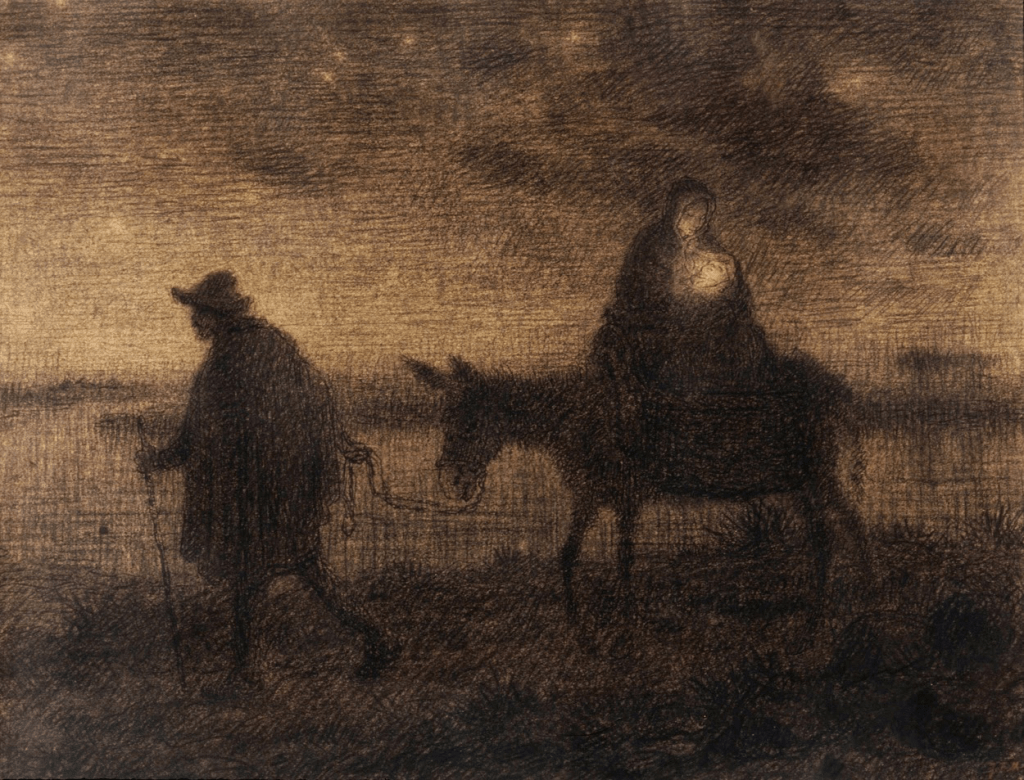
Jean François Millet French, 1814-1875 The Flight Into Egypt, c. 1864
Jean François Millet
The Flight Into Egypt, c. 1864

This is the second reason that our reading of Leviticus 19:33–34 is preparation for Christmas. We are preparing our hearts to meditate on this bewildering truth: we see Jesus in the terrified, exhausted faces of our Syrian neighbors. We see Mary’s tears and Joseph’s desperation. We see the body of a child washed up on the shore—and the mangled bodies of many others if we dare turn our eyes on the war—and we know indeed which flesh it is that the Word has taken on.

The Savior born to us is born as a refugee. The king we honor flees before violence, into Egypt, and recapitulates the story that Israel was prone to forget. “Remember, you were foreigners in Egypt. I am the Lord your God!” Incarnate God himself begins his life as a foreigner in Egypt, a refugee from the politicians who wield the sword and enforce a different law. What else could Christmas be about this year?!

I’m sickened by those who call themselves Christians but also align themselves with the interests of politicians whose rhetoric has nothing to do with this story. And in this case, the American church’s problem is exactly that we do not live Israel’s story as our own, and so the word remember is meaningless. “We” were not foreigners in Egypt. The only thing “we” remember is privilege, so we fear it might be put at risk by the intrusion of those who are not “us”—to say nothing of the cost of loving them as we love ourselves. But this is what the Christian calendar is for: we cycle through holidays not to recall the warm memories of Christmases past but to induct ourselves into the memories of the story we take on in Christ. We are the people of the refugee king! We celebrate the arrival of God in the flesh—the flesh of a refugee—a flesh descended from the children of Abraham, who were once foreigners in a hostile land. Who learned to do to others what was not done to them. Who were commanded to remember these lessons. Who are commanded, in Christ, to keep the law of love at whatever cost to themselves. For God so loved the world that he became a refugee.

John Mark Hicks wrote an article yesterday that I would recommend to anyone considering how, this Christmas, to bring together love of the foreigner among us and our celebration of the incarnation. He offers a theologically rooted but practical approach to Christmas budgeting. But more specifically, I pray that many Christians will seek to welcome and bless Syrian refugees in such practical ways. Of all people, we are not those who will turn them away. That is not our story. Let’s pray that they become our neighbors, so that we might keep the law of love with courage and generosity.

If you’re wondering what to do once you’ve redeemed some Christmas funds, look for organizations that already know what they’re doing. In the Los Angeles area, for example, the Interfaith Refugee and Immigration Service has a co-sponsorship program. (If you’re interested in co-sponsoring with us, let me know!) Such organizations exist throughout the country (but due diligence to make sure they’re legit is essential).

Relentless Now (Global Missions Experience Address)

This is the text of my address at the Global Missions Experience, hosted by Harding University at Camp Tahkodah, Sept. 17-20, 2015.

Relentless

The theme for the experience was “Relentless.” We reflected on God’s own relentlessness, serving and pursuing him relentlessly, the relentless cry of the world, and the relentless advance of the kingdom. My contribution was the final keynote, focused on our participation in God’s relentless mission.

There were a few extemporaneous additions and subtractions in the presentation, but this is the essential content.


Preamble

Let’s stand up for a moment more. I invite all of you who are willing to take off your shoes. I suppose we sometimes resist with this symbolic act for good reason. We are, after all, the people who believe that, by the Holy Spirit, God is everywhere always present with his people. Scattered from the temple, scattered as the temple, as the reimagined tabernacle in which God dwells not among his people but through his people among the nations—the church may well struggle to grasp what it means to stand in the presence of God and experience the holiness of a particular place. Yet, I invite you by this bodily act not to make a statement about where God is or how God is here, but to open your imagination to why God is here just now. Step into the story of Moses, and stand alongside a sinful, resistant, fearful man, but a man who, nonetheless, is about to be sent. The ground is holy because from that ground the God who sets the captive free is going to sweep this man into his redemptive purposes.

We are standing here, on this ground, at this time, another chapter of the same story. We are here for consecration, holy purpose, and from this ground we will be sent—sent for the first time, sent once again, but sent from this ground, if we will step into God’s purposes.

Go ahead and have a seat, and let the simple fact of your bare feet be a reminder to listen for that voice.

Now, let’s put cards on the table. I’m supposed to persuade you here at the end to commit to becoming long-term, full-time missionaries. And let’s be realistic. Long-term, full-time missionary is a category of commitment that requires a lot more than a moment of conviction. In fact, it requires relentlessness. But here’s the catch: our perseverance is only derivative. The mission is relentless, and the mission is not ours. We stand as witnesses to God’s relentless love and justice and perhaps hear a call to step into it, are swept along, and participate in it, by grace, in the power of the Holy Spirit.

That’s not to say I can’t tell you stories of witnesses who have participated God’s relentlessness. I can even tell you stories of how my wife and I have chosen to do so, because it’s a choice. But I hesitate to do that. In regard to my personal stories because I find it awkward. But in general because it risks getting things the wrong way around. Those examples are helpful, but they can’t compel you, and they can’t sustain you. I want you to be compelled and sustained by God’s own relentlessness. I want you to make a choice to step into that holy purpose and be carried by something beyond our determination.

Preview

Here’s what we’re going to do. First, I’m going to ask a question that we’re all going to hold onto until the end. Then I’m going to tell you a story you’ve heard before, and then we’ll talk about geology a bit (no we can’t skip to that part now, just calm down), reflect on the resurrection, I’ll awkwardly share some of my experiences, and hopefully it will all make sense by the end.

Here’s the question to hang onto: What is the opposite of a scar? Not the absence of a scar, but the opposite of a scar. We have these scars on our bodies, these marks of damage done. What is the opposite of that?

Story 1: God’s decision to be relentlessly redemptive

Back to relentlessness. Have you noticed that the only way you can characterize someone as relentless is by telling a certain kind of story. You can claim, “Abe is honest,” by telling a story about a time that Abe told the truth. You can only say, “Abe is relentlessly honest,” by telling the story of how Abe told the truth time after time, whatever the cost.

We love these kinds of stories. They’re usually classified as “inspirational.” The Rocky movies probably capitalized on our main idea more than any other story in pop culture: will Rocky relent when he’s outclassed, will he relent when he’s been beaten to a pulp, will he relent when his health is at risk, when his wife won’t support the rematch, when he’s been defeated, when his beloved trainer dies, when he faces a Soviet boxing machine, when he has brain damage and goes bankrupt at the same time, when his protege betrays him, and finally, will he even relent when he’s arthritic? And we feel a rush when he doesn’t give up. But whether it’s Rocky’s fights, little Rudy’s struggle to play football for Notre Dame, or homeless Chris Gardner’s pursuit of happiness, such stories, though they move us, are not our story. We are not the heroes who persevere by willpower, determination, and grit. Sure, we are capable of tremendous tenacity—so these stories ring true. Of course. But that is not what is at stake when we stand on this ground and speak of relentlessness. For we are called into God’s story as participants in his relentless mission, carried along by his faithfulness, with an endurance sustained not by willpower but by hope in his promise.

In order to catch one more glimpse of God’s own relentlessness, I want to focus on the moment early in the story when God decided to be relentless. Like all stories of relentlessness, this one hinges on a moment of decision, a resolution to take a path and follow it to the end. Let’s get a running start.

Creation and Commission

The Creator orders the chaos, and from that order springs life. The ancient authors of Genesis 1 are interested in making one point exceedingly clear: it was good, it was good, it was good, it was good, it was good, it was good, and it was very good. You got that? It was ____. Very good.

So when vv. 26–27 says that humankind was created in the image and likeness of God, if we’re reading the story from the beginning forward, we are working with a very limited but unambiguous couple of characteristics. God the Creator is creative and ____. Precisely. Creative and good. He produces things that are beneficial for life. The 1:28 mandate to be fruitful and multiply, and fill the earth, and rule it, is therefore about the multiplication of this image, which is to say, it’s about filling the world with agents of creative goodness who would do for the world what God himself would do. And the astounding implication of creating co-creators is that God has left the work of creation unfinished. In its goodness, it is not yet what he wills it to be. His purpose, his vision for the future is good creation filled with good people doing good. And it is to humans that he says, “Be responsible for creating the goodness of which you are capable.” The Creator chooses to make us instrumental in his purposes!

Notice I didn’t say he chooses to “let us participate.” That word, participate, is the right word, but the phrase “let us participate” suggests the wrong idea: it suggests that our is an optional contribution, should we so choose. That is not the case: good creation filled with good people doing good hinges upon human participation. We have to open our hearts to the fact that from God’s perspective, our participation is the only way his purposes proceed, because if that doesn’t sink in, we cannot perceive what tonight is really about.

We know that the story goes wrong with human rebellion. But contrary to our tendency to talk about sin and guilt abstractly, the biblical text portrays the very specific problem that humanity’s spiral into violence presents. Listen to the language of Genesis 6:

Now the earth was corrupt in God’s sight, and the earth was filled with violence. And God saw that the earth was corrupt; for all flesh had corrupted its ways upon the earth. And God said to Noah, “I have determined to make an end of all flesh, for the earth is filled with violence because of them; now I am going to destroy them along with the earth.

Do you hear the echo of the 1:28 mandate? Humankind was to multiply and fill the earth with goodness (that which benefits life), and instead it has multiplied and filled the earth with violence (that which destroys life). In this way the flood story is one of deeply ironic symmetry. “If,” God says, “you insist upon destruction and violence rather than order and life, then let’s take this to its conclusion. The separation of waters above and below and from the dry land that make life possible in the first place will be removed. If it’s chaos you want, it’s chaos you will get.” So our heartbroken God nearly scraps the whole project. He nearly relents. And at that moment we come to the most important “yet” in the history of the world. (I was going to say the most important “but” in the history of the world, but that could be misheard, so we’ll go with “yet”) It’s this one little contrastive conjunction. Listen to it in context: “So the LORD said, “I will blot out from the earth the human beings I have created—people together with animals and creeping things and birds of the air, for I am sorry that I have made them.” Yet, Noah found favor in the sight of the LORD.” Yet, Noah! A single image bearer. A single agent of creativity and goodness who chose to participate in God’s purposes. Just one! And all of us are alive today. Nearly, God relents, but he is so absolutely committed to the participation of humankind in the fulfillment of his purposes, that one alone is enough. I don’t know where God is going to send you, but contemplate that math.

The word used to describe Noah’s participation in God’s creative goodness appears here in Scripture for the first time. That word is ṣaddîq. Say it with me. Ṣaddîq means just. It’s also translated as righteous sometimes, and we’ll deal more with that issue in due course. What we must see here, though, is that a flood of injustice and violence threatens God’s creation and thwarts his intentions, and God’s decision in that moment is to depend on the justice of a human being in the middle of that overwhelming force. If that sounds scandalous, fine. If that sounds crazy, I kind of agree. But that is our story!

So now, in the aftermath of the flood, we come to the pivotal moment when God decides to be relentless. As Noah worshiped God on dry land, “the LORD said in his heart, ‘I will never again curse the ground because of humankind, even though the inclination of the human heart is evil from youth; nor will I ever again destroy every living creature as I have done.'” This eternal covenant is the moment when God permanently rules out abandonment of the project. Giving up will not be the solution. Violence will not be the final response to humanity’s violence. Even though our hearts are inclined to evil, God will not wipe the slate clean.

Some of you are artists. Do we have any painters or photographers here? You know how negative space works. When the area around the main subject is actually the main subject. The implication of this passage is the epitome of textual negative space. You see, if God will not destroy us, then what option is left? He has not given up his intention to see a good creation filled will good people doing good. And he refuses to give up on human participation in that purpose, even though our hearts are inclined not to participate. All that remains is redemption. The covenant with Noah is a decision to relentlessly pursue the redemption of sinful image bearers and to relentlessly rely on human agency. And the plot has thickened. Now human participation in the redemption of humankind must precede the restoration of creation to its original trajectory. This is God’s decision to depend on human participation in his relentless mission, despite our sinfulness, despite our weakness. He will transform us into a people of justice, for the sake of the world, whatever it takes, however long it takes. This is God’s sacred promise.

How do we wrap our minds around the scope of this commitment? Knowing the inclination of humanity, knowing how slow and possibly disastrous would be the process of re-creating a just people starting with a single family, and knowing how much longer still until this people would become a blessing for all nations until, finally, a worldwide kingdom of justice is established, how do we conceive of such relentlessness? Inspiring sports stories and tales of astonishing perseverance simply cannot capture the meaning of a thousand generations of mercy and grace, patience, steadfast love and faithfulness, and forgiveness.

Story 2: A parable of God’s relentlessness

I don’t know if there is an analogy for such a thing. But I’m going to take a page from Jesus’s book and try to let nature represent the almost unfathomable.

The Parable of the Grand Canyon

5.5 million years ago, a massive lake, larger than Lake Michigan, overflowed and began to pour tremendous amounts of water across a plateau. This volume, combined with the steep grade of the flow (10ft./mile), created an incredible erosive force. In the course of that 5.5 millions years, the river cut through 5300 ft. of rock. That is 1 ft. per 1000 years, a little more than 1 in. per century. That is relentless.

You may have guessed that I’m talking about Grand Canyon.

[images of Grand Canyon]

What is the relentless mission of God like, or to what shall we compare it?

It is like an unceasing river that reshapes the earth one inch at a time, one century at a time, until it takes our breath away.

This relentlessness is the love of God rushing across the face of creation. It flows, not as a destructive flood, but as a torrent of justice. I imagine it in the poetry of the prophet Amos: “let justice (mišpāṭ) roll down like waters, and righteousness (ṣĕdāqâ) like an everflowing stream” (Amos 5:24).

This second word, ṣĕdāqâ, translated as righteousness, is the noun form of the adjective that described Noah. It would be bad composition to translate both words as justice, of course, and each word does carry its own connotations, but as Amos’s imagery indicates, they are essentially two streams of the same river that, once merged, are difficult to distinguish. Whereas mišpāṭ is usually justice in terms of evaluating what is right (judging justly), ṣĕdāqâ is usually justice in terms of doing what is right (acting justly). Call them justice, call them righteousness, but either way, when the two flow together, this is what happens according the prophet Jeremiah:

Thus says the LORD: Act with mišpāṭ and ṣĕdāqâ, and deliver from the hand of the oppressor anyone who has been robbed. And do no wrong or violence to the alien, the orphan, and the widow, or shed innocent blood in this place. (Jer 22:3–4)

Perhaps this description, which could be multiplied if we had time, suggests why I started off talking about God’s relentless justice but ended up referring to his relentless love. We know that care for the poor and the vulnerable, compassion for the stranger, and peacemaking are deeply rooted in the love that Jesus reveals as the heart of God and teaches us to practice. But these acts of love are also what the prophet clearly describes as justice. Because the raging, surging love of God sets the world right. It does justice. Justice is the labor of love. This loving justice is our God’s relentless mission.

Story 3: The story of our participation in the resurrection life of Jesus

Justice and Love

Now hear the apostle Paul’s words in those terms:

I am convinced that neither death, nor life, nor angels, nor rulers, nor things present, nor things to come, nor powers, nor height, nor depth, nor anything else in all creation, will be able to separate us from the love of God in Christ Jesus our Lord. (Rom 8:38–39)

Relentless love! But did you catch it? Neither death nor life! Not even death. Put death before the onslaught of God’s love, and it will be ground into sand and swept away. For by the love of God, Jesus Christ is raised. Resurrection is God’s relentlessness in the face of death, and it is his final act of relentlessness, beyond which there is no more violence and destruction.

But Paul says we “were also raised with him through faith in the power of God” (Col 2:12). When we’re in Jesus, that future invades the present. We live resurrection life now. We are able to participate in that ultimate relentlessness now. The full extent of God’s relentlessness breaks into the present through our lives in Christ and carries us relentlessly onward. This unstoppable love of God is what makes God’s people persevere.

The apostle’s participation is breathtaking:

Five times I have received from the Jews the forty lashes minus one. Three times I was beaten with rods. Once I received a stoning. Three times I was shipwrecked; for a night and a day I was adrift at sea; on frequent journeys, in danger from rivers, danger from bandits, danger from my own people, danger from Gentiles, danger in the city, danger in the wilderness, danger at sea, danger from false brothers and sisters; in toil and hardship, through many a sleepless night, hungry and thirsty, often without food, cold and naked. (2 Cor 11:24–27)

Why? Why would he persist? What makes it possible? Nothing less than the love of God that carries him beyond death into the resurrection.

So it is with all the martyrs. What does martyr mean? Yes, witness. Someone might mistake them for being especially relentless, but they are simply witnesses to the resurrection—the fact that the love of God does not relent at death, and so they give their lives.

The thing is, most of you won’t face death as you bear witness to God’s love in the world. Most of you will face life—the long unfolding of years. Your call is not to give your life but to live your life. And in the face of life, the question is no less, does God relent? Not, will you relent? But, does God’s love relent? And if in fact it doesn’t, then you may be carried on as witnesses to that relentlessness, even when your resources have run dry, even when you courage is gone, even when your sin persists, even when the evil and corruption and violence around you is by every conceivable measure insurmountable.

I would like to stand up here and give you stories about how Megan and I were relentless—but that would be nonsense. Look, when I was at Harding, there were over twenty students meeting regularly as a Latin American missions interest group, working on a timeline and a plan. By the time we had researched cities on the ground in South America and selected a city my junior year, everyone who had graduated was no longer a part of the conversation. It seemed like everyone talked about mission until it was time to move on with real life. But there was a dozen of us who committed to go. By the time I graduated, there were nine. And there was plenty of opportunity along the way to doubt. Maybe God’s not sending us, and we’re just insisting on our own plan. Maybe this is a failure of leadership. Maybe I’m the problem.

Then there is the call to graduate work. God is preparing us for mission, or at least that’s the assumption. Maybe not—maybe it’s just four more years for things to unravel. Within a year, we’re down to three couples and a single woman. In the next year, she’s married and gone, and it’s just six of us who embark on the trial by fire we call fundraising.

Now, when you ask the question, how do you know God is calling you to full-time, long-term mission work, there is a way to know. If you don’t hear the voice of God like Isaiah or Paul, then you turn to the church for discernment. Those with whom you worship and serve, those who disciple you and shepherd you and pray about you are in the best place to help you answer the question. And unfortunately, it’s easy to mistake fundraising for that process. See, fundraising feels like congregation after congregation saying no not to funding your work but no to your calling. And when it seems like God isn’t providing a way forward financially, it’s easy to think: maybe this is God’s no. Maybe this is how we finally come to terms with the fact that we’re not meant to go.

In our case, the message was a little more pointed, though. After some major “not interested” letters, all three couples had a chance to be funded together by a single large church. But this big church, obviously serious about missions, had a serious process for candidates. So we went through their intensive three-day screening. And when we finished, they told us not only that they had decided not to support us but also that we shouldn’t go. At what point do you give up? And if not at that point, when a group of God’s people literally say, “You’re not ready,” then why not at that point? (By the way, if you’re wondering what to do at that moment, you call the people who have discipled you. You call your mentors. Or in your case, you text your mentors—but you get the idea. And if you don’t have a mentor, find one. Tomorrow. More than one, if possible.)

Well, one of the three couples did give up after that experience. Once more than twenty university students, now two young couples remain. Of course, you pray, and you question, and you decide whether to go on. And we did. And we lived and served in Arequipa, and saw God do amazing things. But I’m telling you, this is not the story of our relentlessness. This is the story of God’s mission in Arequipa—his relentless love for the people there. Our decision was not whether to be relentless, but whether to be God’s loving justice, which is already relentless, already surging past our financial needs, our inadequacies, our fears, and our challenges.

For the love of Christ urges us on, because we are convinced that one has died for all; therefore all have died. And he died for all, so that those who live might live no longer for themselves, but for him who died and was raised for them.

Do you hear resurrection life?

From now on, therefore, we regard no one from a human point of view; even though we once knew Christ from a human point of view, we know him no longer in that way. So if anyone is in Christ, there is a new creation: everything old has passed away; see, everything has become new!

Actually, Paul gets so excited he stops bothering with complete sentences. He says: “If anyone is in Christ—new creation!” Do you think Paul had the story of the Creator’s purposes running in his head?

All this is from God, who reconciled us to himself through Christ, and has given us the ministry of reconciliation; that is, in Christ God was reconciling the world to himself, not counting their trespasses against them, and entrusting the message of reconciliation to us. So we are ambassadors for Christ, since God is making his appeal through us; we entreat you on behalf of Christ, be reconciled to God. For our sake he made him to be sin who knew no sin, so that in him we might become the ____. (2 Cor 5:14–21)

So that we might become the ____. Righteousness of God. I told you we would come back to the translation problem. Righteousness is one of those words that seems to have lost its flavor. Through all kinds of theological debates and cultural influences, for many of us it has become bland. It communicates something like piety or the absence of immorality. Or maybe just saved-by-Jesus-ness. So here, where Paul speaks this heart-stopping truth, it doesn’t hit us with the force of a claim that changes the world. The claim that the loving justice of Noah’s life, the loving justice of Abraham’s faith, the loving justice of the prophets’ vision of the the way things are supposed to be, the loving justice of Jesus’s way in the world, the loving justice of God that sets the world right—the claim that God’s loving justice is what we become in Christ. For our sake he made him to be sin who knew no sin, so that in him we might become God’s justice.

This is not an explanation of how we get saved. This is where Paul explains how the whole creation gets saved because we have been reconciled with God and raised with Christ. When we get swept into resurrection life, we become the justice of God in the world. We become the fulfillment of God’s relentless love now, in the present. And we participate in the realization of God’s longsuffering dream to see his good world filled with good people doing good.

Will you choose to be the justice that rolls down like waters, and the righteousness that rushes like an everflowing stream? This is what it at stake in our decision. This is why we commit to the “work of faith and labor of love and steadfastness of hope in our Lord Jesus Christ.” This is why we sow the kingdom and establish communities of God’s just people—because the church must be the justice of God in the world.

The church is not Noah’s ark, saving people out of the lost world. No, we are the flood. We, God’s people, are the waters that reshape the face of creation. We are the justice of Noah multiplied to fill the earth, and we do not retreat from the violence and destruction in the world, because the relentless love of God in us and through us will overwhelm it.

Afterword

What is the opposite of a scar? I don’t know. What I do know is that the resurrected body of Jesus bears the scars of his crucifixion. Whatever our transformed bodies are, they share enough continuity with our present bodies to be scarred by violence. Think about it: those marks of damage done are eternal. But here is the punch line: whatever is the opposite of a scar is eternal too. All the good we do in the world, every mark our justice makes on the world, gets resurrected. So Paul finishes his fullest discussion of the resurrection with these words:

Therefore, my beloved, be steadfast, immovable, always excelling in the work of the Lord, because you know that in the Lord your labor is not in vain (1 Cor 15:58).

Your labor is not in vain! Your work in the Lord will be vindicated, resurrected, and made into the stuff of new creation!

And every mark we don’t make will be absent.

God doesn’t need you to do no harm, to make no scars. The absence of damage is not enough. God needs you to wage peace in the world, to wreak justice upon the face of the earth, steadily, relentlessly. You are the relentless righteousness of God in the world, the relentless resurrection already lived in the present, reconciling and restoring in the face of corruption and death, whatever the cost, however long it takes, because the love of God in us and through us does not relent.

They’ve called us generation justice. Yes, us. I’m not that old. And it’s probably true that we dream more about making the world the way we think it’s supposed to be than some other generations have done. But they’ve also said we’re afraid of commitment. All talk and no follow through. Big dreamers who can’t handle anything but instant gratification. We might say that Millennials seem to love justice but relent when it comes to the hard labor of it, the grueling pace of it, and the ungratifying incompleteness of it. We have to decide, in the words of the great contemporary theologians Mumford and Sons, to “love with urgency but not with haste.” We must choose to participate in God’s relentlessness.

Will you commit to go into the world, into the midst of what looks like godforsakenness in order to say and show that God has relentlessly refused to forsake us? Will you point to the cross and say that there in the mud and the blood is the love of God that will not quit. Will you make followers of that Jesus and nurture new creation communities whose loving justice relentlessly reshapes the world around them? Will you choose to step into the current of God’s relentless loving justice as it flows into every nation. Will you choose to participate?

—-

The same passage that describes Noah as just and upright in his generation uses another phrase, a parallel thought, to summarize his creative goodness: “Noah walked with God.” How tangible, how concrete, this image of walking, of our feet treading the earth in company with God as agents of his justice. Those who are ready to make a commitment tonight are going to share in a symbolic act. . . . Wherever in the world your feet tread as you walk with God, there you are God’s loving justice. Will you walk with God toward a place?

On Cultural Intelligence

I’m a fan of David Livermore’s work on cultural intelligence. His book Serving with Eyes Wide Open: Doing Short-Term Missions with Cultural Intelligence would be at the top of my recommended reading for those who insist on engaging in STM. It is highly readable and equally insightful for those thinking for the first time about STM’s difficulties among US North American trip goers. The last of the book’s three sections introduces the theory of cultural intelligence, or CQ (like IQ and EQ), which Livermore has been developing as a full-blown program through the Cultural Intelligence Center.

CQ consists of four components. These are my own descriptions of them:

Knowledge CQ: how much you know about cultural dynamics in theory.

Interpretive CQ: how much you perceive cultural dynamics in real life.

Perseverance CQ: how much you care about dealing with cultural dynamics despite difficulty.

Behavioral CQ: how much you adapt to cultural dynamics in actual interactions.

As I’ve adapted CQ for university internships in Peru over the last few years, the focus of the learning experience has been on knowledge and interpretive CQ. The other two are not less important, but they are less conducive to the kind of learning that the internship entails. We provide some basic behavioral dos and don’ts in the internship orientation, but mimicking behaviors or following instructions is not what behavioral CQ is about, although that is often the full extent of training STM goers receive. Instead, behavioral CQ derives from the other three, consisting of behavioral adaptation based on insightful, perceptive, well-motivated cross-cultural interactions. Likewise, we discuss STM motivations among interns, but even though this is a vitally important conversation, the best way to increase perseverance CQ is to “align our motivation with what we are growing to understand about a culture—both through knowledge and interpretive CQ[1. David A. Livermore, Serving with Eyes Wide Open: Doing Short-Term Missions with Cultural Intelligence (Grand Rapids: Baker, 2006), 146-47.] The focus in our internship, then, was cultural learning focused on the intersection of knowledge and interpretive CQ: “As we interpret the cues received through interpretive CQ, we continually adjust our knowledge CQ. These two elements of CQ are very dependent upon one another.”[2. Ibid., 130]

I developed this simple matrix to help us think about where we are and in what direction we need to grow:

CQ-Matrix

Ideally, we’re moving toward the top left quadrant. Our motivation to move in that direction is perseverance CQ, and our skill at converting increased understanding and sensitivity into adaptive behavior is behavioral CQ. This is just my own little tool for helping students think about their cross-cultural learning experience. If you’re interested in learning about your own CQ, I highly recommend a look at the Cultural Intelligence Center’s resources.

This has been an unpaid public service announcement. =)


Notes