Worldview in Grenz and Franke’s Postfoundationalist, Postmodern Method

A Missional Method for Constructive Theology (Part 9)

The next two parts of the series consider what significant evangelical theological methods with underdeveloped conceptions of worldview stand to gain by working with a missiological understanding of worldview. I consider the use of worldview in Grenz and Franke’s Beyond Foundationalism and in Vanhoozer’s The Drama of Doctrine. They deserve consideration in the present argument for three reasons. First, both are widely recognized as noteworthy evangelical expositions of theological method. Second, they are already attuned to missional concerns. Third, they engage profoundly with the post-everything context that concerns missional theology.

Stanley Grenz and John Franke’s book Beyond Foundationalism already bends toward missional theology, claiming the “final purpose of theology” is “the church’s mission.”[1. Stanley Grenz and John Franke, Beyond Foundationalism: Shaping Theology in a Postmodern Context (Louisville, KY: John Knox, 2001), 26, 50, 273.] This phrasing still reflects an ecclesiocentric missiology that has not been restructured by the priority of God’s mission, but the trinitarian and participatory theology they elaborate resonates with missional theology nonetheless.[2. One reader asked whether we shouldn’t read this phrasing more generously. I can’t disagree: Franke is a missiologist and currently serves as General Coordinator for the Gospel and Our Culture Network; see The Gospel and Our Culture Network, GOCN Board, http://www.gocn.org/network/team. My concern here, however, is the broad tendency of evangelical theology into which this phrasing still plays and which, undoubtedly, many still bring to their reading.] Their proposal is particularly attentive to culture, engaging missiological concerns more than most theological methods. Yet, a clearer conception of worldview could resolve a critical equivocation in their method and make an already fruitful work even more valuable for missional theology.

The authors identify their context as “postmodern,” which they take to designate a “rejection of certain central features of the modern project” that unifies the work of deconstructionists, postliberals, and posconservatives alike.[3. Grenz and Franke, 21.] As the book’s title indicates, their “especially crucial” theological concern is the demise of modern epistemological foundationalism.[4. Ibid., 28.] This is the primary sense of their question, “How should theology respond to the collapse of the modern worldview?”[5. Ibid., 11.]:

The results of the foundationalist approach of modern liberals and conservatives have been astounding. In different ways both groups have sought to respond to the challenge of the Enlightenment and rescue theology in the face of the secularist worldview of late modernity. Although the liberals and conservatives routinely dismiss each other’s work, they share the single agenda of seeking to maintain the credibility of Christianity within a culture that glorifies reason and deifies science.[6. Ibid., 37.]

The question, in other words, is how to do theology when the theological appeal to foundationalist epistemology is no longer culturally appropriate, because the worldview that theology needs to address has passed from modern to postmodern.

Their suggestion for theology “beyond foundationalism” begins with the work of Reformed epistemologists, “which raises the question as to what—if anything—might be deemed basic for Christian theology.”[7. Ibid., 47.] Grenz and Franke’s point of departure becomes, therefore, the “communitarian turn” of Reformed epistemology, identifying as “basic” for theology the “interpretive framework” of the Christian community that shares the experience of the “encounter with the God of the Bible through Jesus.”[8. Ibid., 48–49.] It is here that the confusion about worldview begins, however, because Grenz and Franke are now using the conception of worldview typical of the Reformed theologians discussed above: worldview is “basic beliefs.” Hence, “any such interpretive framework is theological in nature, for it involves an understanding that sees the world in connection with the divine reality around which that tradition focuses.”[9. Ibid., 49; emphasis added.] This “cognitive framework” is not foundationalist, because it participates in a hermeneutical circle in which the articulation of a theological understanding already presumes a theological understanding.[10. Ibid., 49–50.] Worldview is now essentially synonymous with a product of a coherentist theological method, a “belief-mosaic”:

Therefore, while we might view the Christian interpretive framework as in a certain sense foundational for theology, we could more properly speak of theology as the articulation of the cognitive mosaic of the Christian faith. This mosaic consists of the interlocking doctrines that together comprise the specifically Christian way of viewing the world. This worldview is truly theological and specifically Christian because it involves an understanding of the entire universe and of ourselves in connection with the God of the Bible and the biblical narrative of God bringing creation to its divinely destined goal.[11. Ibid., 51.]

The shift in the usage of worldview is subtle and easy to miss: from a description of a culture (modernity) in which an epistemological presupposition set the agenda for theology to an alternative epistemology based on experience and theological reflection among a religious community. The key to this shift is twofold: the conflation of culture and community and the conflation of epistemology and worldview.

A community may be monocultural, or not. The sharper point, however, is that a Christian community always participates in a larger culture. Conflating culture and community, therefore, obscures the extent to which the “theological worldview” of the Christian community does not account for the total worldview of the culture in which it is a participant. Likewise, a worldview serves an epistemological function in the broadest sense: it may be considered comprehensively as the way that a person knows. Yet, reducing worldview to epistemology proper obscures the other theologically determinative dimensions of a worldview.[12. See, e.g., Paul G. Hiebert, Transforming Worldviews: An Anthropological Understanding of How People Change (Grand Rapids: Baker Academic, 2008), 46, where epistemological assumptions are only one aspect of worldview.] Thus, the claim that “scripture mediates a specifically Christian ‘interpretive framework’” that consists of a  “set of categories, beliefs, and values—whether consciously formulated or merely unconsciously presumed—which forms one’s perception of reality and life” may be true as far as it goes.[13. Grenz and Franke, 81.] But identifying this as a worldview[14. Ibid., 85–86.] derails the book’s vitally important discussion of culture in theological method.

Grenz and Franke rightly assert, “Theology emerges through an ongoing conversation involving both ‘gospel’ and ‘culture.’”[15. Ibid., 158.] They characterize this process by contrast with both liberal correlation and evangelical contextualization methods that rely on foundationalism. So far, so good. They continue:

Discerning what characterizes the socially constructed worlds people around us inhabit places us in a better position to address the generation God calls us to serve. Doing so, however, necessitates that we conceptualize and articulate Christian beliefs—the gospel—in a manner that contemporary people can understand. That is, we must express the gospel through the “language” of the culture—through the cognitive tools, concepts, images, symbols, and thought forms—by means of which people today discover meaning, construct the world they inhabit, and form personal identity.[16. Ibid., 159.]

This sounds identical to typical accounts of contextualization, but the contrast they wish to draw is that the “gospel” to be articulated is not a “Christian universal, which in turn functions as the foundation for the construction of the theological superstructure” but an understanding of the gospel that only emerges on the basis of the interaction with culture.[17. Ibid., 158. Their characterization of foundationalist contextualization, taking Kraft as an example, is dubious. By their own admission (citing Bevans in fn. 139), there are exceptions, leaving one to wonder why they do not retrieve a nonfoundationalist account of contextualization given its anthropological sophistication. In one sense, that is what I am proposing.] As I stated in regard to the development of the cognitive framework (which is the theological belief mosaic), this is a hermeneutical circle in which the articulation of a theological understanding already presumes a theological understanding—which is now seen to be a culturally determined theological preunderstanding. This is correct. Yet, by (a) defining worldview as a system of Christian beliefs that function epistemologically, (b) defining the Christian community constituted thereby as a culture, (c) identifying Christian beliefs as the gospel, and (d) stating these beliefs must be conceptualized and articulated through the language of the culture, they have crippled the method. If the gospel is the beliefs that constitute the worldview of Christian culture, then it cannot be conceptualized in another culture, for that would logically be constituted by other beliefs. If the “set of values, beliefs, and loyalties”[18. Ibid., 163–64.] that make Christian community a culture are, as already stated, also an epistemology, how can an epistemology be articulated in terms of “the cognitive tools, concepts, images, symbols, and thought forms” that are by their definition a different epistemology?

The only way to make their method function, I believe, is to clarify the conception of worldview missiologically. This does not entail attributing “neutrality” to cultural forms, but it does require a more anthropologically nuanced account of worldview that does not confuse the pretheoretical dimensions of culture by which communities may speak in a variety of ways with the content of Christian theology. Grenz and Franke go a long way toward a missional theological method, identifying the style of Christian theology as “trinitarian in content, communitarian in focus, and eschatological in orientation,” recognizing the purpose of theology as missional, and indispensably requiring a culturally dialogical method. But they also demonstrate that such a method cannot proceed without a clearer conception of worldview. Only by dealing explicitly with the pretheoretical dimensions of meaning-making can intercultural, interreligious, and interconfessional theological dialogue result in mutual understandings that might serve God’s mission.


Notes

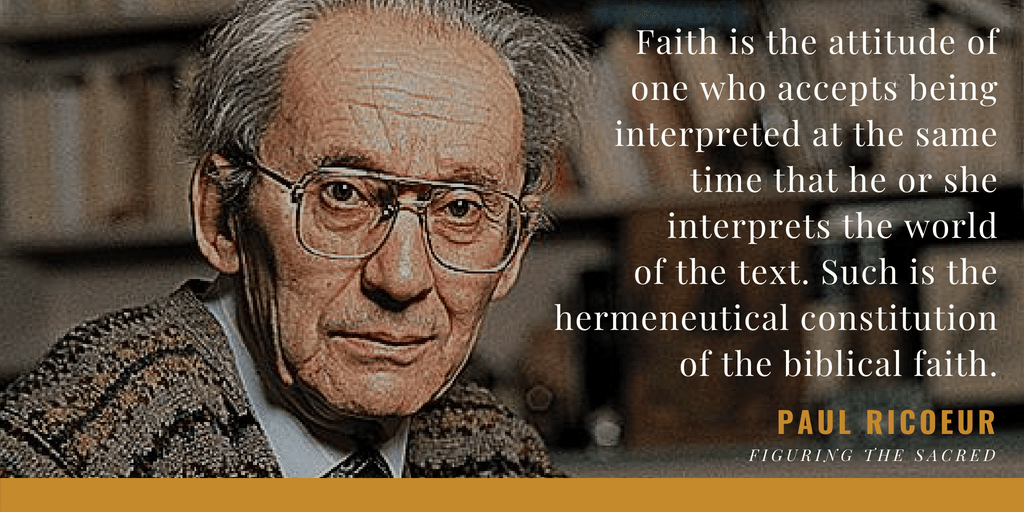
Ricoeur on Biblical Interpretation and Resurrection Hope

Some excerpts from two essays. I highlight the thread of “new creation” that ties them together.

From Paul Ricoeur, “Toward a Hermeneutic of the Idea of Revelation”:

“What is finally to be understood in a text is not the author or his presumed intention, nor is it the immanent structure or structures of the text, but rather the sort of world intended beyond the text as its reference. In this regard, the alternative “either the intention or the structure” is vain. For the reference of the text is what I call the issue of the text or the world of the text. The world of the text designates the reference of the work of discourse, not what is said, but about what it is said. Hence the issue of the text is the object of hermeneutics. And the issue of the text is the world the text unfolds before itself.

. . .

Religious discourse is poetic in all the senses we have named. Being written down as scripture removes it from the finite horizon of its authors and its first audience. The style of its literary genres gives it the externality of a work. And the intended implicit reference of each text opens onto a world, the biblical world, or rather the multiple worlds unfolded before the book by its narration, prophecy, prescriptions, wisdom, and hymns. The proposed world that in biblical language is called a new creation, a new Covenant, the Kingdom of God, is the “issue” of the biblical text unfolded in front of this text.”

From Paul Ricoeur, “Freedom in the Light of Hope”:

“The task of a hermeneutics of the Resurrection is to reinstitute the potential of hope, to tell the future of the Resurrection. The meaning of the “Resurrection” is in suspense insofar as it is not fulfilled in a new creation, in a new totality of being. To recognize the Resurrection of Jesus Christ is to enter into the movement of hope in resurrection from the dead, to attain the new creation ex nihilo, that is, beyond death.

If such is the meaning of hope on its own level of discourse, that of a hermeneutics of the Resurrection, what is the meaning of freedom if it also must be converted to hope? What is freedom in the light of hope? I will answer in one word: it is the meaning of my existence in the light of the Resurrection, that is, as reinstated in the movement which we have called the future of the Resurrection of the Christ. In this sense, a hermeneutics of religious freedom is an interpretation of freedom in conformity with the Resurrection interpreted in terms of promise and hope.

. . .

[Hope] is allied with the imagination insofar as the latter is the power of the possible and the disposition for being in a radical renewal. Freedom in the light of hope, expressed in psychological terms, is nothing else than this creative imagination of the possible.

But we can also speak in ethical terms and emphasize its character of obedience, of listening. Freedom is a “following” (Folgen). For ancient Israel, the Law is the way that leads from promise to fulfillment. Covenant, Law, Freedom, as power to obey or disobey, are derivative aspects of the promise. The Law imposes (gebietet) what the promise proposes (bietet). The commandment is thus the ethical face of the promise. Of course, with Saint Paul this obedience is no longer transcribed in terms of law; obedience to the Law is no longer the sign of the efficacy of the promise; rather, the Resurrection is the sign.

Nevertheless, a new ethics marks the linkage of freedom to hope — what Moltmann calls the ethics of the mission (Sendung); the promissio involves a missio, in the mission, the obligation which engages the present proceeds from the promise, opens the future. But more precisely, the mission signifies something other than an ethics of duty, just as the passion for the possible signifies something other than what is arbitrary. The practical awareness of a “mission” is inseparable from the deciphering of the signs of the new creation, of the tendential character of the Resurrection, to quote Moltmann once more.

The mission would thus be the ethical equivalent of hope, just as the passion for the possible was its psychological equivalent.

This second trait of freedom in the light of hope removes us further than the first trait did from the existential interpretation, which is too much centered on the present decision; for the ethics of the mission has communitarian, political, and even cosmic implications, which the existential decision, centered on personal interiority, tends to hide. A freedom open to new creation is in fact less centered on subjectivity, on personal authenticity, than on social and political justice; it calls for a reconciliation which itself demands to be inscribed in the recapitulation of all things.

. . .

Hope, insofar as it is hope of resurrection, is the living contradiction of what it proceeds from and what is placed under the sign of the Cross and death. According to an admirable phrase of the Reformers, the Kingdom of God is hidden under its contrary, the Cross. If the connection between the Cross and the Resurrection is of the order of paradox and not of logical mediation, freedom in the light of hope is not only freedom for the possible but, more fundamentally still, freedom for the denial of death, freedom to decipher the signs of the Resurrection under the contrary appearance of death.”

Both essays are in Paul Ricoeur, Essays on Biblical Interpretation, ed. Lewis S. Mudge (Philadelphia: Fortress, 1980), http://www.religion-online.org/book/essays-on-biblical-interpretation.

Worldview in the Missiological Language Game

A Missional Method for Constructive Theology (Part 8)

If anything, my survey of the contours of worldview has only established the dizzying ubiquity and ambiguity of the term. A clarified conceptualization remains to be seen, though perhaps what should be clarified is more evident. Moreover, it is evident that what should be clarified depends on the context of the concept’s use. Therefore, I turn to missiology in order to mark the bounds of a theological language game in which missional theology should further develop, according to its own grammar, a conception of worldview that can serve as a theoretical basis for a constructive theological method. Evangelical missiologists Paul Hiebert and Charles Kraft developed missiological models of worldview over the course of their careers, culminating in two important volumes.[1. Paul G. Hiebert, Transforming Worldviews: An Anthropological Understanding of How People Change (Grand Rapids: Baker Academic, 2008); Charles H. Kraft, Worldview for Christian Witness (Pasadena, CA: William Carey Library, 2008).] Their understandings have deep affinities, but they are not identical.[2. See Yoshiyuki Billy Nishioka, “Worldview Methodology in Mission Theology: A Comparison between Kraft’s and Hiebert’s Approaches,” Missiology: An International Review 26, no. 4 (October 1998): 457–76; Kraft, 116–24. Neither of these accounts, however, represent the full disclosure of Hiebert’s thinking in his posthumous 2008 volume.] My purpose here is not to sort out the differences or offer a synthetic account but to suggest that their heuristic models of worldview already establish the bounds of the missiological language game for the purpose of further developing worldview methodologically for missional theology. I propose there are four relevant dimensions of the missiological conception of worldview.

(1) Worldview analysis serves God’s mission. It is participatory in nature, developed only by participation with others’ worldviews and meant to facilitate understanding for a dialogical participant in others’ lives. Unlike worldview in ostensibly secular anthropology, the missiological conception of worldview is not designed for purely descriptive purposes but overtly raises the question of how worldviews change (mutually), in order to participate more wisely in God’s transforming work in the world. (2) A worldview is a human, socio-cultural phenomenon. Because it is a feature of humanity, a person may not choose not to have a worldview. The anthropological elaboration of the concept has philosophical roots but cannot proceed on any basis except rigorous ethnography. As such, it is a pragmatic theory concerned with the way people actually make meaning in cultural contexts. (3) Worldviews are pretheoretical, implicit, and explicable. Cultures have a component that is not what people think but what people think with. As the deep structure of culture, this pretheoretical component is largely tacit. This does not mean simply that people tend to live the unexamined life but that the very act of examining life depends on a mostly implicit worldview. Worldview is by definition presuppositional and predispositional, therefore what a person consciously “believes” and “values” is generally a product, not a statement, of worldview. Yet, worldview can be made explicit. This is the most problematic aspect of the concept, because a worldview can only be conceived and articulated on the basis of a worldview, whether reflexively or dialogically. Moreover, explicated worldview tends to take the propositional form of a “belief” or “core value,” but, as Wittgenstein has taught us, this is deceptive. (4) Worldviews are commensurable. Translatability is the fundamental assumption of the missiological conception of worldview, but this does not gloss radical difference. The rigor of worldview analysis is motivated by the experience of radical difference and misunderstanding. Yet, some form of critical realism, or perhaps ontological monism, makes a sort of triangulation between God, world, and worldviews a working theoretical assumption.

In summary, vulnerable participation in mutual transformation, rigorous ethnographic observation, dialogical explication of tacit cultural phenomena, and a functional critical realism in the midst of deep difference designate the contours of a missiological theory of worldview. Of course, these four dimensions only begin to suggest how worldview analysis might become a methodological crux of missional theology. There is need yet to develop a functional model of worldview for missional theology, but that is an undertaking for another time. The task at hand is to argue for the methodological value of the missiological concept per se.


Notes

Worldview in Anthropology

A Missional Method for Constructive Theology (Part 7.5)

Within the social sciences too, worldview enjoys a diverse history.[1. Despite the oddly reductive portrayal of Sander Griffioen, “The Worldview Approach to Social Theory,” in Stained Glass: Worldviews and Social Science, ed. Paul A. Marshall, Sander Griffioen, and Richard J. Mouw, Christian Studies Today (Lanham, MD: University Press of America, 1989), 90, fourteen years prior Michael Kearney, “World View Theory and Study,” Annual Review of Anthropology 4 (October 1975): 247–70, had already surveyed an expansive amount of worldview study, particularly in anthropology. Mark E. Koltko-Rivera, “The Psychology of Worldviews,” Review of General Psychology 8, no. 1 (2004): 3–58, provides a similarly expansive presentation of worldview in psychology. Annick Hedlund-de Witt, “Exploring worldviews and their relationships to sustainable lifestyles: Towards a new conceptual and methodological approach,” Ecological Economics 84 (December 2012): 74–83, explores a number of more sociologically oriented approaches.] I limit my comments here to anthropology. Clifford Geertz is the best representative of worldview conceptualization in anthropology, both because of his influence (including in missiology) and because his work is dated.[2. His well-known essay “Ethos, World View, and the Analysis of Sacred Symbols,” The Antioch Review 17, no. 4 (Winter 1957): 421–37, is nearly sixty years old.] The latter is important because worldview has seemingly become passé in anthropology, raising the question of whether worldview analysis like that of Geertz has been debunked or proven unsustainable in some way. It appears, to the contrary, that worldview as an analytic construct is alive and well at least in American anthropology.[3. Beine, David. “The End of Worldview in Anthropology?” SIL Electronic Working Papers 2010-004 (September 2010): 1–10, http://www-01.sil.org/silewp/2010/silewp2010-004.pdf.] Geertz has also recently been the object of vindication despite significant critique.[4. Kevin Schilbrack, “Religion, Models of, and Reality: Are We Through with Geertz?” Journal of the American Academy of Religion 73, no. 2 (June 2005): 429–452; Jung Lee, “Ethos and Worldview Reconsidered: Geertz, Normativity, and the Comparative Study of Religions,” Religion Compass 6, no. 12 (December 2012): 500–510.] Furthermore, much of worldview’s decline in anthropology is related to wider philosophical critiques of representationalist epistemology, along with the rise of antirealism. Yet, ethnographers continue to wrestle with the need to affirm both a common world and socially constructed views of the world.[5. Two recent programmatic essays by João de Pina-Cabral, in which he urges the recovery of worldview, may well signal the resetting of the board in ethnography. See João de Pina-Cabral, “World: An Anthropological Examination (Part 1),” HAU: Journal of Ethnographic  Theory 4, no. 1 (2014): 49–73; João de Pina-Cabral, “World: An Anthropological Examination (Part 2),” HAU: Journal of Ethnographic  Theory 4, no. 3 (2014): 149–84.] The conception of worldview must and can find a middle way between skeptical relativism and naive representationalism—which it already needed to do on the basis of early philosophical conceptions—and ethnography and comparative anthropology is in a unique position to “go beyond the limits of speculation to point to the actual empirical conditions under which humans produce meaning.”[6. De Pina-Cabral, “World: An Anthropological Examination (Part 1),” 59.] With that in mind, I summarize the implications of the preceding subsections en route to the missiological conception of worldview.

Worldview across Philosophy, Biblical Studies, Theology, and Anthropology

  1. Worldview has gone through various philosophical articulations and critiques. Three important qualifications have resulted. First, having a worldview does not put one in the position of a subject viewing the objective world. The human perception of the world is mediated by perceptual experience, and worldview is a way of designating the total perceptual system of the human being. Second, the state of being-in-the-world is a given for perceptual experience, so the designation worldview necessarily implies a holistic, embodied experience of the world. Third, worldview is pretheoretical and linguistically mediated. Thus, while a worldview is, to some extent, articulable, its first-order function is not as a theory or philosophy but rather as that which undergirds the articulation of a theory or philosophy.
  2. In post-romanticist biblical studies, worldview does not refer to the mind of the author as an object of historical-critical study that, once reconstructed, might render authorial intent. Instead, worldview is the very horizon meditated by an author’s language, which the reader only encounters through her own horizon.
  3. Following the above qualifications, it is a mistake for theology to equate worldview with a Christian philosophy or philosophical theology, or even an explicated set of Christian presuppositions. Because worldview is an embodied, cultural-linguistic, pretheoretical phenomenon, it cannot rightly be reduced to a cognitivist belief system. Furthermore, the narrative dimensions of worldview, which come to the fore in the linguistically mediated horizon of an author, orient theology to human narrativity rather than mere beliefs.
  4. Cultural anthropology’s continued deployment of worldview is concerned with the ways in which humans both inhabit a shared world and socially construct views of the world. This is once again a holistic investigation, whose accent falls on the concretely cultural aspects of perception.

Notes

Worldview in Theology

A Missional Method for Constructive Theology (Part 7.4)

Since the early 1980s, there has been a flurry of publication on “the Christian worldview.” This has reflected the lack of clarity about the relationship between philosophy and worldview, adding to the confusion the contested relationship between philosophy and theology. Often, worldview is conflated with the articulation of some sort of Christian philosophy or philosophical theology, or at least the mingling of philosophy and theology.[1. See, e.g., William Hasker, Metaphysics: Constructing a World View, Contours of Christian Philosophy (Downers Grove, IL: InterVarsity Press, 1983); Arthur F. Holmes, Contours of a World View, Studies in a Christian World View (Grand Rapids: Eerdmans, 1983); W. Andrew Hoffecker, Building a Christian Worldview, vol. 1 (Phillipsburg, NJ: P&R Publishing, 1986); Ronald H. Nash, Worldviews in Conflict: Choosing Christianity in a World of Ideas (Grand Rapids: Zondervan, 1992); J. P. Moreland and William Lane Craig, Philosophical Foundations for a Christian Worldview (Downers Grove, IL: InterVarsity Press, 2003).] Such approaches are generally in search of a comprehensive system of belief or “theory of everything.”[2. James W. Sire, Naming the Elephant: Worldview as a Concept (Downers Grove, IL: InterVarsity Press, 2004), 93, notes this common misapprehension.] Others, such as Albert Wolters, characterize worldview as pretheoretical basic beliefs, which the “basic concepts” of biblical theology should constitute—at which point they are apparently no longer pretheoretical.[3. Albert M. Wolters, Creation Regained: Biblical Basics for a Reformational Worldview, 2nd ed. (Grand Rapids: Eerdmans, 2005; 1st ed. 1985), ch. 1, offers the prime example; Walsh and Middleton do much the same.] Subsequently, the elaboration of “the Christian worldview” as the framework for Christian university education has morphed into an industry all its own.[4. See, e.g., Walsh and Middleton, chs. 11–12; David S. Dockery and Gregory Alan Thornbury, eds., Shaping a Christian Worldview: The Foundations of Christian Higher Education (Nashville: B&H Publishing Group, 2002); Robert A. Harris, The Integration of Faith and Learning: A Worldview Approach (Eugene, OR: Cascade, 2004); Mark P. Cosgrove, Foundations of Christian Thought: Faith Learning, and the Christian Worldview (Grand Rapids: Kregel, 2006). This stream seems to originate from the affinity between “basic beliefs” and the notion of “control beliefs” elaborated by Nicholas Wolterstorff, Reason within the Bounds of Religion (Grand Rapids: Eerdmans, 1976), though Wolterstorff himself is none too fond worldview in the Kuyperian tradition; see Nicholas Wolterstorff, “On Christian Learning,” in Stained Glass: Worldviews and Social Science, ed. Paul A. Marshall, Sander Griffioen, and Richard J. Mouw, Christian Studies Today (Lanham, MD: University Press of America, 1989), 66–67.] In the context of this final development, especially in the Reformed tradition, James K. A. Smith registers a significant concern about worldview: it tends to be deeply biased toward beliefs and, therefore, assumes an overly cognitive anthropology.[5. James K. A. Smith, Cultural Liturgies, vol. 1, Desiring the Kingdom: Worship, Worldview, and Cultural Formation (Grand Rapids: Baker Academic, 2009), 24–25.] There is much in the philosophical conceptions already discussed, and more in the social scientific conceptions below, to suggest that the cognitivist Reformed misconstrual of worldview is not representative, yet given the overwhelming tendency in theological circles to reduce the concept to express beliefs—and, indeed, given the cognitivist bent of Western theology generally—Smith’s warning is weighty. While one might argue that Charles Taylor’s “social imaginary” (which Smith prefers over worldview) is synonymous with worldview properly conceived, the point in any event is that the conception of worldview, if it is to be theologically fruitful, needs to move toward its postmodern realization as an embodied, cultural phenomenon.[6. The missiological account of worldview, attuned to cultural anthropology, already moves in this direction. In fact, the most curious thing about Smith’s discussion is that, in order to undertake a cultural analysis, he invites the reader to imagine being a Martian anthropologist doing ethnography in North America (19). Why not just imagine being an actual anthropologist and appeal to established ethnographic methods? Even when it is reduced to mere “practical theology,” missiology already offers at least that much as a discipline within Christian theology. Its absence here is especially glaring because of Smith’s purported attention to culture, but the lacuna is typical of most theology—and a major contrast with missional theology methodologically organized around worldview.]

A second important development in theology is the use of worldview in theological hermeneutics. The leading representative in this regard is N. T. Wright, whose massive series Christian Origins and the Question of God has made extensive use of Brian Walsh and Richard Middleton’s worldview questions.[7. Beginning with N. T. Wright, Christian Origins And The Question Of God, vol. 1, The New Testament and the People God (London: SPCK, 1992), 123, and continuing through his most recent volume in the series.] As a work of New Testament theology dealing extensively with first-century Christianity through the lens of a worldview model, I might have mentioned it in connection with biblical studies, especially given the hermeneutical concerns that relate so directly to Wright’s endeavor to reconstruct the worldview of, for example, second-temple Jews. Yet, his melding of historical worldview analysis with narrative theology places his work in the no-man’s land of theological hermeneutics. Because other theologians have followed Wright in developing a narrative account of worldview, and because it only seems right to disassociate his biblical theology from the objectivist hermeneutics Gadamer has made untenable, the discussion is best placed here. The upshot is that narrative worldview analysis is now at home in biblical theology and, increasingly, missional hermeneutics.[8. Edward W Klink III and Darian R. Lockett, Understanding Biblical Theology: A Comparison of Theory and Practice (Grand Rapids: Zondervan, 2012), part 3, have gone so far as to classify an entire approach to biblical theology, following Wright, as “biblical theology as worldview-story.” See also Craig G. Bartholomew and Michael W. Goheen, The Drama of Scripture: Finding Our Place in the Biblical Story (Grand Rapids: Baker Academic, 2004); Michael W. Goheen and Craig G. Bartholomew, Living at the Crossroads: An Introduction to Christian Worldview (Grand Rapids: Baker Academic, 2008); Michael Goheen, “The Mission of God’s People and Biblical Interpretation: Exploring N. T. Wright’s Missional Hermeneutic,” A Dialogue with N. T. Wright, Scripture and Hermeneutics Seminar Meeting, San Francisco, November 18, 2011, http://64.64.27.114/~mission/wp-content/uploads/2013/01/Missional-Hermeneutic-A-Dialogue-with-NT-Wright.pdf. Mike Goheen and Al Wolters, “Postscript: Worldview between Story and Mission,” in Creation Regained: Biblical Basics for a Reformational Worldview, 2nd ed. (Grand Rapids: Eerdmans, 2005), 119–43, even take Wolter’s original proposal in a narrative direction.]


Notes

Worldview in Biblical Studies

A Missional Method for Constructive Theology (Part 7.3)

Dilthey is also a major worldview protagonist in biblical studies, though for a different reason. Dilthey was the hermeneutical heir of Friedrich Schleiermacher, and together they are the epoch-makers of modern biblical hermeneutics.[1. See, e.g., Anthony C. Thiselton, Hermeneutics: An Introduction (Grand Rapids: Eerdmans, 2009), ch. 8.] But it was Dilthey who brought worldview to the fore as a hermeneutical concern. Hans-Georg Gadamer’s landmark work Truth and Method takes the romanticist hermeneutics of Schleiermacher and Dilthey to task and, thereby, establishes the essential hermeneutical problem with worldview, including its use in biblical studies. Essentially, Dilthey combined Schleiermacher’s romantic hermeneutics with historical consciousness, which resulted in a conception of all of history as a text to be interpreted through a psychologizing hermeneutic of human “life.”[2. Hans-Georg Gadamer, Truth and Method, rev. 2nd ed., trans. Joel Weinsheimer and Donald G. Marshall (New York: Bloomsbury, 2004), 241–43.] While Dilthey’s specific use of worldview is not at issue in this case, his melding of history and hermeneutics to justify the social sciences epistemologically becomes an abiding basis for interpreting historical texts such as the Bible by identifying a “coherence” in the life of the texts’ authors that is not only a matter of their psychological life but is, furthermore, a coherence of significance beyond what they themselves could have articulated. In other words, by reference to the “objective mind” of biblical authors, the historical method becomes a God’s-eye-view of their meaning.[3. Ibid., 231.]

The idea that a text gives access to an author’s worldview (which is related to “authorial intent”) is dubious, therefore, when such interpretation purports, as Schleiermacher put it, “to understand a writer better than he understood himself.”[4. Ibid., 198.] For Gadamer, however, the problem is not that it is impossible to make valid claims about the implications of a text’s historical cultural context. It is, rather, impossible to do so objectively as Dilthey believed the social sciences must, lest their claims cease to be scientifically valid. Gadamer’s “fusion of horizons” has been widely influential in biblical hermeneutics as an account of how tradition encounters tradition in interpretation (though naïvely objectivist historical-critical methods still dominate many sectors). But the important observation here is that worldview finds a new lease in Gadamer’s claim that “the linguisticality of understanding is the concretion of historically effected consciousness,”[5. Ibid., 407.] specifically in taking up Wilhelm von Humboldt’s insight that “a language-view is a worldview.”[6. Ibid., 459.] The way this develops is important for missional theology insofar as biblical hermeneutics is a key methodological concern that can be developed in terms of worldview with great sophistication, but the point at present is that Gadamer’s use links worldview to the Sapir-Warf hypothesis of linguistic relativity with its concomitant problems.


Notes

Worldview in Philosophy

A Missional Method for Constructive Theology (Part 7.2)

The word worldview (Weltanschauung) first appeared in the philosophy of Immanuel Kant (1724–1804) and quickly developed in different directions.[1. See David K. Naugle, Worldview: The History of a Concept, Kindle ed. (Grand Rapids: Eerdmans, 2002), for the best overview of the concept available. The following accounts of Husserl, Heidegger, and Wittgenstein take Naugle as a point of departure.] Three later philosophers represent abiding critiques of the concept (as they had respectively received it): Edmund Husserl (1859–1938), Martin Heidegger (1889–1976), and Ludwig Wittgenstein (1889–1951). Responding primarily to Wilhelm Dilthey’s “science of worldview,” Husserl objected that worldview philosophy ended in relativism. Dilthey had proposed a historicist metaphilosophy that attributed every philosophical system’s failure to account for reality to its historical conditioning.[2. Ramon Betanzos, “Wilhelm Dilthey: An Introduction,” in Wilhelm Dilthey, Introduction to the Human Sciences: An Attempt to Lay a Foundation for the Study of Society and History, trans. Ramon Betanzos (Wayne State University Press), 29.] While Dilthey sought an objective basis for analyzing the worldviews that produce metaphysical accounts of reality, Husserl (and many others) felt Dilthey espoused subjectivism. From a postmodern perspective, it is not a very substantial critique to insist on “scientific” objectivity, yet Husserl’s concern establishes the persistent need to distinguish between the claim that worldviews mediate human perception of the “world” and the claim that the “world” is therefore not really accessible. Husserl believed the former entailed the latter and devised phenomenology as the means to make philosophy a “rigorous science” in which one might study the human consciousness of objects that precedes scientific theories (or psychological assumptions such as worldviews). The world perceived by consciousness, the “lifeworld” (Lebenswelt), is not merely the world a worldview mediates but is always already the object of consciousness through perceptual experience. Thus, while Husserl ultimately espouses a form of direct realism that may not be tenable, his dispute with Dilthey underscores the need to clarify whether worldview necessarily maintains a Cartesian subject-object dualism and, if not, how to characterize the epistemological role of a worldview.

Heidegger, a student of Husserl, makes a similar point but takes it farther. Philosophy has been about the production of worldviews, Heidegger claims, but he desires to redefine philosophy as fundamental ontology. This is similar to Husserl’s desire to define philosophy as the phenomenology of consciousness, but if it were simply a semantic move to limit the meaning of “philosophy,” the traditional task of philosophy (producing worldviews) would become nameless but remain intact. Rather, the being with which fundamental ontology is concerned is by definition being-in-the-world.[3. Martin Heidegger, Being and Time, trans. John Macquarrie and Edward Robinson, Kindle ed. (Seattle: Amazon Digital Services: 2013), Kindle locs. 2129–36.] Again, similar to Husserl’s rejection of subject-object dualism, being-in-the-world assumes a sort of ontological holism. The upshot for Heidegger is that worldview has come to signify the modernist human objectification of the world as a “world picture” (Weltbild), which necessarily prevents the recovery of the “question of being” in philosophy, given that being is being-in-the-world, not being-as-subject-over-the-world.[4. Heidegger admits that a better understanding of Weltanschauung as a less objectifying “view of life” is justified. Yet, “the fact that, despite this, the phrase ‘world view’ asserts itself as the name for the position of man in the midst of all that is, is proof of how decisively the world became picture as soon as man brought his life as subiectum into precedence over other centers of relationship.” Martin Heidegger, “The Age of the World Picture,” in The Question Concerning Technology and Other Essays, trans. William Lovitt (New York: Garland, 1977), 134.] Subject-object dualism therefore becomes an ontological problem in addition to an epistemological one. Does worldview inherently misconstrue human beings’ relationship to the world? Even if not, it must certainly be conceived so as to rule out a modernist objectification of the world.[5. As representatives, Husserl’s and Heidegger’s concerns relate to those of many others who do not treat worldview per se. Particularly noteworthy from a postmodern perspective are (1) John Dewey’s characterization of representationalist epistemology as a “spectator theory of knowledge,” taken up in Richard Rorty’s discussion of the “optical metaphor,” and (2) Jacques Derrida’s critique of the historical association of sight with knowledge in metaphysics, leading into the burgeoning discussion of “carnal hermeneutics.” A knot of problems entangle sight as a root metaphor for human perception, with which any viable conception of worldview must recon. See John Dewey, The Quest for Certainty: A Study of the Relation of Knowledge and Action, Gifford Lectures 1929 (New York: Minton, Balch & Co., 1929), 23 and passim; Richard Rorty, Philosophy and the Mirror of Nature (Princeton, NJ: Princeton University Press, 1979), 39; Jacques Derrida, “The Principle of Reason: The University in the Eyes of Its Pupils,” Diacritics 13, no. 3 (Fall 1983): 4; Jacques Derrida, On Touching—Jean-Luc Nancy, trans. Christian Irizarry (Stanford, CA: Stanford University Press, 2005); Richard Kearney and Brian Treanor, eds., Carnal Hermeneutics, Perspectives in Continental Philosophy (New York: Fordham University, 2015).]

Finally, not unlike Dilthey’s search for a metaphilosophy, Wittgenstein’s later work seeks an understanding of the linguistic preconditions of philosophical claims. Wittgenstein takes worldviews to be “the form of our representation, the way we see things”[6. “Remarks on Frazer’s Golden Bough” in Philosophical Occasions: 1912–1951, ed. James C. Klagge and Alfred Nordmann, Hackett Classics (Indianapolis, IN: Hackett, 1993), 133.]—which amounts to a philosophical understanding (i.e., contra Dilthey, philosophy produces worldview, which is the assumption Heidegger identified as the norm to be rejected in favor of fundamental ontology). In particular, Wittgenstein identifies the modern worldview (“typical of our time”) as a kind of worldview that assembles data hypothetically in order to achieve “perspicuous representation.”[7. Ibid. 131–33. This seems consistent with his early use of worldview, by which he identifies the assumption that the sun will rise tomorrow as a hypothesis, not a natural law: “At the basis of the whole modern view of the world lies the illusion that the so-called laws of nature are the explanations of natural phenomena.” Notably similar to his comments in “Remarks,” here natural laws elicit the same deference as God and Fate, but the conceit of the modern worldview is that “in the modern system it should appear as though everything were explained.” This is the assumption of perspicuity typical of the modern worldview. Ludwig Wittgenstein, Tractatus Logico-Philosophicus in Major Works (New York: HarperCollins, 2009), §§6.36311–6.372.] Because he desires to explain how the language of philosophy functions rather than to present an alternative representation of reality, he does not want his work to be taken as a worldview.[8. Yet, he seems to have an ironic awareness that his account of language itself may still constitute a worldview. The irony is clear, because Wittgenstein’s language in “Remarks” is verbatim in Philosophical Investigations, as he claims the problem is that “our grammar is deficient in surveyability” (Übersichtlichkeit being translated as surveyability or perspicuity). But whereas he identifies the surveyable representation of data according to a hypothesis as a worldview, he self-consciously asks of his own quest for a surveyable representation of “grammar”: “Is this a ‘Weltanschauung’?] His argument, instead, focuses on the idea of the “world-picture” (Weltbild) that precedes the survey of things that a worldview undertakes: “I have a world-picture. Is it true or false? Above all it is the substratum of all my enquiring and asserting.”[9. Ludwig Wittgenstein, On Certainty in Major Works (New York: HarperCollins, 2009), §162. Wittgenstein’s use of Weltbild is not related to Heidegger’s objectivized Weltbild.] He continues with a statement that contrasts clearly with the hypothesis-based modern worldview: “I say world-picture and not hypothesis, because it is the matter-of-course foundation for [the scientist’s] research and as such also goes unmentioned.”[10. Ibid., §167.] In short, worldviews are construals of reality that do not take into account the way philosophical language is predicated on world-pictures.[11. I agree with Naugle, Kindle locs. 2174–6, that world-pictures seem to be synonymous with “forms of life.”] Thus, Wittgenstein’s world-pictures occupy a place strikingly similar to that of Dilthey’s worldviews: both precede and determine philosophical understanding.[12. And indeed, Wittgenstein is often taken to be just the sort of relativist that Husserl thought Dilthey was. Yet, Wittgenstein also imagines a virtually pragmatic interaction with the world that produces the world-picture, akin to Husserl’s lifeworld—and Wittgenstein never claims that the world-picture cannot be explained (though he is as uninterested in Husserl’s method as any other), only that some aspects of the world-picture cannot be doubted or investigated for the purpose of justification. One turn of phrase is particularly interesting in the context of the present discussion: “Giving grounds, however, justifying the evidence, comes to an end;—but the end is not certain propositions’ striking us immediately as true, i.e. it is not a kind of seeing on our part; it is our acting, which lies at the bottom of the language-game.” Wittgenstein, On Certainty, §204.] Another question the conception of worldview must answer, therefore, is whether it is truly pretheoretical or is, instead, the product of something more basic—or whether it is both. To some extent, the fuzzy relationship between worldview, world-picture, and lifeworld is already contained in two definitions of perception: (1) the capacity for perceiving and (2) the result of perceiving. Whether two different terms should represent these distinct ideas depends largely on whether Wittgenstein was right to characterize the world-picture as presuppositions that can be identified as such. Presumably, once presuppositions are explicated, they are almost indistinguishable from what Wittgenstein would call a worldview—which is no doubt what caused him to ask whether his own explicated “picture” of language was not ultimately a worldview too.


Notes

How Millennials Can Reach the Church

There has been a flood of advice in recent years aiming to teach churches how to “reach Millennials.” I think there is a better question: how can Millennials reach the church?

On the one hand, churches are way harder to reach than Millennials. It’s going to take some real intentionality to help the church hear the gospel, and Millennials who care about the kingdom of God are going to have to find a better solution than abandoning stagnant churches. On the other hand, the solution that churches seem to be looking for is likely to be found in a posture of openness to learning and changing rather than in trying to push the right buttons to become appealing to the ever elusive post-Christian Millennial.

I started cataloguing these “how to reach Millennials” articles in order to get a big picture of what the trend seems to be about. It got a bit out of hand, but I figure it might be interesting to others to see the broad strokes. Here’s a sampling:

  1. Be Contemporary and Culturally Engaged
  2. Be Authentic
  3. Care for the Hurting
“7 Ways to Draw Millennials to Your Church” (2014), https://factsandtrends.net/2014/05/20/7-ways-to-draw-millennials-to-your-church/
  1. Be online
  2. Invest outside your walls
  3. Speak honestly
  4. Reach outside your comfort zone
  5. Be open to institutional change
  6. Develop community
  7. Preach Christ
“10 Reasons Churches Are Not Reaching Millennials” (2014), http://frankpowell.me/ten-reasons-church-absent-millennials/
  1. There is a strong resistance to change
  2. A compelling vision is lacking or non-existent
  3. Mediocrity is the expectation
  4. There is a paternalistic approach to leading Millennials
  5. There is a pervasive insider-focused mentality
  6. Transparency and authenticity are not high values
  7. Mentoring is not important
  8. Culture is viewed as the enemy
  9. Community is not valued
  10. The church is a source of division and not unity
“7 Simple Ways to Engage Millennials at Your Church” (2015), https://churchplants.com/articles/10270-7-simple-ways-to-engage-millennials-at-your-church-2.html
  1. Feltneeds must be addressed, no matter the age group.
  2. Young adults want to connect
  3. Don’t underestimate the power of convenience
  4. Engage in their community
  5. Expect more insiders than outsiders
  6. Give them real responsibility
  7. Allow them to make a difference beyond the church
“The Best Ways for the Church to Reach Millennials” (2015), http://www.radicallychristian.com/the-best-ways-for-the-church-to-reach-millennials
  1. Start Focusing on Individuals
  2. Build Relationships
  3. Listen to Them
  4. Serve Those in Need
  5. Teach the Gospel
  1. Authenticity
  2. Relevance
  3. Room For Individual Experience
  4. Compassion
  5. Cyber Savviness
“3 Things Millennials Need From Your Church” (2017), https://prochurchtools.com/reach-millennials/
  1. Millennials want your church to be real
  2. Millennials want to experience community
  3. Millennials want to be included
And lastly, here’s one from a website called . . . wait for it . . . Missional Marketing:

Nope, I can’t do it. There’s the line.

Come on, Millennials! What more evidence do we need? Churches badly needs us to reach them. So how can you reach a church?

  1. Be gracious.
    They mean well, and writing off church culture is a weak move. Quit being so offended and disappointed. Fact of life: the church is disappointing. They think we’re a bunch of entitled, less-holy-than-thou narcissists. Great, we’re all offended and disappointed by each other. Openly practicing forgiveness and bearing with each other is the only Christlike way forward.
  2. Ignore institutional stagnation instead of walking away from it.
    Stop waiting for an invitation. Create community inside the church, invite people in, and create change. The fact that churches have to be told that community is important means they don’t know what real community is. Show them; do the work. The fact that churches have to be told to serve those in need beyond the church isn’t an excuse for bailing. You’re going to do the work anyway, so do it form the inside. This is guerrilla warfare, people. Step up and do the work, whether you have permission or not.
  3. Stop relegating your authenticity to social media and put it in the midst of the congregation.
    If you’re willing to fight, fight where it matters. Speak truth outside the echo chamber, where easily unfriending each other isn’t an option. The reason churches are scrambling to reach you is that they’re in sharp decline, so let’s be clear: there isn’t a lot to loose. There is no version of reaching the church that doesn’t involve conflict, so conflict isn’t an excuse (see Jesus). And anyway, what does your authenticity matter if being who you really are and caring about what you really care about affects no one who doesn’t understand you already?
  4. Make someone mentor you even if it wasn’t their intention.
    We all know we have a lot to learn from others with more experience in faith. Obviously. No, people don’t generally know how to start intimate discipling relationships. Quit waiting. You start. Ask for time; intrude. Ask questions. Open up and be vulnerable. Many older Christians will respond without putting a label or a formal expectations on the relationship. You can lead by aggressively following. If it doesn’t work, try with someone else.

Probably, there are lots of other good suggestions. Feel free to share yours.

Worldview: Conceptual Jumble or Conceptual Juggernaut?

A Missional Method for Constructive Theology (Part 7.1)

Having laid some groundwork in parts 1–6, we come to the primary question: why worldview? The next part, broken into various subsections, overviews the significance of the concept and the particular value of its missiological conception.

At first glance, worldview seems to many to be an irredeemable conceptual jumble. The term’s use is both ubiquitous and ambiguous. My initial claims, therefore, are two: (1) ubiquity is a sign that worldview is a conceptual juggernaut that creates common ground between diverse theological methods and (2) ambiguity is not an argument against the use of a term but an argument for its clarification—or better, the specification of the language game in which it is employed. Compare, for example, the chief concern of any theology: God. Neither the ubiquity of the term nor its profound ambiguity is a prima facie argument that it should be tossed on the terminological garbage heap. Granting worldview is not as semantically essential to theology as God, the point remains. The ubiquity and ambiguity of worldview commend clarification, to which I turn.

A Contested Concept, An Enduring Idea

Worldview has been widely contested yet endures in diverse usages. Apparently, a word that straightforwardly denotes the idea of a view of the world is precious currency. Perhaps it comes near the mark to consider view a root metaphor for human perception, making worldview far too felicitous to discard. In any case, it is evident in the debates about worldview that the same basic thing is at issue—a human view of the world. Rather than leaving the term in the possession of previous expositors, and rather than coining a new one for their own use, many thinkers have been compelled to rescue worldview (though there are a number of synonyms and cognates meant to compete with worldview as alternative accounts of the same phenomenon). I am participating in the same tradition. In order to argue missiology should set the rules of the language game in which worldview can function as a theoretical basis for a missional theological method, it will be helpful to consider (in subsequent posts) the contours of the concept in four fields: philosophy, biblical studies, theology, and the social sciences.

Enneagrammar Issues

“I have some concerns about the Enneagram.”

People who like the Enneagram: “That means you don’t understand the Enneagram.”

So, this is a followup to my previous post, “Enneagram? Meh.”

I want to start with a response email whose subject line was “Enneagram? Mehgusta.” This delightfully snarky wordplay-as-riposte indicates that it was written by my people. But here’s an excerpt that confirms my deep affection for its author:

I thought the Enneagram emphasized something powerful—inner work, self reflection, awareness of our own barriers, patterns and gifts—in order to break free from them. Breaking free from self-hate, shame, unhealthy patterns of operating, thinking, feeling or seeing the world/ourselves/each other/God. (And through this honest process, simultaneously becoming increasingly more compassionate toward another person’s shit, thereby creating a ripple of powerful love, of Kingdom). . . .

But then your comment about the self-help culture pops into my head and I wonder if I’ve leaned too hard in that direction with all this tuning into self stuff….
It’s almost my own spiritual journey’s reaction to what seemed like a faith that encouraged self-hate, self deprecation, animosity with self, not trusting ourselves (or maybe I brought my own shit into my perceptions of faith, God, Christianity, idk). . . .

And then where you wrote, “a journey of dying to self” and looking for our true self outside ourselves, it did make me question what I’m really doing with the Enneagram and all these other practices I consider to be spiritual and essential, good and true. But at the same time my instinct is to push back on your words because . . . maybe somewhere beneath all my skewed humanity is a more whole and true self waiting to be nurtured, protected, guided and uncovered. Maybe we were all born with that in us, but to be human is to interact with less than ideal influences and situations, and so our precious/whole nature gets off balance along the way. And if spirit lives in all of us, wouldn’t that be an essential part of a process to freedom/living full life as intended/finding our true self?

Yeah, we’re all dealing with our shit, and each other’s. The Enneagram’s role as a shovel is not trivial. There was more to this email, and it was all worth hearing.

I need to be transparent: when I read this (among various other reactions), I thought, What am I doing? Why am I pushing back on something that people find so helpful? Is this just nitpicking? Is this a compulsion to intellectually virtue signal? Is it a defense mechanism?

The reader should understand, however, that such questions are not an epiphany for me; they are my everyday inner monologue. Not only is self-critique my jam (but no, I’m not a 1), self-awareness has been one of my primary values since I can remember. I need awareness of what I’m doing, why I’m doing it, how others are reacting to it, and what it all means. I revel in it, even when the outcome is unflattering. Tools that serve this end are playthings for me. Pursuit of self-awareness is not navel-gazing or selfishness. Unless it is—I don’t know. I only know it’s the air I breath. So I refuse to be misunderstood on this point: my problem with self-help culture is not that attention paid to the self is a problem. Hold on, though; I’ll get to the problem later.

No, I don’t believe I am quibbling or neurotically ducking for cover. I savor a good fight (and no, I’m not an 8), but I’m not reflexively raging against the Enneagram machine. I have a real concern—though it’s up to me to explain it far more clearly, which is what this post is about.

I have to reiterate that I am not condemning the Enneagram. I continue to grapple with the fact that its advocates claim it works. And words like my friend’s quoted above matter a great deal to me. God forbid I encourage self-hate or discourage transformation. Catalysts of real growth are rare and precious, and I’m all for “doing our work” with the tools at our disposal. Shovel while ye may!

But here’s the thing: the testimony of those who have found the Enneagram to be very useful, even transformative, should not be the end of the conversation. The authors I will deal with below seem to say (as I will demonstrate) that proven usefulness of the tool is a sufficient excuse for its bluntness, but it is not (and I will also show that they know it). This objection is not because I reject pragmatism. To the contrary, I am a pragmatist in the proper sense of the word. My problem is precisely what the theological entailments of the Enneagram are doing. So, caveat lector: If you think theology is beside the point—if, like Suzanne Stabile, you would say, “I’m not too interested in dogma and doctrine. It just gets me in trouble, and I don’t know, I don’t think Jesus cares much”[1. The Road Back To You, “Dealing With Your Stuff: Continued Conversation with Nadia Bolz-Weber – Enneagram 8 (The Challenger) – Episode 4,” https://www.theroadbacktoyou.com/podcast/2016/7/17/dealing-with-your-stuff-continued-conversation-with-nadia-bolz-weber-enneagram-8-the-challenger-episode-4, 49:52–49:59.]—then you might as well tune out now. Because theological entailments do things in the world. There is no such thing as mere theory (that is one of modernity’s little illusions). Exactly because Jesus cares about what becomes of us, he cares about dogma and doctrine. Your Enneagram number may explain your caring less, but it doesn’t change what our theology actually does to us.

In other words, my contribution here is limited. I’m no expert in the pastoral usefulness of the typology, and I’m not about to say what it is or isn’t doing for your personality issues. All I can offer is a perspective on what else the very specific claims of books about the Enneagram entail—and what else they are doing that you may not be aware of.

A bit on what theology does and why it matters regardless of whether you care

I’m going to take a page out of a school of theology called Postliberal. The name doesn’t really matter at this point; I just need to acknowledge whose ideas I’m adapting. One of the major catalysts of Postliberalism was George Lindbeck’s 1984 book The Nature of Doctrine. His argument is complicated, and not all of it is relevant to what I’m saying here, but he uses some very understandable and interesting comparisons and examples that seem useful for this discussion.

My wife tells me this section is boring, but it’s pivotal for what I’m trying to say, so let’s start with an example before getting to the theory.

Have you ever thought about what it means to kill someone in the name of Jesus?

What is happening when someone combines a theological claim with an action that seems to be contradictory? We all think and act inconsistently, which can be explained in terms of hypocrisy or weakness or ignorance. But what about a theological claim that is used sincerely as a justification for an apparently incompatible action? What is happening in such cases?

Lindbeck’s classic example:

For a Christian, “God is Three and One,” or “Christ is Lord” are true only as parts of a total pattern of speaking, thinking, feeling, and acting. They are false when their use in any given instance is inconsistent with what the pattern as a whole affirms of God’s being and will. The crusader’s battle cry “Christus est Dominus [Christ is Lord],” for example, is false when used to authorize cleaving the skull of the infidel (even though the same words in other contexts may be a true utterance). When thus employed, it contradicts the Christian understanding of Lordship as embodying, for example, suffering servanthood.[2. George A. Lindbeck, The Nature of Doctrine: Religion and Theology in a Postliberal Age (Louisville: Westminster John Knox, 1984), 64.]

Now for theory. Lindbeck makes two claims that are especially relevant:

Claim 1: Religions function like languages, and doctrines function like grammar.

The religious person (or “spiritual” person, if you like) who says, “I don’t really care about doctrines,” is assuming that a doctrine doesn’t do anything except express an isolated truth or understanding. Since truth claims and understandings have become obviously fragile and fallible in postmodernity, and since I can’t presently know whether I am ultimately right or wrong about any given doctrine, therefore doctrine doesn’t affect my spirituality or religious practice. Doctrine is dispensable.

By contrast, Lindbeck suggests that the major issue with doctrine is not whether you hold a true one but how it functions to regulate your religion. As a grammar is the logic that allows you to make sensible statements in a language, so a doctrine makes sense of a religious action. Without it, the same action makes a different sense, regardless of your claim to be a member of that religion.

Claim 2: The doctrine (grammar) of a religion (language) integrates the use of its content (lexicon) in a more or less coherent system.

If doctrines are isolated truth claims, then being right or wrong about one thing has little or nothing to do with being right or wrong about another. In other words, when your primary idea of doctrine is the expression of fallible truth or understanding, you may come to a different understanding of one thing, but that does’t really affect your understanding or practice of another. Any given doctrine is dispensable.

By contrast, if a religion or spirituality is regulated by doctrines that make sense of it as a whole, changes in doctrine make a different sense of the whole system. On the one hand, this means that changes within the system cause minimal disruption, because they are still regulated by the same doctrine. On the other hand, changes in doctrine affect the whole system and the meaning of its every part.

Back to the crusader. There are two religious/spiritual performances in view: the cry “Christ is Lord” and the action of cleaving the infidel’s skull.

Lindbeck’s point is that within the system governed by “the Christian understanding of lordship” (doctrine), this performance indicates that “Christ is Lord” is not true—in view of cleaving the infidel’s skull, the Christ of Christian doctrine is patently not this crusader’s Lord.

From a different angle, in view of cleaving the infidel’s skull, Christian doctrine is clearly not regulating the crusader’s spirituality, despite the cry “Christ is Lord.” These words are a Christian idiom, borrowed from the lexicon of Christianity, used in a way that breaks the grammatical rules of Christian religion/spirituality. The result is a different language, in which the idiom “Christ is Lord” means and does something different. Doctrine is indispensable, because some grammar is inevitably making sense of our religious performances.

Furthermore, the crusader’s two performances are mutually interpreting, meaning each indicates what the other means—especially for the infidel!

One of the amazing things about religious/spiritual performances is that they can serve double duty as compressed doctrines. Creedal slogans (such as “Christ is Lord”) are the supreme examples of this phenomenon. For example, “Christ is Lord” may be a baptismal confession, an act of worship, a political statement, a formal truth claim, or an interpretation of actions. But compression makes a doctrine vulnerable to misunderstanding by others in the absence of fuller explanation, and co-performances necessarily serve as interpretive clues.

So, one problem is that the crusader is playing by the wrong set of rules—like speaking Latin words using Hebrew grammar. Another problem is that he is yelling (and swinging a sword) at someone who speaks another language altogether. From the infidel’s perspective, the sequence of noises “Christus est Dominus” means nothing more than that sword swing.

These are some of the basic dynamics that I take to be at work in spiritual/religious performances, including those that make use of the Enneagram. Now I need to be more specific about the idiom and claims being made by Enneagram experts in order to work toward an account of what grammar is at work.

The claims of Christian Enneagram authors and their theological entailments

I’ll begin with the claims of usefulness that I mentioned earlier. Ian Morgan Cron and Suzanne Stabile’s book The Road Back to You (RBTY hereafter) puts it this way:

To borrow a quote from the British mathematician George Box, “All models are wrong, but some are useful.” That’s how I see the Enneagram. It is not infallible or inerrant. It is not the be-all and end-all of Christian spirituality. At best, it is an imprecise model of personality . . . but it’s very useful. (RBTY, 20)

That’s a duly humble starting point, but it’s at least a little disingenuous. Why? Because the reason for the Enneagram’s usefulness in the authors’ view is that it corresponds to a true understanding of human nature. Furthermore, this is an adamantly theological claim:

The good news is we have a God who would know our scrawny butt anywhere. He remembers who we are, the person he knit together in our mother’s womb, and he wants to help restore us to our authentic selves.

Is this the language of the therapeutic under the guise of theology? No. Great Christian thinkers from Augustine to Thomas Merton would agree this is one of the vital spiritual journeys apart from which no Christian can enjoy the wholeness that is their birthright. (RBTY, 23–24)

The Enneagram works because you really, truly have an authentic self—theologians say so. Richard Rohr and Andreas Ebert’s book The Enneagram: A Christian Perspective (ECP hereafter) is very clear about this:

The starting point of the Enneagram is the blind alleys into which we stumble in our attempt to protect our life from internal and external threats. The person, as created by God, is according to the Bible very good (Gen. 2:31). This human essence (one’s “true self”) is exposed to the assault of threatening forces even during pregnancy and at the latest from the moment of birth. The Christian doctrine of original sin points to this psychological fact by emphasizing that there actually is no undamaged, free, and “very good” person at any point of an individual’s existence. (ECP, 4–5)

Hence, for these authors, the major premise of the Enneagram—that we have “true selves” distorted by maladaptive personalities—is derived from a theological anthropology.

Let me be clear: doctrine is what Christian Enneagram authors are selling. Which is what provokes me to spend the time and effort writing about this. I have never felt the need or desire to write about other personality typologies that I’ve used, because none of them claims, “We have found this very helpful for lots of people, because God made humans a particular way.” At that point, I figure the Enneagram is asking for a rigorous theological critique. Why? Because it has made itself a spiritual/religious performance, taking up the idiom of Scripture and Christian theology.

If the crusader yells “Christ is Lord” while cleaving the infidel’s skull, the Enneagram consumer says “God made my true self” while taking up the shovel of the typology. The latter is not evil like the former—that is not the comparison. The comparison is that in each case the mutuality of two performances, as well as the entailment of a doctrine that purportedly regulates their meaning, is inevitable.

So, here’s how I think this works: You have an understanding of human nature, more or less explicit, more or less thought out. It’s inevitable—every culture and every person in a culture has some view of who we are, what our problem is, why, and how to fix it. This understanding plays the role of a doctrine, at least tacitly, and becomes a doctrine when it is articulated and taught.

Your understanding of human nature aligns more or less with Enneagram claims. If less, then your attempt to use the Enneagram will be a performance that makes less sense. If you hold a very different doctrine of human nature than the Enneagram’s true-self theology, you may find the Enneagram pretty unintelligible or ill-suited to growth, like someone handing you a shovel when the job before you is to write a story.

Think of a pilgrim to Jerusalem during the crusades, who chants “Christus est Dominus” on the road. Handing him a sword for the journey makes no sense precisely because Christ is Lord. It’s not that he can’t hold it or swing it or cleave the skull of the infidel. But the doctrine of Christ that regulates his performance of the pilgrimage makes those actions nonsensical.

Of course, you can pick up the shovel and start trying to uncover your true self, regardless of what you believe. Doctrine doesn’t force or prevent anything—grammar doesn’t prevent you from playing with a language or learning another or mixing them. But at some point, like a pilgrim swinging a sword, using this shovel to uncover your true self will indicate that your contrary claims about human nature are not true—that you are using the idiom of another belief system in a way that means something different in your usage. And it will ultimately demonstrate what doctrine is really regulating  your performances and giving them meaning.

As with a crusader who tries to tell the family of the cloven infidel, “That’s not what I meant about Jesus,” denying the Enneagram’s theological entailments is futile. You can say the words, but they too are part of the coherent system regulated by mutually interpreting performances. Some doctrine regulates the claim that the Enneagram is “just a useful tool, and I don’t care about doctrine,” and the claim itself is a performance that accompanies the use of the typology. Doctrine isn’t dispensable.

I was talking with a friend about the Enneagram recently, and he said that the conversation made him think of 1 Thess 5:21: “but test everything; hold fast to what is good.” I received a more proverbial version of this advice in graduate school: “eat the fish, but spit out the bones.” Nothing, in other words, is necessarily all good or all bad, and some things may be extracted from their original context and used piecemeal “without the bones.” Right: you can pull “Christ is Lord” out of its biblical context and use it as a battle cry. Or, you can pull “Lord” out of its Roman imperial context and use it as a confession of suffering love. But there are limits. You can’t pull “Caesar is Lord” out of its context and make it a Christian confession, nor can you pull cleaving the skull of your neighbor out of its context and make it a sign of suffering love.

Interestingly, ECP opens with a reference to 1 Thess 5:21:

The New Testament calls Christians to the “discernment of spirits” (1 John 4:1). “Test everything; hold fast to what is good” (1 Thess 5:21). Paul trusts the community’s capacity to decide what it can critically adopt and what it can’t. In principle, the whole world and everything in it that is good, true, and beautiful is at the disposal of Christians: “For all things are yours . . . and you are Christ’s (1 Cor. 3:21, 23).

In their writings Paul himself and John the Evangelist have taken over and “baptized” ideas and images from the Greek philosophy of religion of their own day. Thus John describes Christ as the incarnate Logos (John 1). . . . John does not shy away from taking over this “esoterically handicapped” term. He recasts it and in that way he explains the Gospel to his contemporaries in linguistic categories that they understand. (xii–xiii)

 Ebert goes on at length about baptizing nonChristian resources, concluding that “despite their ‘non-Christian’ origin such models have proved useful instruments of pastoral care. This is all the more true for the Enneagram, which has genuinely Christian features” (xiv). Now we are cutting close to my primary concern, which is  the relationship between Christian doctrine and other cultural understandings that are a play in the Enneagram—in missiological terms, matters of contextualization and syncretism.

The example of logos theology is case in point: it is not that John uses an extracted, sanitized linguistic category. Logos theology is loaded with baggage, fraught with complications, and deeply related to the Platonism of some early streams of Christianity. John’s was a bold, risky, brilliant move, and it put Christian doctrine in a state of perpetual negotiation with the Hellenistic worldview—a negotiation that hasn’t ended in two millennia.

My point is that this negotiation is normative. We are supposed to be openly working out the implications of communicating between cultures and languages. Christian Scripture and doctrine itself is the product of such negotiations and the fusions that result. But it is naive to think that you can simply “baptize” pieces of a belief system. Once those crusaders were out of a job, most of them got shipped to the New World, where they baptized a lot of people at sword point. Christ is Lord, right? The result (aside from Latin American Catholicism) is called Christopaganism; it is a different religion by any doctrinal or sociological standard.

John does not baptize Greek logos philosophy. He transforms it. It becomes a loanword regulated by a totally different grammar. Yet, for Greek readers, it may carry a compressed philosophy—this is the risk of contextualization. It leaves the possibility of importing another grammar that would radically alter the use and meaning of the language.

Now, I’m not worried about what baggage the Enneagram carries from its ancient “baptized” sources. Rather, as I read the anthropological claims that are part and parcel of the Enneagram performance, it seems to me that those who pick up this shovel should be aware of the modern sources of its idiom and how much the supposedly Christian theology behind the Enneagram is being reconfigured as a different grammar. I think a lot of Enneagram consumers may be swallowing the bones.

What I think worth pointing out to those who pick up this shovel

I’ll start with the “Great Christian thinkers from Augustine to Thomas Merton” from the previous quote. The opening epigram of RBTY is a quote from Augustine: “Grant, Lord, that I may know myself that I may know thee” (5). That is a fair representation of what makes Augustine the patriarch of introspection in the Western Christian tradition. But consider what is says: Augustine believes that the image of God in human beings means that introspection can help us know God. For example, the “trinities” of memory, understanding and will or mind, knowledge, and love in the human manifest the Triune God. Augustine is not looking for his “true self.” That is a very different project.

Yes, Augustine pioneered spiritual autobiography and made the human self a major theme of Western Christianity. But the modern view of the self that seems to be in play in the Enneagram is many evolutions from Augustine. I’m going to rely on Charles Taylor’s The Ethics of Authenticity[3. Charles Taylor, The Ethics of Authenticity (Cambridge: Harvard University Press, 1991)] (EOA hereafter) for some explanatory aid (rather than his massive, groundbreaking tome Sources of the Self: The Making of the Modern Identity, which is far less accessible). These are long quotes, but I don’t think a summary would be half as convincing. Taylor explains:

[Authenticity] is a child of the Romantic period, which was critical of disengaged rationality and of an atomism that didn’t recognize the ties of community.

One way of describing its development is to see its starting point in the eighteenth-century notion that human beings are endowed with a moral sense, and intuitive feeling for what is right and wrong. The original point of this doctrine was to combat a rival view, that knowing right and wrong was a matter of calculating consequences, in particular those concerned with divine reward and punishment. The notion was that understanding right and wrong was not a matter of dry calculation, but was anchored in our feelings. Morality has, in a sense, a voice within.

The notion of authenticity develops out of a displacement of the moral accent of this idea. On the original view, the inner voice is important because it tells us what is the right thing to do. Being in touch with our moral feelings would matter here, as a means to the end of acting rightly. What I’m calling the displacement of the moral accent comes about when being in touch takes on independent and crucial moral significance. It comes to be something we have to attain to be true and full human beings.

To see what is new in this, we have to see the analogy to earlier moral views, where being in touch with some source—God, say, or the Idea of the Good—was considered essential to full being. Only now the source we have to connect with is deep in us. This is part of the massive subjective turn of modern culture, a new form of inwardness, in which we come to think of ourselves as beings with inner depths. At first, this idea that the source is within doesn’t exclude our being related to God or the Ideas; it can be considered our proper way to them. In a sense, it can be seen just as a continuation and intensification of the development inaugurated by Saint Augustine, who saw the road to God as passing through our own reflexive awareness of ourselves. (EOA, 25–27)

This is a masterfully brief rendition of complex transitions, and it locates Augustine clearly in relation to the distinctly modern notion of authenticity, in which both the moral accent of early Romantic self-awareness and the earlier goal of knowing God are displaced. One more long passage to indicate where things end up:

But to return to the ideal of authenticity: it becomes crucially important because of a development that occurs after Rousseau and that I associate with Herder—once again its major early articulator rather than its originator. Herder put forward the idea that each of us has an original way of being human. Each person has his or her own “measure” is his way of putting it. The idea has entered very deep into modern consciousness. It is also new. Before the late eighteenth century no one thought that the differences between human beings had this kind of moral significance. There is a certain way of being human that is my way. I am called upon to live my life in this way, and not in imitation of anyone else’s. But this give a new importance to being true to myself. If I am not, I miss the point of my life, I miss what being human is for me. (EOA, 29)

This is the powerful moral ideal that has come down to us. It accords crucial moral importance to a kind of contact with myself, with my own inner nature, which it sees as in danger of being lost. . . . Not only should I not fit my life to the demands of external conformity; I can’t even find the model to live by outside myself. I can find it only within.

Being true to myself means being true to my own originality, and that is something only I can articulate and discover. In articulating it, I am also defining myself. I am realizing a potentiality that is properly my own. This is the background understanding to the modern ideal of authenticity, and to the goals of self-fulfillment and self-realization in which it is usually couched. (EOA, 28–29)

Sound familiar? There is a reason that the Enneagram makes sense to so many postmodern consumers: it is speaking the culture’s native language.

“Authenticity” is the Enneagram’s stock-in-trade. The terms “true self” and “authentic self” are interchangeable in its literature. The words “It accords crucial moral importance to a kind of contact with myself, with my own inner nature, which it sees as in danger of being lost” could have been lifted from a review of The Road Back to You. Or, as the book itself puts it: “Worst of all, by overidentifying who we are with our personality we forget or lose touch with our authentic self—the beautiful essence of who we are” (RBTY, 23) Thus: “The purpose of the Enneagram is to develop self-knowledge and learn how to recognize and dis-identify with the parts of our personalities that limit us so we can be reunited with our truest and best selves, that ‘pure diamond, blazing with the invisible light of heaven,’ as Thomas Merton said” (RBTY, 24).

Indeed, Merton (listed alongside Augustine as the other great Christian thinker) seems to be the source of the “true self” language in Christian Enneagram parlance. Explaining the Enneagram’s “negative” approach, Rohr says, “The Enneagram does not have the intention of flattering or stroking the ‘empirical ego.’ Rather it aims to support efforts to let go of or render unnecessary what Thomas Merton calls the ‘false self'” (ECP, 23). Now, I’m not trying to pick a fight with Merton. I’m sure his fans will insist that his perspective is thoroughly Christian, and I’m not objecting. My point is that “authentic self” means something in the context of the late modern/postmodern understanding of the self. Authenticity is the doctrine regulating—or in a strong position to regulate—the performances of those who take up this shovel, especially those who say they don’t care about doctrine.

Frankly, you can sing “Christ is Lord” all day long while you shovel, but that doesn’t make the “authentic self” a Christian understanding of the human person nor make its discovery a pathway to knowing God. To reiterate, however, I’m not condemning the Enneagram. Nor am I deciding whether or how much modern authenticity can be incorporated, like logos philosophy, into a Christian “language.” I’m saying that we’re swimming in deep waters and strong currents, but everything I read and hear about the Enneagram from Christians suggests that we’ve forgone the discussion.

It needs to be said: the negotiation between the culture of authenticity and Christianity should be ongoing in the American context, and the Enneagram is currently ground zero for a lot of serious Christians.

Personally, I would advocate a different understanding of the human person—one that does not fixate on a previously lost, essentialized true self. I think there are good reasons to suspect that is a false path and that it has major implications for the way Christian identity is formed. But that must be for another post.

At this point, I can say that I see (and affirm the testimonies of others) that the Enneagram is useful. Yet, it seems to me like the usefulness of a shovel for a canoe trip: I might need it to dig the boat out of the mud, and it could serve as an emergency paddle, but formation of a Christian identity and the process of transformation look like they are about a fundamentally different sort of task than what the shovel is designed for. If you find yourself digging instead of paddling, you might be playing the wrong language game.

Sources