Grant Osborne published The Hermeneutical Spiral: A Comprehensive Introduction to Biblical Interpretation nearly twenty years ago. It has become a standard textbook among evangelicals. I became aware of it quite some time ago but only had occasion to read a few chapters for a graduate class. It has been one of many books hovering on the periphery of the urgent. In the last year, I have been chipping away at its four hundred pages bit by bit, between other books, reading and rereading. It has been a very good refresher of many fundamentals I had covered in one way or another during the last decade, sometimes too quickly or superficially (cramming for tests, in other words). At the same time, Osborne intrigued me, even from the time I knew only the title of the book, because he opted for a metaphor that is the only model that makes intuitive sense to me hermeneutically: the spiral. I was hopeful that he had really pounded out the conceptualization of a spiraling hermeneutical progression, leaving me some dark corners to explore fruitfully. So, I read slowly, taking my time to consider the assumptions at work even in the most rudimentary exegetical theory (it is a comprehensive intro.), hoping to perceive the finer nuances of his developing thesis. As the book progressed, though, I realized that there were going to be more than a few corners yet to illuminate. In fact, my own thinking would perhaps lead me to discover quite a different building altogether.
I can say that I have never read a book that I both agreed and disagreed with so much. I’m not sure what that means about the consistency of my own mind, but it’s a fact. I think that, essentially, the book works with seminal ideas that get me very excited but then end up budding into a totally different plant than I expected. There was a lot of intellectual “go, Go, GO, GO! DOH!” in the course of my reading. I feel indebted, though, because the spiral continues to be the operating model for my own hermeneutical meanderings, and wrestling with Osborne has been incredibly helpful in refining my thinking. The idea is not original with him, of course, and while I was still in the process of reading Spiral, I read Orlando Costas’s Liberating News (published two years prior to Spiral) which contains a discussion of a hermeneutical “spiral” delightfully resonant with my own thinking (more on which later). Still, Osborne had the good sense to make much of the idea, so I give credit where it is due.
There have been some significant shifts in the last two decades, and an important part of my critique of Spiral finds its basis therein, so I freely admit that some of my dissension will be anachronistic (this post is a thought exercise rather than a review anyway). Tackling this book in 2010 is obviously a late swing. Yet, the majority of the book remains highly representative of conservative methodology, and more importantly, some of the most significant shifts were already well under way in 1991, indicating their poor acceptance in the author’s scheme of things. For the record, I have not read any reviews (alas for my lost access to ATLA Religion Database) or anything Osborne has written since. This is just me in Peru with a copy of Spiral (Note: I have the first edition, not the revised and expanded edition linked below—I have no idea how much he changed in 2006  ). Okay, that’s enough prologuing.
The Main Idea and the Basic Problem: Circle, Spiral, or Straight Line?
I disagree with Osborne as to what should comprise the hermeneutical spiral, though his basic procedure of putting so many pieces of the interpretive process together is indicative of what generally needs to happen. The easiest way to give a sense of it is to quote various passages that demonstrate his progression.
Each unit of the surface structure will be analyzed in detail, tracing themes through all the extant parallel passages and noting the deep structure underlying it with its effect upon the total message of the surface structure. The result will be a continuous spiral upward toward the intended meaning of the text in terms of both the parts and the whole. The separate units can be understood only from the standpoint of the immediate context, for the possible interpretations . . . will be narrowed down only on the basis of semotaxis, the influence of surrounding ideas. Therefore, there is a continuing spiral as the interpreter moves in a circular motion from the parts to the the whole and back to the parts, then in a spiral upward to the most likely interpretation . . . (117).
In sum, the hermeneutical spiral is now extended to include theology in a dialogue between five compartments of the hermeneutical process: exegesis, biblical theology, historical theology, systematic theology, and practical theology (265).
Without traditional dogmas we would fail to catch the implications of the biblical passages. Yet at the same time these preformed belief systems can play a negative role when they force biblical statements into preconceived dogmatic categories. The answer is a proper hermeneutical circle or spiral within which the text is reconstructed on the basis of our theological system, yet challenges our preunderstanding and leads to a reformation of our tradition-derived categories (266).
In actuality, any attempt to separate the tasks too greatly is artificial, for one cannot be done without the other: they are interdependent. Biblical theology must watch over the theologian to check . . . when his enthusiasm runs away with him (p. 7). In similar fashion the dogmatic preunderstanding of the biblical theologian interacts in a type of hermeneutical circle as each discipline informs and checks the other . . . (269).
One of the major purposes of this book is to provide methodological controls . . . so that interpreters can indeed allow the text to speak to their diverse theologies and thereby allow divergent traditions to interact and move together. No person is only a biblical theologian or only a preacher. Everyone who reads a biblical text and seeks to discern its meaning (including what it meant and what it means) must of necessity blend the disciplines.
At the same time homiletics is further removed from biblical theology. The biblical data has been translated and interpreted by exegesis, collated by biblical theology, forward transformed into dogmatic theses by systematic theology, developed into the thought patters of various church situations and traditions by historical theology, and now is applied to the current situation by homiletical theology. There is no single hermeneutical circle but rather a spiral of interlocking spheres of dialogue. The purpose is to allow what the text meant to address the church anew (269-70).
Inductive reasoning utilizes the imagination to move from observations on the material (Scripture) to the theories or concepts that best explicate those truths for today. Deductive reasoning utilizes logic to establish theological models that can be verified on the basis of the evidence. Moreover . . . there is a continuous cycle (I prefer to call it a spiral) from one to the other as the theologian continues to refine the model on the basis of an increased understanding of the data (298).
The basic problem of theological models is the tendency of their adherents to give them an absolute or permanent status that often becomes more powerful than Scripture itself. This is demonstrated in the tendency of all traditions to interpret Scripture on the basis of their beliefs rather than to examine their systems and alter them as needed on the basis of the scriptural evidence. The answer is to utilize the basic hermeneutical metaphor of this book, that of the spiral. The systematic model forms the preunderstanding that we bring to the scriptural data when we interpret, collate and contextualize it, yet at the same time we must allow the text to challenge, clarify and if necessary change that very system. The continuous interaction between text and system forms a spiral upward to theological truth (304).
The solution is to maintain the tension between meaning and significance as two aspects of a single whole. The intended meaning does have a life of its own as a legitimate hermeneutical goal. However, it is not complete until the significance of that data has been determined. Since I have already discussed the problem of preunderstanding, I will illustrate it with the hermeneutical spiral (see figure 15.1).

The text itself sets the agenda and continually reforms the questions that the observer asks of it. The means by which this is accomplished is twofold: grammatical-syntactical exegesis and historical-cultural background. These interact to reshape the interpreters preunderstanding and help to fuse the two horizons. The actual contextualization then occurs as this process of fusion reaches out in another and broader hermeneutical spiral to encompass the interpreters life and situation (see figure 15.2).
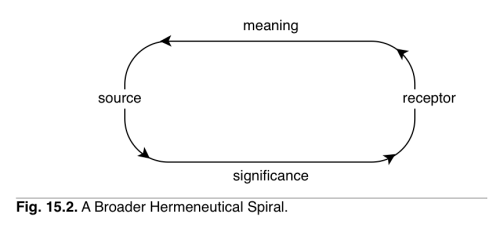
Here the receptor culture/interpreter goes to the source/Scripture to determine its meaning. This is the goal of the first spiral (figure 15.1). The source then yields not only meaning but significance (324).
So, the idea is that there are various smaller spirals or spheres that combine into a larger, total spiral, something like the the moon spinning around the earth, spinning around the sun, spinning around the galaxy. In other words, we are dealing with a variety of dynamic interactions; the model’s first payoff is an appreciation for the inevitable complexity of interpretation. We have, in the first place, to set aside romantic notions of simplicity as we approach this ministry. They only blind us to the forces at work upon individual interpreters and their communities.
For Osborne, the smaller spirals are exegesis (interplay between semantics, grammar, syntax, history, culture, composition, genre), biblical theology (interplay between unifying themes, diversity, preunderstanding, historical theology, methodology), systematic theology (interplay between tradition, experience, community, philosophy), and homiletics (interplay between principlizaiton, current situation, application-making, and rhetoric). These are well-known categories, so the value added is really found in (a) the comprehensiveness of his overview and (b) the model of interaction proposed.
The basic problem is that, despite the description of a spiral, the process Osborne lays out seems very linear (“In one sense they flow in a straight line in the order presented here,” 267). Two of his diagrams are indicative: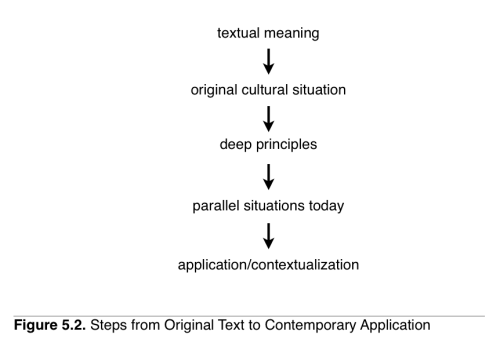

He is attempting to move known descriptions of a hermeneutical “circle” to something that has a progressive (spiraling) movement, as one sphere of interpretation (small spiral) refines another, and so on. What he really has in mind, however, seems to be an interaction in which (1) historical-critical methodology corrects theological presupposition, (2) the whole canon (his analogia scriptura) corrects erroneous conclusions that single passages might generate, and (3) traditional consensus corrects erroneous conclusions that historical-critical excesses might generate. There is certainly circularity to this, as the traditional consensus is often the substance of theological presupposition, but none of these checks and balances are novel. Moreover, Osborne is really concerned with a process that gets from point A (exegesis) to point D (homiletics), and I find no indication that the spiraling continues from there. That is to say, his proposal is actually a spiral that stops at application.

The process starts over rather than continuing on—contextualization plays no positive role in relation to the spheres of of exegesis, biblical theology, and systematic theology in subsequent iterations of the spiral. The movement from exegesis to application-making is repeated over and over, meaning that there is a continual challenge from fresh exegesis to presupposition and from tradition to fresh conclusion—which is healthy—but the spiral is broken. There is a strong separation between the context considered in homiletics and the objective meaning (exegetically determined) that is the basis for biblical theology and systematics. In this sense, the process is far more unilateral than the spiral metaphor suggests—that is, from homiletics Osborne does not truly circle back to exegesis. It will be necessary to discuss this observation more below in contrast to the spiral I have in mind.
Osborne’s Critical Insight for Missional Hermeneutics: The Place of Contextualization in Theology
What most excited me about the book was the table of contents, because it includes near the end a chapter entitled “Homiletics I: Contextualization.” I was already firmly convinced of two things when I started the book. One, contextualization needs to be understood as an essential aspect of all biblical interpretation. Two, homiletics has long failed to recognize its place as a mere subspecialty of the larger theological discipline of contextualization and, subsequently, failed to practice this essential aspect of biblical interpretation, resulting in a phenomenon of widespread hermeneutical deficiency in American pulpits (and probably other contexts as well). So, I was hopeful that the book would work to this vital point and offer some significant correctives.
While it turns out that Osborne had the insight to recognize the need to bring the missiological discussion of contextualization into the mainstream of biblical interpretation—a critically important move in and of itself—he conceptualizes contextualization very badly and does not capitalize on all it offers the hermeneutical spiral. On one level, he simply misdefines contextualization; on another, his conservatism denies contextualization the theologically generative power it offers. It is this prohibition that breaks the spiral, as contextualization is not allowed to create significance that may then spiral back to the text.
Concerning his definition, one of the most bewildering aspects of the book is his equation of both systematic theology (294, 297, 309) and homiletics with contextualization. Furthermore, both uses of contextualization are wrongly defined. The former does not even refer to what is now called a “contextual theology,” which goes a great deal further than Osborne’s notion of merely shuffling or augmenting the theological topoi of Western systematics and updating the language for a “modern” (294) or “contemporary” (305, 309, 316) context. The latter actually reduces contextualization (and so homiletics) to de-culturizing a text so that it can be principlized and then concretely applied (i.e., he believes contextualization and application are synonymous).
This “application/contextualization” is where he discusses the meat of the significance-generation that hermeneutics aims for, but for Osborn it is controlled by an overwhelming defensiveness against letting the context have “hermeneutical control” (335; cf. the “crux” discussed on 322). Rather, the processes that he appropriates “contextualization” to describe are an exercise in avoiding hermeneutics when possible (i.e., stick with “meaning” if at all possible, foregoing the need for “significance”). This is symptomatic of the common conservative a priori commitment to the perspicacity of Scripture, which is usually expressed in terms of Scriptures self-evidently “universal truths.” In other words, there is much we do not have to think about contextually, because it is the same for all contexts. This universality is the ideal for such interpreters. All that remains are the passages too deeply encased in their cultural or situational particulars to be of immediate use (application). Therefore, the movement from meaning to significance reduces down to the tiresome conversation about what is “cultural” and what is not. The passages deemed “cultural” are dealt with by an astoundingly simple process of principlization (my word for it), whereby the “content” of those not-universal bits is recast propositionally and therefore universally, ready for application in any context—it is only cultural “form” that varies in Osborne’s “evangelical contextualization” (319-21, 325-26).
The difficulty with this procedure is exemplified in what Osborne calls “extended application” (259)—applying the “principle” of a passage to a situation that is not closely parallel to that passage’s own situation. He, like other conservatives (e.g., Fee and Stuart), warns against extended application. The impulse to apply a passage only to supposedly similar situations (333-35, 345-46, among many) is symptomatic of the anxiety about making passages say something they do not, which is natural to both the conservative and the committed exegete (Osborne is both). But hermeneutics, which ultimately seeks to move from meaning to significance, is about finding the significance of Scripture for radically different contexts. We do not actually need to interpret the Bible if passages either mean just what they say or supply applications that simply require imitation in parallel situations. Exegesis is enough, in those cases.
Yet, in fact, limiting the significance of Scripture to situations similar to those recorded in Scripture is, in a deeply ironic way, a denial of its universality. We need a hermeneutics that is not so fixated on reducing the distance between meaning and significance. While we do not want to make Scripture say what it does not, that is hardly grounds for a hermeneutics that operates on the assumption that distance is bad and to be avoided when possible (which implicitly casts the entire interpretive enterprise negatively). The existence of distance between meaning and significance does not inevitably lead to discontinuity. Rather, it calls for a hermeneutics that can legitimately deal with the distance as distance. In other words, whereas one hermeneutics attempts to reduce the distance between meaning and significance, another hermeneutics attempts to accept it as natural, traverse it, and discover continuity. I am advocating the latter as a positive, creative endeavor that corresponds to the church’s image-bearing vocation and as the only viable option for a missional church. It is not without risk, but fear is not its controlling characteristic.
Now I need to look more closely at Osborne’s limited hermeneutic of principlization. One way to come at it is to consider its assumption about the function of Scripture, which is also to consider the real operating assumption of conservative Christianity. The assumed function is to provide guidance, which may instruct, incite, or prohibit. This is why Osborne often refers to the result of his hermeneutic as “command” in the discussion of principlizaiton, even though one would expect command to be too narrow a category for discussing every result of a hermeneutical spiral. His hermeneutical process functions to produce applications, that is, specific commands that tell the interpreter what to do in a given situation. This is, for him, Scripture’s ultimate function. (In this sense, even instruction about truth is the command to believe that truth, which suggests how doctrinal error is perceived among conservative Christians: to believe falsely is to break a command.) This is the basis for what I refer to as the taxonomy of distanciation that frames Osborne’s hermeneutics. Because Scripture’s function is to tell me what to do, I simply do anything in Scripture that can be done immediately in my culture and situation. I do not need to move from meaning to significance in such passages in order for Scripture to function as it should. In other passages, I do need to move from meaning to significance, because I cannot (or should not) simply put the explicit command into practice in my situation. In these cases I principlize, which renders the command.
The purpose of taxonomies of distanciation, then, is to classify types of passages, in order to determine which ones actually need a hermeneutical movement from meaning to significance. Interestingly, Osborne rejects a couple of taxonomies of distanciation proposed by Charles Kraft (who, as an “ethno-theological anthropologist,” is a negative foil for Osborne, despite still working on the same assumption):
In applying [his] theory Kraft finds three types of passages in Scripture (1979:139-43): (1) culture-specific commands, which are completely tied to the ancient culture and must be altered to fit the current situation (such as head-covering on women, 1 Cor 11:2-17); (2) general principles, which apply ethical truths (such as “Thou shalt not covet,” Ex 20:17) that transfer directly from culture to culture; and (3) human universals, which automatically transcend their own cultural context and are mandated in every age (such as love of God and neighbor, Mk 12:29-31). The latter two types of commands do not need to be contextualized, while the former does (322).
Astoundingly, Osborne’s complaint with this taxonomy is that “there is too little left of the text when Kraft finishes, too little that is supracultural. The Bible as he sees it is too culture bound, with too little theological truth that carries over.” Kraft has only one category that requires contextualization, but that is too much. Rather than simply developing a hermeneutics that deals with category (1), however prolific it is, Osborne fights for a hermeneutical a priori that wants to reduce the need for hermeneutics as much as possible. He would rather have supracultural theological truth that carries right over without the need for the full hermeneutical spiral.
Osborne shortly returns to another articulation by Kraft, which he also rejects:
Kraft argues for a “dynamic equivalent” approach and believes that the key is the specificity of the command (1987:357-67). As the level moves to the more specific the command becomes more culture-bound as the product of “Western thinking.” He proposes three levels of abstraction: (1) the basic idea level, which is the most general category and therefore is true for all cultures; (2) the general principle level, which is true in all cultures but may be interpreted differently; and (3) the specific cultural form, which differs between cultures. The basic ideas would be those supracultural commands such as love for one’s neighbor (Mt 22:39) or the need for proper order in church (1 Cor 14:40). The general principle would be the command not to steal, a sin against your neighbor. The specific cultural form would then be the command for women to pray with heads covered, as in against proper church order (328).
The taxonomy that Osborne advocates is that of J. Robertson McQuilkin:
McQuilkin names three ways we can determine a “generic principle,” a biblical standard that applies to later situations (1983: 258-65): (1) it might be stated directly in the text, as in “You shall love your neighbor as yourself” (Lev 19:18; Mk 12:31); (2) in historical portions it might be implied on the basis of the text’s explicit interpretation of the event, as when Scripture itself commends the occurrence (such as the “thesis paragraph” on early church life and worship in Acts 2:42-47); (3) it may apply indirectly in terms of general principles rather than specific situations if the cultural/supracultural indicators so dictate (such as the holy kiss being the same as the loving greeting in Christ). Many historical passages, especially Old Testament stories, apply only indirectly to us . . . . In such cases we must search for the parallels or “implications” for us today (346).
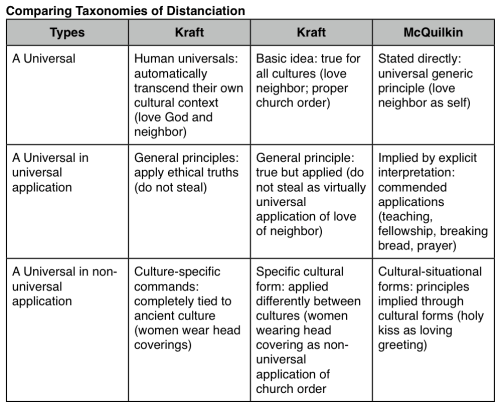
I’m sure this figure indicates clearly that I think there is no real difference between what Osborn advocates and what Kraft proposes. All of the above assumes that everything in Scripture is universal, though some (and quantity is the real disagreement) is encased in non-universal forms. In other words, all of these taxonomies presuppose that the goal is to figure out the universal commands and applications that contemporary Christians need to do, which Scripture serves to provide, whether directly or indirectly.
The key to this part of Osbornes methodology is the phrase if the cultural/supracultural indicators so dictate, found in his description of McQuilkin’s meaning. This phrase references the hermeneutical model he lays out for deciding whether a particular command is normative or cultural (328). The four-page model constitutes his actual methodology for determining which parts of Scripture are not immediately universal, and it is akin to other conservative proposals (again, see Fee and Stuart for the most well-known). The entire procedure, therefore, begins with the assumption that, if possible, the Christian should literally obey or imitate the command/principle/form of Scripture. The purpose of the full hermeneutics is to address the ensuing doubt about the appropriateness of such literalism—that is, to examine the indicators and make a judgement as to the degree of immediate universality. From a historical vantage, one can make the general observation that conservative churches tend to start on the side of literalism and gradually work through the indicators of certain topics to arrive at less literalistic, more diverse practices and forms. Osborne’s hermeneutical paradigm is made to facilitate that process rather than challenge it starting point.
I still have not discussed Osborne’s methodology for actually moving from meaning to significance—for determining implications for us today—once the examination of indicators has ruled a passage cultural, which is rather significant for this scheme of things if we affirm, once more, that hermeneutics is essentially concerned with that movement. To restate, Osborne thinks of this in terms of principlization, because the principle spans the gulf between the past and the present, with a truth that is relevant to both (345; quoting Roy Zuck). He conceptualizes principles in terms of Charles Taber’s and Eugene Nida’s use of transformational linguistics, which yields deep structure—meaning principles in Osbornes usage. As it turns out, though, the back-transformation to the kernel level of meaning is merely a matter of informed syntactical analysis and restatement (94-96; cf. 333). Osborne is well aware of the complexities of this and related fields, as he demonstrates mastery of a vast amount of literature and grapples instructively with issues of meaning in contemporary philosophy (not least in the book’s two appendices). Yet, at the end of the day, he demonstrates that he, though aware of said perspectives and complexities, still opts for a fairly simple theory of correspondence. It is to this theory that he turns when it comes to principlizing cultural-situational bits of Scripture.
To sum up, Osbornes hermeneutics basically has two primary movements: (1) determine whether a passage is immediately universal or not; (2) if universal, apply concretely; if not, principlize, then apply concretely. Both of these steps depend on thoroughgoing exegesis (chs. 1-12 of 16) and a critical realist approach to authorial intent (meaning).
Toward a Fuller Hermeneutical Spiral
I share some basic commitments and starting points with Osborne, which is why I find working through his book so fruitful. Perhaps most basically, I too begin with an approach that is broadly critical realist. I believe authorial intent is accessible, and my hermeneutics is a quest for genuine continuity between meaning and significance. Moreover, I am seeking a full-orbed methodology for dealing with the biblical text, in part and in whole. The realist part of my approach finds expression in an equal advocacy of exegesis as essential to Scriptural interpretation, and I find little to critique in Spiral’s first twelve chapters (though certainly some particulars are debatable), which are an introduction to exegetical methodology. The critical part of my critical realism, though, expresses itself more strongly than Osborne’s. This is the root of much of what I will say in my proposal of a fuller hermeneutical spiral.
Of the issues I would like to discuss, which are all related in my thinking, it is easiest to begin with Liberation Theology, because it is something of a whipping boy for Osborne. Liberation Theology’s greatest contribution to hermeneutics is a simple principle: praxis before theory. Yet, it is not so general as that; it is embedded in a theological commitment: God’s preferential option for the poor. Liberation Theology understands Scripture itself to be the basis for beginning with a preferential option for the poor, so there is something of a chicken-egg issue here, but the point is that it is not an unfounded a priori. Perhaps it is helpful to say that in Osborne’s terms, Liberation Theology finds Scripture quite perspicacious in regard to God’s preferential option for the poor, so that the text clearly provides it as a methodological starting point for hermeneutics. The community’s engagement with the poor (praxis) precedes further theologizing (theory). The experience of solidarity with the poor is intended to shape perceptions of the text. Thus, it is a subjective norm injected into the hermeneutical spiral, which causes great alarm for Osborne, who wants to maintain a place for the text as the objective control over subjective experience.
The anxiety created for Osborne is the usual conservative reaction to Liberation Theology and other advocacy perspectives (Black, Feminist, etc.). The agenda, it is feared, will make the text say what it does not. Though there is a place to mention preunderstanding and experience in Osborne’s scheme, and his grappling with the literature causes him to admit they are not forces to be glossed over, the exegetical process he advocates is assumed to be sufficiently objective to provide a methodological control over those biases. This is, for him, the essential purpose of the spiral—the exegesis checks the preunderstandings affecting biblical theology and the experiences and traditions affecting systematic theology. In fact, he minimizes experience and tradition more than the broad Protestant tradition, for he says that they are not norms: “The important thing to keep in mind is that there are not several norms (Scripture, experience, tradition, philosophical speculations) but only one final source of revelation, the Word of God” (298).
Yet, these have usually been thought of as norms that are normed by Scripture, which is the norming norm (norma normans). The wording of the quotation hints at the real operating assumption in Osbornes spiral, however, which is that a norm is considered to be revelation. In other words, we are dealing with an epistemological concern. Osborne is ultimately after revealed principles and commands based upon an epistemologically foundationalist approach to Scripture, meaning that other norms threaten to compete for status as foundation (revelation). Note the language of the following quotations:
Liberation theologians ask the right questions but arrive at the wrong answers. There is no doubt that community and context play a significant role in theological formulation. The issue is whether this aspect is formative or supplemental. I would argue that the community’s situation influences but does not determine theological decisions (294; emphasis added).
It is quite clear that the relationship between the five components above [Scripture, tradition, community, experience, philosophy] depends in large measure upon where one places the locus of revelation. If the theologian locates it in tradition as well as in Scirpture (the classic Roman Catholic view), the resultant dogma will be dependent on the church’s magisterial decisions. If one makes the current context (community and experience) revelatory (as in liberation theology), then the present situation will determine the shape and thrust of the theology (299; emphasis added).
[Liberation theology’s] theologian’s evaluation of context is certainly correct—the economic oppression of the poor, the misuse of Scripture by the wealthy to keep the poor content to wait for their reward in heaven and so forth. They also correctly note the strong emphasis on care for the poor in the Torah, the prophets, Jesus’ teaching and the Epistles. However, when they give this context hermeneutical control over Scripture and turn even the cross into a protest against economic exploitation, they go too far (335; emphasis added).
To summarize, Osborne is not content that praxis (community experience) should be an epistemological foundation, as he perceives Liberation Theology to employ it. Praxis should not affect the content of principles, which are only to be derived exegetically and syntactically (back-transformation). The context of praxis merely affects the form in which those principles are restated (forward-transformed).
These considerations bring me to make three affirmations in departure from Osbornes basic paradigm:
- Scripture’s epistemological function is that of a metanarrative that corresponds to reality rather than that of a propositional foundation that provides truth claims.
- Biblical theology renders that metanarrative, which may be understood in terms of biblical worldview.
- Contextualization is the intentional dialogue between the biblical metanarrative and the metanarrative of another worldview.
Scripture’s Epistemological Function
I take my cue from George Lindbeck’s The Nature of Doctrine. While there has been thoroughgoing evangelical critique of postliberalism, I believe postliberalism as a whole is quite different than the substance of Lindbeck’s seminal work, as I have discussed in a paper available here. As demonstrated in that paper, because I believe the distinction Kevin Vanhoozer draws between his own proposal and Lindbeck’s is perceived rather than real, I can also point to Vanhoozer’s The Drama of Doctrine as indicative of my thinking and, indeed, Vanhoozer does even more to develop the sort of hermeneutic Lindbeck and peers allowed many to begin imagining.
The basic point here, regarding Osbornes limited spiral, is that it is limited first because of the assumed function of Scripture. To use Lindbeck’s categories, Osborne perceives Scripture in cognitive-propositional terms. This boils down to an epistemology that takes Scripture to be a storehouse of truth. It is a source of epistemologically foundational propositions, which it exists to dispense, thus his hermeneutic intends to make those available.
Lindbeck conceives of Scripture as story, and although the story as a whole or system corresponds to reality—is true (again, see my paper linked above)—it does not function primarily to provide foundational propositions. Rather, the story absorbs the world, and living from within it the church is able to articulate understandings (among other activities) that cohere with the story. These articulations are second-order, which means that they do not correspond with reality as the story itself does. Rather, they are intended to cohere with the story as much as possible, recognizing that their coherence may be challenged at some point and eschewed in favor of more cohesive articulations. It is important to note that this way of conceiving doctrine (the articulations) is largely motivated by the desire to account for major shifts in understandings of fundamental doctrines that were at times claimed to correspond directly to reality—to be indisputably true, not to mention essential to Christianity (e.g., justification; Lindbeck deals with Catholic and Protestant disagreements and subsequent agreements, but at this point the New Perspective on Paul may be mentioned to make the point all the more forcefully).
Metanarrative has become a common way of describing such accounts of reality as Lindbeck claimed Scripture to be. Therefore, because I advocate this construal of Scripture’s epistemological function, I refer to it in terms of metanarrative. Yet, there is an important caveat here: Scripture per se is not a metanarrative; rather, it gives witness to and reveals one. Its range of genres and diversity of perspectives combine into a whole that implies the metanarrative. It is the job of biblical theology to render that metanarrative to us.
Biblical Worldview
While biblical theology is recognized as a particular theological discipline, I prefer to conceive of exegesis and biblical theology as a coextensive interpretive movement called theological exegesis (which is also known terminology). Thus, while we can talk about the two separately, biblical theology cannot exist without exegesis, and for hermeneutical purposes exegesis is incomplete without biblical theology. Incidentally, I seem to be in agreement with Osborne here (the two are interdependent, 265). The short of it is that theological exegesis puts together the parts of the story so as to tell it in terms of its inherent meaning as a whole. If exegesis of a passage is interested in authorial intent, biblical theology is interested in metanarrative intent.
This synthetic description is itself second-order, but it can be extremely fruitful as the starting point for analyzing the worldview that corresponds to the metanarrative. Some would actually talk about worldview and metanarrative synonymously. Yet, while that equation is elementally correct, we can gain much more hermeneutically by considering worldview analytically from the perspective of anthropology (I rely heavily on Paul Hiebert’s Transforming Worldviews for my thinking here). And it is within missiological anthropology that we find an understanding of contextualization that moves far beyond Osborne’s superficial use of the term. Contextualization is, in fact, where worldviews collide.
Osborne points toward this function of biblical theology in relation to biblical worldview, though with a less developed conception of worldview, it seems. He refers to biblical theology’s concern with the thought patterns of the biblical period, which evokes one facet of worldview (266). Yet, his basic idea of biblical theology collating the data of exegesis and his topical emphasis on unifying themes is not actually conducive to describing a worldview. Moreover, he is sympathetic with the desire to avoid a romantic tendency to canonize biblical thought patterns, as if the modern person should think like the ancient Hebrew (278). This is a legitimate concern, for which my viewpoint will have to give an account, but it is also indicative of Osborne’s disinterest in a biblical worldview per se. At the same time, his reference to worldview in the chapter on systematic theology affirms that theology transforms the biblical worldview into a coherent and relevant worldview for the contemporary setting (296; summarizing Vanhoozer, let it be noted!). And along lines similar to what I will say below, he says:
Contextualization is the second half of a unitary hermeneutical journey from meaning to significance as the Word of God is actualized in human, cultural experience.
This does not mean that the interpreter can move behind his own preunderstanding to meaning, as if we can leave our own cultural history and move solely into the biblical world to objective knowledge. As Dietrich asserts, “Any theology is necessarily contextual. Therefore it will be more honest the more it becomes conscious of its context.” Within a proper hermeneutical spiral, the biblical worldview highlights our own and enables us to place our belief system in front of the context for challenge or (if need be) correction (335).
I find this to be very well stated. It must be noted, however, that he continues:
Certainly, once we have explained the meaning of the text, we have already contextualized it to an extent. However, if the process of backward and forward transformation diagrammed above works (as I believe it does), then we can discover that transcultural meaning which bridges from the text to our context without violating the original meaning. In this way we bracket and transcend our preunderstanding, yet communicate properly to our own cultural context (334-5; emphasis added).
If I am reading Osborne correctly, in light of the whole argument of the book, the expectation that Scripture will render a transcultural, objective meaning (first-order propositional truth), which allows the interpreter to bracket and transcend preunderstanding, is what undermines contextualization as a hermeneutically generative force.
Contextualization
While there are a variety of understandings of contextualization in the literature, for now I will simply advocate my own conceptualization. Rather than being the use of cultural forms (in the case of ecclesiology or liturgy) or the use of cross-cultural communication (in the case of evangelization or teaching), I believe a more substantial idea of contextualization begins with worldview, of which forms or language are merely expressions (and are therefore secondary, though important). Contextualization is the process whereby a an explicated worldview is strategically confronted with the biblical worldview. This needs some unpacking.
Worldviews consist of unconscious assumptions. They are very rarely explicit or conscious, though they can be explicated. Likewise, the biblical worldview is implicit in the expressions of Scripture.
Biblical theology reconstructs the narrative, which begins the process of bringing vital assumptions to the surface, but theology as a whole is about further explication: (1) making explicit what is implicit (not stated theologically in the text) and (2) then working out further implications of those assumptions. This resonates deeply with Lindbeck’s conception of doctrine (theological statements) as a cultural-linguistic system. He is, of course, borrowing from some of the linguists and philosophical anthropologists who have shaped the study of worldview, so the continuity is natural.
I am merely attempting to make the connection between what happens in contextualization and what happens in all theological formulation: the revision of a cultural-linguistic system that is attempting to cohere with the worldview to which Scripture gives us access, though always in dynamic tension with the worldview in which the theologian lives and speaks. That dynamic tension is hermeneutically generative of implications that are not available to other contexts from within their particular encounter with the biblical worldview. To say that all theologizing is done in tension with the theologian’s worldview is to say, in one sense, that all theology is necessarily contextualization. The difference is that contextualization as a discipline is done with intentionality. Contextualization attempts to deal with this cultural locatedness explicitly, in order to recognize theological implications as culturally appropriate, cohesive articulations.
Thus, theological discourse about the ways in which the biblical worldview confronts or affirms another worldview’s assumptions is contextualization. In confronting or affirming, contextualization entails a process of discerning the implications of the biblical worldview for the way of life predicated on the culture’s worldview. These implications can be stated theologically (propositionally). Contextualization, then, is the process of facilitating conscious worldview transformation. Stated in different terms, contextualization facilitates the appropriation of or absorption by the biblical metanarrative. This can be done to a limited extent by simple rehearsal of the biblical text, which gives the reader access to the world she may then begin to inhabit. But to call contextualization facilitation is a tacit admission that explication is often necessary, because the assumptions of both the biblical worldview and the cultural worldview can remain hidden, which is what often leads to syncretism. That is to say, theology—evangelizing, teaching, preaching, counseling, praying, worshiping, and so on—serves to help create the language (cultural-linguistic system) by which a culture can deal with those assumptions explicitly in ways that cohere with the biblical worldview, which facilitates the worldview transformation of disciples. It is critical to emphasize, however, that that theological cultural-linguistic system can only ever be formed from within the culture, in its own language, which is deeply rooted in its original worldview. This is the generative dynamic, and it is what cannot be bracketed and transcended. It is also the reality that precludes worldview transformation from meaning “cultural imperialism,” because the biblical worldview does not replace but rather shapes—challenges and affirms—the cultural worldview without interest in uniformity (more on which in the next post).
To conclude, one more quote will clarify why it is that Osborne does not conceive of contextualization as a generative interaction between two worldviews:
I believe that philosophy works functionally in terms of reference rather than empirically in terms of sense data and so we must consider religious statements in terms of a metaphysical world view rather than in terms of positivistic empiricism. This metaphysical world view is fact-oriented rather than logic-oriented and proceeds on the basis of ontology rather than on logical necessity. Paradigm communities critically interact on the basis of the criteria of adequacy and coherence, testing their truth claims. The Bible, seen as a revelatory communication from God, makes all this possible, for it provides the objective data for judging these truth claims (405; emphasis added).
While I agree that it is a worldview functioning in ontologically referential terms that provides the proper context for religious statements, I do not believe that fact-orientation is the best way to conceive that worldview, because the Bible’s revelatory capacity is not the provision of objective data than can fill in as those facts. Its revelatory capacity is that through contextually-specific lived appropriation of the biblical worldview—which is ontologically true as metanarrative—we may make ever more cohesive, adequate religious statements. Consciousness of this dynamic is far less ghettoizing for a given paradigm community (cultural-linguistic context) than the presumption of access to objective data; it fosters inter-paradigm discourse and discernment, which reiterates again and again the generative cross-cultural interaction between worldviews seeking to speak cohesively about the common biblical narrative.
Okay, that about does it for discussing Osborne in particular. I’m going to stop here and pick up my discussion of the spiral in the next post, where I will attempt to reconceive it in terms of ongoing discussions about missional hermeneutics.
George Lindbeck, The Nature of Doctrine: Religion and Theology in a Postliberal Age
Gordon Fee and Douglas Stewart, How to Read the Bible for All It’s Worth
Grant Osborne, The Hermeneutical Spiral: A Comprehensive Introduction to Biblical Interpretation
Kevin Vanhoozer, The Drama of Doctrine
Orlando Costas, Liberating News: A Theology of Contextual Evangelization
Paul Hiebert, Transforming Worldviews: An Anthropological Understanding of How People Change

 Scripture & Mission