Are Churches of Christ Evangelical?: A Pragmatic Cultural Question (Part 4)

Worldview

If we can establish a legitimate basis for analyzing similarity and dissimilarity, it becomes feasible to answer the question at hand with more than surface-level comparisons. Because worldview is often the basis of comparison in the relevant literature, a meaningful model of the concept can provide such a basis. For easier (though not easy) reading, I have broken my discussion of worldview into four separate posts.

On Worldview 1 (Missiological Anthropology)

On Worldview 2 (Philosophy)

On Worldview 3 (Wittgenstein/Pragmatism)

On Worldview 4 (A Provisional Model)

Back to the Question at Hand

The implication of a well-formed conception of worldview is twofold.  First, the reductive contrast of Barton Stone’s and Alexander Campbell’s worldviews or of Churches of Christ’s and evangelicals’ worldviews is probably doomed to topple under the weight of scrutiny.  I submit that examination of multiple dimensions of the conflicted and contested Protestant American worldview at work in both evangelical churches and Churches of Christ will reveal far more similarity than dissimilarity and that the dissimilarities will not be sufficient to make a fundamental distinction between the two groups.  Second, the similarity of worldview contains the two groups in the same stream of theological semiosis, with the same present struggles and needs.  More on the two groups’ identities to come.

On Worldview 3 (Wittgenstein/Pragmatism)

Wittgenstein, Weltanschauung, Weltbild, and Wherefore Pragmatism

There is much to say about what Danièle Moyal-Sharrock calls Wittgenstein’s “logical pragmatism” in relation to missional theology (Moyal-Sharrock).  I will mention only some starting points for the present discussion of worldview.  Though Wittgenstein was cautious about Weltanschauung (worldview), the concept of Weltbild (world picture) was critical for his philosophy.  Naugle explains succinctly:

Wittgenstein is apparently content to label his philosophical outlook a Weltbild or world picture, but to call it a Weltanschauung is unacceptable. The reason for this, in Judith Genova’s opinion, is that for Wittgenstein “a Weltanschauung forgets its status as a way of seeing and parades itself as the way of seeing. It takes itself too seriously, as the ultimate explanation and foundation of our convictions. In contrast, the concept of Weltbild completely avoids the knowledge game.” This is the very game that Wittgenstein sought to avoid. He recognized that his own philosophy could be interpreted as another system of thought that seeks to get the world right. (Naugle, locs. 2045-2048)

The point for the present discussion is that Wittgenstein’s critique of worldview was contextual and particular.  It was contextual in that he rejected some popular early twentieth century ideas of worldview; if he were alive today, distance from “worldview” for this reason is unlikely, not least because his own philosophy has helped evolve the concept.  It was particular because he was at pains to achieve a kind of meta-description of philosophies, which were themselves articulations of worldviews in that early sense of the word.  Whereas worldviews were overtly explanatory, his aim was to be merely descriptive, specifically describing how those explanatory systems actually work in human thought and language.  Yet, Naugle is right to identify Wittgenstein’s work as deeply resonant with current conceptualizations of worldview.  Sire concludes, “world picture as he uses the term seems synonymous with worldview” (though Sire rejects Wittgenstein’s views because Sire’s ontological priority demands the explanatory foundationalism that Wittgenstein finds irrelevant to his descriptive project) (Sire, 30).  Even within Renata Badii and Enrica Fabbri’s recent thesis that Weltbild and Weltanschauung, “although they belong to the same family, cannot be nevertheless superimposed one on the other and need to be reconstructed in their singularity as well as in their reciprocal connections” (Baddi and Fabbri, 5), the distinction is possible only by virtue of the definition of worldview that one adopts.  Naugle’s definition is the case in point:

Consider for example the definition of Weltanschauung-worldview proposed by Naugle: “I will also propose that a worldview as a semiotic structure consists primarily of a network of narrative signs that offers an interpretation of reality and establishes an overarching framework for life”. As we shall see, the same function can be attributed to a Weltbild, so one can question what the difference between the two concepts actually is. (Baddi and Fabbri, 5, fn. 4)

They go on to say:

The relevance of Weltbilder for practical conduct and their pragmatic function are underestimated by the semantic approach used by Naugle in his definition of worldview: “A worldview as a semiotic system of world-interpreting stories also provides a foundation or governing platform upon or by which people think, interpret, and know”. In our opinion, this definition should be integrated with a direct reference to action. (Baddi and Fabbri, 9, fn. 8)

I fully agree, but this is a weakness present in Naugle’s definition at the beginning of chapter ten, though not in the second iteration at the end of chapter ten, which I quoted earlier: “a semiotic system of narrative signs that creates the definitive symbolic universe which is responsible in the main for the shape of a variety of life-determining, human practices” (Naugle, locs. 4384-4386).  Moreover, it is not present in either Hiebert or Sire, much less in Olthuis, who directly integrated Wittgenstein’s Weltbild.  Given that Naugle’s second articulation is also connected with Wittgensteinian “channels,” the critique is even less substantial.

It is to these channels and their connection to pragmatism that I now turn.  As a preliminary matter, is necessary within a theological context that is accustomed to a derogatory usage of “pragmatism” to clarify what is at stake here.  Pragmatism, in philosophical usage, should not be confused with utilitarianism (the end justifies the means).  Nor should it be reduced to an epistemic criterion that is only interested in what is functional.  Wittgenstein himself denied being a pragmatist, explaining, “For I am not saying that a proposition is true if it is useful” (RPP 266).  But it is despite this understanding of pragmatism that Wittgenstein has been shown to have deep affinities with pragmatism.  Hilary Putnam says that when Wittgenstein’s ideas sound like pragmatism, “it is not the mythical pragmatism (which the real pragmatists all scorned) which says ‘It’s true (for you) if it is good for you'” (Putnam, 51).

Specifically, the connection to William James is important, because it is precisely in the metaphor of “stream” and “channel” that Wittgenstein is in conversation with him (Boncompagni, 2012a, 36–50).  That is, just at the articulation of his conception of Weltbild, which is a vital insight for our understanding of worldview, a pragmatic philosophical element is at work.  By exploring this connection, I think it is evident that worldview should be pragmatically conceived.

Wittgenstein’s description of language results in a “pragmatic philosophical anthropology” (Pihlström, 16).  This is, in my view, the ground on which the anthropological and philosophical notions of worldview meet, and pragmatism is the bond that unites them.  I suggest that Wittgenstein’s logical pragmatism offers two foundational insights for conceptualizing worldview.  One, worldviews are epistemically neutral.  Two, worldviews are formed and transformed—and by implication, judged—on a pragmatic basis.  The key pericopes from On Certainty are as follows:

94. But I did not get my picture of the world by satisfying myself of its correctness; nor do I have it because I am satisfied of its correctness. No: it is the inherited background against which I distinguish between true and false.

95. The propositions describing this world-picture might be part of a kind of mythology. And  their role is like that of rules of a game; and the game can be learned purely practically, without learning any explicit rules.

96. It might be imagined that some propositions, of the form of empirical propositions, were hardened and functioned as channels for such empirical propositions as were not hardened but fluid; and that this relation altered with time, in that fluid propositions hardened, and hard ones became fluid.

97. The mythology may change back into a state of flux, the river-bed of thoughts may shift. But I distinguish between the movement of the waters on the river-bed and the shift of the bed itself; though there is not a sharp division of the one from the other.

98. But if someone were to say “So logic too is an empirical science” he would be wrong. Yet this is right: the same proposition may get treated at one time as something to test by experience, at another as a rule of testing.

99. And the bank of that river consists partly of hard rock, subject to no alteration or only to an imperceptible one, partly of sand, which now in one place now in another gets washed away, or deposited.

***

341. That is to say, the questions that we raise and our doubts depend on the fact that some propositions are exempt from doubt, are as it were like hinges on which those turn.

342. That is to say, it belongs to the logic of our scientific investigations that certain things are in deed not doubted.

343. But it isn’t that the situation is like this: We just can’t investigate everything, and for that reason we are forced to rest content with assumption.  If I want the door to turn, the hinges must stay put.

344. My life consists in my being content to accept many things.

Worldviews do not function as truth claims: they are epistemically neutral, neither true nor false in the epistemic sense.  Moreover, worldviews cannot be justified; they are the assumptions that make the language game of justification possible.  Anna Boncompagni identifies the function of Weltbild as “common sense,” calling to mind a significant concern of both Churches of Christ and evangelical theology: Common Sense Realism.  Wittgenstein identifies the function of Weltbild or common sense in human language without proposing any epistemic thesis.  A Weltbild is common sense because of the way it works vis-à-vis the language game.  It is not a self-evident proof of our direct access to what is real; neither is this neutrality to be mistaken for skepticism.  In fact, it demonstrates the “impotence” of skepticism:

Our relation to common sense propositions lying in the background of our picture of the world, is not epistemic, it is practical: our certainties are in actions, not in words; they are embedded, enacted, to use two very fashionable words for today’s philosophical debate. And it is precisely this practical character that enables them to defuse the skeptical objection: the skeptic’s doubt is an epistemic doubt, it deals with knowledge, not with this instinctive and thoughtless sureness. (Boncompagni, 2012b, 48)

Or as Moyal-Sharrock puts it:

Our objective certainty is not a coming-to-see type of certainty; it is not of the order of knowing, justification, reason or reflection, and is therefore immune to mistake, doubt, or falsification—for where no epistemic route was followed, no epistemic fault is possible. It is a nonpropositional, ungrounded certainty which manifests itself ineffably in what we say and do. To be certain, here, means to be unwaveringly and yet thoughtlessly poised  on something which enables us to think, speak or act meaningfully. That something is  grammar. Our basic  certainties are grammatical rules, manifesting themselves as a flawless know-how. The rules can be articulated into sentences, as exemplified above, but such articulation is effected only for heuristic purposes, such as philosophical discussion or grammatical instruction. Once verbalised, however, these rules of grammar misleadingly  look like empirical propositions—conclusions that we come to from experience. This  resemblance has confused philosophers, and disconcerts Wittgenstein himself throughout On Certainty.  And yet, he does come to the realisation that we have, yet again, been mystified by the appearance of language: “I am inclined to believe that not everything that has the form of an empirical proposition is one” (OC 308). It is On Certainty‘s greatest contribution to philosophy to have revealed the nonpropositional, nonempirical, nonepistemic nature of our basic certainties. Uncovering their grammatical status moves us to realise that our mistaking what are in fact rules of grammar for falsifiable propositions constitutes one of the greatest category mistakes of philosophy: that responsible for the apparent indefeasibility of philosophical scepticism. (Moyal-Sharrock, 4)

Thus Wittgenstein “deflates” the epistemic-ontological question:

Wittgenstein, true to his strategy of not offering “theses”, tries to convince us that there is no interesting thesis in this area [the Kantian assertion “we can’t describe the world as it is in itself”]. For Wittgenstein, the negation of a pseudo-proposition is a pseudo-proposition; the negation of  nonsense is nonsense. If we are persuaded that it is unintelligible to say “We sometimes succeed in describing reality as it is in itself”, then we should realize that it is equally unintelligible  to say “We never succeed in describing reality as it is in itself”, and even more unintelligible (more, because it introduces the peculiar philosophical “can’t”) to say “We can’t describe reality as it is in itself”. . . . We can learn and change and invent languages, and in them we can state truths; that is describing reality. If you say, “Yes, but it is not describing reality as it is in itself “, you are saying nothing. (Putnam, 39–40)

To recognize the relevance of these conclusions for the conception of worldview, it is necessary to remember the earlier discussion of epistemology as a component of worldview.  The realist epistemology at work in commonsense action is a hinge or channel, a rule of human life that forms part of one’s worldview, not a justified theory of knowledge.  Even after a philosopher articulates an epistemology propositionally in order to justify it, the epistemology remains a hinge assumption, the certainty of which can only be demonstrated by action.  The epistemologist has articulated the grammar by which true statements are made, but it remains functionally a grammatical rule despite its propositional form.  In effect, a realist epistemologist may say “I have succeeded in describing the reality of human knowledge.”  The sense of this description might be, for example, that a person does not walk into traffic because the nature of his relationship to reality is direct, commonsense perception.  The explanation of the person’s epistemic relationship to traffic, though, would be for Wittgenstein a statement of nonsense:

Wittgenstein says of  the sentence: ‘There are physical objects’ that it is ‘nonsense’. This is meant to indicate that  all hinges are nonsense. Indeed, hinges have no sense; they  enable sense. Nonsense is not a derogatory term for Wittgenstein; it is a technical term applied to strings of words that stand outside the bounds of sense. And strings of words can stand outside the bounds of sense either because (1) they violate sense, such as the negations of grammatical rules (e.g. ‘Red is lighter than pink’), or in that (2) they  enable sense, such as grammatical rules themselves (e.g. ‘Red is darker than pink’). Grammatical rules stand  outside our language-games; they make the game possible. They do not, as such,  bear saying within the  stream of the language-game but only in heuristic situations: that is, in situations where rules of grammar are transmitted (through drill or training) to a child, a disturbed adult or a foreign speaker; or in philosophical discussion. To articulate grammatical rules  within the stream of the language-game—that is, in the flow of ordinary discourse—is to articulate bounds of sense as if they were descriptions or informative statements. If I were to say to the cloakroom attendant as I hand him my token: ‘This is a token’, he would look at me  puzzled, nonplussed. Am I joking or slightly deranged? That ‘This is a token’ is not information for him, so why am I saying it? Nothing justifies my saying it. The information he requires in order to retrieve my coat is not that this is a token, but what the number on the token is. That this is a token is the ineffable hinge upon which his looking for the number on the token revolves. Our shared certainty that ‘this is a token’ can only  show itself in our normal transaction with the token; it cannot qua certainty be meaningfully said. To say a hinge in an ordinary context is to suggest that it does not go without saying; that it needs support, grounding, context. (Moyal-Sharrock, 6)

Like “red is darker than pink,” the next levels of analysis, such as why red appears darker than pink, or how we perceive the color, or whether we all really perceive the color as it is are also grammatical in nature and no less nonsensical: “Sceptical doubt as to whether the color we all call ‘red’ is red is incoherent” (Putnam, 35).  So with my example.  One kind of nonsense statement would be, “Those are moving cars.”  Another kind would be, “I know those moving cars will run over me because my perception of them corresponds to the laws of physics.”  The person walks into traffic, or he doesn’t.  If he doesn’t, the epistemic hinge on which his action turns certifies itself; his practical assumption is realism.  But there can be no propositional justification (nor, of course, propositional disproval) of realism as the “reality [of human knowing] as it is in itself.”

The upshot is that all epistemologies are hinges in the Weltbild—assumptions in the worldview.  They are one of the places where Wittgenstein would say, “If I have exhausted the justifications I have reached bedrock, and my spade is turned. Then I am inclined to say: ‘This is simply what I do'” (PI 217).  Of this realization, Olthuis says:

Finally here comes an end to our reasoning and we answer such end questions in terms of the affirmation and surrender of faith rather than in proof or demonstration.

It is not that such ultimate answers lack cognitive content. But on the ultimate level of faith, reason is impotent to determine what is true. At that level all the options are ultimates and there is no further standard or norm by which they can be assessed. There is no logical move that we can make to achieve an ultimate premise beyond doubt. (Olthuis, 5)

When it comes to theology, this understanding of worldview must apply to the ideas of revelation and inspiration as well, not to mention Common Sense Realism as it has been applied to the Bible in Restoration and evangelical interpretation.  Description of the inspiration of Scripture as epistemology is a grammatical claim, not to be mistaken for a truth claim because of its propositional form.  Of course it can be and often is made as a truth claim, but as such it is of the most circular order of claims: the church “knows” Scripture is inspired because Scripture claims to be inspired; the validity of the claim depends upon the assumption that Scripture is a way of knowing, which it is because of its inspired nature.  Even if we marshal a defense to “justify” belief in inspiration, making recourse to church tradition, adding an argument from historical reliability that brings us convincingly back to the words of the apostles or even the ipsissima vox of Jesus, and bolstering it with a reasonable apology for the resurrection of Jesus, our defense is not proof.  We have no way to demonstrate inspiration as a process or dynamic at work in Scripture.  Those (like myself) who employ it as an epistemology may have reasons for doing so but must ultimately trust it as a hinge, a fixed place on which other biblical theological truth claims turn.

Despite possible first appearances, this does not leave us in a state of absolute relativism.  Sire is wrong about the ontological priority, not because the being of God is not really first, but because his truth claim that ontology is first turns on a biblical epistemological hinge for which he can give no proof.  Sire himself is the case in point: he perceives ontology to come first because, within the functioning of his worldview, epistemology and hermeneutics actually come first.  Thus, a biblical worldview sees God’s being to have priority, but as worldview it only permits this realization to flow through  through epistemological-hermeneutical channels.  Yet, the relativism that Sire hopes ontological priority will defeat is not actually the consequence of this description of worldview:

Not only are there better or worse performances within a language game, but it is quite clear that Wittgenstein thinks that there are better and worse language games. . . .

Wittgenstein  inherits and extends what  I above called Kant ‘s pluralism; that is the idea that  no one language game deserves the exclusive right  to be called ” true”,  or  “rational”, or “our  first-class conceptual system”, or the system that “limns the ultimate nature of reality”, or anything  like that. Wittgenstein, so to speak, splits the difference between Rorty and Quine;  that  is, he agrees with Rorty, against Quine,  that  one cannot  say that scientific language games are the only language games in which we say or write truths, or in which we describe reality; but, on the other hand, he agrees with Quine as against Rorty that language games can be criticized (or “combatted”);  that there are better and worse language games. (Putnam, 37–38)

The evaluation of a language game (which, akin to culture, includes the Weltbild or worldview and the way of life it engenders) is bound up with the complex evaluative function of worldview, but Wittgenstein’s descriptive analysis asserts that fundamentally the plasticity of the bedrock, the formation or destruction of a hinge, is pragmatically determined:

The pragmatists—and, perhaps analogously, Wittgenstein—can be seen as offering us a new kind of metaphysics, one based not on the futile attempt to climb above our forms of life into a God’s-Eye View but on human practices and especially our practice-embedded ethical and more generally evaluative standpoints and considerations. (Pihlström, 16)

Rather than lay claim to a God’s-eye-view, for example, by asserting that the “biblical worldview” is true because God revealed it—a claim that cannot be proven by rational argumentation—the evaluation of the biblical worldview alongside another worldview must be an embodied evaluation:

The Weltbild concerns our “matter-of-course foundation” (which is deeper than a scientific foundation), and we learn it or swallow it when we are children, in our everyday activities and in our parents teachings and examples. We do not explicitly learn its contents and rules: we learn by doing, we are thought[sic] judgments and their connections with other judgments, and we begin following rules without being aware of following rules, to hold beliefs and certainties without being aware of possessing them. The Weltbild becomes natural, as natural as body movements or, on the other hand, linguistic behavior. This is the reason why to describe an encounter between two different world-pictures Wittgenstein does not use the words of rational argumentation, but those of persuasion, conversion, even combativity: when the bottom of beliefs is reached, no argumentative strategy is possible anymore, and to convince another person of our Weltbild, or conversely to change our own picture, means to change the way he or we see the world, to change perspective, ultimately to change the form of life (hence the ethical dimension of Wittgenstein’s thought on Weltbild and forms of life). (Boncompagni, 2012b, 47)

Consider also Putnam’s insight:

In the “Lectures on Religious Belief”, Wittgenstein makes it clear that he, standing outside religious language (or affecting to), cannot  say that religious  language  is cognitive or  non-cognitive; all he can say is that, from the “outsiders’ ” perspective,  the religious man is  “using a picture”.  But  he adds that in saying this he is not saying that the religious man is only using a picture, or only “expressing an  attitude”.  I take Wittgenstein  to be saying here that  (1) the possibilities  of  “external” understanding of a deeply different form of  life are extremely  limited; and (2) that religious claims are not simply badly formulated “empirical” claims.  Yet they are not rejected by Wittgenstein out of hand, as are metaphysical claims. So what  is going on?

It is here that I detect a moral as well as a philosophical purpose in Wittgenstein’s writing. Wittgenstein is urging a certain kind of empathetic understanding.  (As he explicitly does in  his  “Remarks on Frazer’s Golden Bough“.) Wittgenstein thinks that secular Europeans see all other forms of life as “pre-scientific” or “unscientific” and that this is a vulgar refusal to appreciate  difference. The reason I think that these concerns of Wittgenstein go to the heart of his philosophy is this: To me the remarks near the end of On Certainty about our relationship to other  forms of life, as well as the Lectures on Religious Belief  and the remarks on Frazer’s Golden Bough just mentioned, are a declaration that the language philosopher cannot qua philosopher tell us whether the putative “statements” made in a form of  life very different than the scientific are statements or not; I can say “I  would never talk like that”, or, on the contrary, I can make a form of life my own.  But this is not something that philosophy can decide for me. (On this interpretation, Wittgenstein’s rejection of metaphysics is a moral rejection: metaphysical  pictures are bad for us, in Wittgenstein’s view.) The question, the one we are faced with over and over again, is whether a form of life has practical or spiritual value. But  the value of a form of  life is not,  in general, something one can express  in the language games of  those who are unable to share its evaluative interests. (Putnam, 49–51)

Finally, Russell Goodman puts it this way:

On Certainty works within the framework of the Philosophical Investigations view that language takes the form of language games, which are complicated forms of living—including building, praying, telling jokes, reporting, and playing games (PI, 23). Within each practice, certain beliefs stand fast; and some beliefs stand fast for many, some perhaps for all, of our practices. It is not that these beliefs are “a priori true,” seen in a flash of insight into the nature of things, or a consequence of some definition we decide to adopt; they are off our routes of inquiry or investigation. Wittgenstein’s stress on action in making this point is especially pronounced at section 204 of On Certainty: “Giving grounds, however, justifying the evidence, comes to an end;—but the end is not certain propositions’ striking us immediately as true, i.e. it is not a kind of seeing on our part; it is our acting, which lies at the bottom of the language-game.” “Our acting” forms the background against which our language-games take shape. Our linguistic practices “show” the background against which they appear. But the background shows things on which these linguistic practices depend: “My life shows that I know, am certain, etc.” (OC, 7). In Wittgenstein’s later philosophy, as in this quotation, action and thought are intertwined, with each at times providing the background for the other.

Wittgenstein often speaks of the background as a set of “propositions,” and he also speaks of a “world-picture.” But equally often he speaks, as mentioned previously, of actions, rather than propositions: the “end” of the justificatory questions is said to be not a proposition but a set of actions, a form of life. (Goodman, 20)

Wittgenstein’s insights into the nature of worldview are vitally important for missional biblical theology, both in terms of the way in which the putative biblical worldview interacts with and transforms the church’s worldview through theological language games, and in terms of the way that the church confronts other worldviews in its missional existence.  There are profound resonances with the missional understanding of the incarnation and of the kingdom of God manifest in Christlike lifestyle—the Reason (Logos) is embodied in the Way and can be mediated in no other form amidst incommensurate forms of life.

Cited

Badii, Renata, and Enrica Fabbri. “Framing Our World,or: Reconsidering the Idea of Weltbild.” Humana.Mente Journal of Philosophical Studies 18 (September 2011): 3–29.

Boncompagni, Anna. “‘The Mother-tongue of Thought’: James and Wittgenstein on Common Sense.” Cognitio 13, no. 1 (January/June 2012): 37–60.

Goodman, Russell B. Wittgenstein and William James. New York: Cambridge University Press, 2002.

Moyal-Sharrock, Danièle. “Logic in Action: Wittgenstein’s Logical Pragmatism and the Impotence of Scepticism.” Philosophical Investigations 26, no. 2 (April 2003), 125-48; I’m using a version available online, with different pagination; http://uhra.herts.ac.uk/bitstream/handle/2299/3841/903546.pdf?sequence=1.

Naugle, David K. Worldview: The History of a Concept. Kindle ed. Grand Rapids: Eerdmans, 2002.

Olthius, James H. “On Worldviews.” Christian Scholar’s Review 14, no. 2 (1985): 153-164; I’m using a version available online, with different pagination; http://www.freewebs.com/jamesolthuis/OnWorldviews.pdf.

Pihlström, Sami. “A New Look at Wittgenstein and Pragmatism,” European Journal of Pragmatism and American Philosophy 4, no. 2 (2012): 9–26.

Putnam, Hilary. Pragmatism: Open Question. Cambridge, MA: Blackwell, 1995.

Sire, James W. Naming the Elephant: Worldview as a Concept. Downers Grove: IVP, 2004.

Wittgenstein, Ludwig. On Certainty. Malden, MA: Blackwell, 1975.

________. Remarks on the Philosophy of Psychology. Vol. 1. Edited by G. E. M. Anscombe and G. H. von Wright. Translated by G. E. M. Anscombe. Chicago: University of Chicago Press, 1980.

On Worldview 2 (Philosophy)

Worldview in Philosophy

My primary points of reference in this post will be David Naugle’s Worldview: The History of a Concept, followed by James Sire’s Naming the Elephant: Worldview as a Concept, which Naugle’s work provoked.  In addition to these two, I will discuss with more depth than these two authors the importance of Ludwig Wittgenstein’s philosophy of language, at least in my conception of worldview for a missional hermeneutics.

Naugle’s book is undoubtedly a landmark in worldview studies.  I think it demonstrates definitively that the concept is immensely fruitful and far from defunct.  While particular conceptions at certain moments in history have needed significant critique, Naugle’s diachronic treatment of worldview witnesses to the evolution and cumulative improvement of an idea that will not quit.  It also suggests that no one really claims the definitive articulation; much like a worldview, the concept of worldview remains contested yet is no less effective for that state.  I will not attempt to summarize the history that Naugle narrates.  Instead, I’ll refer to his resultant notion of worldview and note some implications.

Basically put, “worldview as a semiotic system of world-interpreting stories also provides a foundation or governing platform upon or by which people think, interpret, and know” (Naugle, loc. 3881).  This needs considerable unpacking.  His tenth chapter is the key to understanding what is loaded into the definition; in it he discusses worldview’s relation to (1) semiotics, (2) narrative, (3) reason, (4) hermeneutics, and (5) epistemology.  First, Naugle takes semiotics as the best theoretical description of human reality.  His exuberant description of our symbolic existence bears reproduction:

Behold, then, the power of signs and symbols across the whole spectrum of reality and human existence. They permeate the physical universe; they are germane to all aspects of culture; they are essential to human thought, cognition, and communication; they are efficacious instruments of either truth or falsehood; they create symbolic worlds in which people live, move, and have their being. Indeed, a certain string of symbols possesses unique cultural power and determines the meaning of life. Those symbols I would designate a worldview. As an individual’s or culture’s foundation and system of denotative signs, they are promulgated through countless communicative avenues and mysteriously find their way to the innermost regions of the heart. There they provide a foundation and interpretation of life. They inform the categories of consciousness. They are the putative object of faith and the basis for hope, however it may be conceived. They are embraced as true and offer a way of life. They are the essential source of individual and sociocultural security. They are personal and cultural structures that define human existence. (Naugle, locs. 3938-3944)

As this quotation indicates, Naugle draws an important connection to the human heart.  Specifically, he develops the thesis that what the Bible refers to as “heart” is what worldview philosophers have tried to understand (Naugle, locs. 3547–3639).  This is an important foundational insight for missional hermeneutics that will bear greater exploration.

Second, the symbols that compose our lives are narratively construed.  By relating it so completely to semiotics, Naugle expands significantly on Hiebert’s diachronic aspect. “One reason why these signs making up a worldview are so powerful individually and culturally is because of the particular shape they assume: they have been formulated and received internally as a set of narratives or stories that establish a particular perspective on life” (Naugle, locs. 3952-3953).  Thus:

The most fundamental stories associated with a Weltanschauung—those closest to its metaphysical, epistemological, and ethical epicenter—possess a kind of finality as the ultimate interpretation of reality in all its multifaceted aspects. Such stories are considered sacred, and they provide the adhesive that unites those who believe in them into a society characterized by shared perspectives and a common way of life. They also provide a tenacious grid by which competing narratives and alternative claims to truth are judged. Controlling stories, therefore, function in a regulatory fashion both positively and negatively, and are able to bind those who accept them into an intellectual or spiritual commonwealth. Thus the bulk of human praxis does seem to be under the jurisdiction of a worldview, including the significant activities of reasoning, interpreting, and knowing. (Naugle, locs. 4031-4036; emphasis added)

Third, Naugle relates the work of R. G. Collingwood and Alasdair MacIntyre to “the idea of rationality rooted in commitment” (Naugle, locs. 4079-4080).  In Collingwood’s “absolute presuppositions” and MacIntyre’s “tradition” is a philosophical discussion of the pretheoretical constructs that determine reason: “the character and content of rationality are Weltanschauung-dependent” (Naugle, loc. 4111).

Fourth, like reason, hermeneutics is worldview-dependent:

A Weltanschauung—as the primary system of narrative signs that articulate a vision of reality and lie at the base of individual and collective life—is the most significant set of presuppositions on the basis of which interpretation operates. One set of privileged signs—the worldview—provides the foundation and framework by which another set of signs—speech acts, texts, or artifacts—is understood. Hermeneutics is, therefore, a matter of signs interpreting other signs, a context-specific and tradition-bound operation rooted in a fundamental outlook and form of life. Every explanation of the social and natural world is always conditioned by Weltanschauung, the presence of which relativizes the desideratum of unaffected, noncircular scientific knowledge championed by the architects of the Enlightenment. (Naugle, locs. 4159-4163)

The question is how one enters the hermeneutical circle—how one explicates and deals with worldview—more on which later (see Naugle’s reading of Gadamer, loc. 4217).

Finally, Naugle discusses worldview and epistemology.  It is worth pointing out that there is a lack of clear analytical organization so far.  In regard to semiotics and narrative, Naugle is basically describing what worldview is, and in regard to reason and hermeneutics, he is describing what worldview does.  In regard to epistemology, then, there is an important ambiguity: just as a worldview is a way of knowing with certain characteristics, so an epistemology is a way of knowing with certain characteristics.  Therefore, in regard to epistemology, to some extent it is necessary to discuss both what worldview is and what worldview does.  On one hand, if epistemology is “how I know what I know,” then my worldview comprehensively conceived is the best answer to that question—worldview and epistemology are synonymous in this sense.  On the other hand, the field of epistemology has some typical conceptions such as realism, which are in their cognitive focus narrower than worldview.  Interestingly, though, “as a mediating element in cognition, a worldview plays no role in [naive realism], a conditioning role in [critical realism], and the total role in [creative antirealism]” (Naugle, locs. 4285-4286).  So, from another angle, one’s epistemology determines the function of one’s worldview in one’s own thinking.  That is not to say that worldview does not actually mediate in naive realism, as though naïveté were an off switch, or that worldview actually determines everything in antirealism, as though relativism could disconnect one from reality.  But one’s epistemology does undeniably have a kind of mediating function for worldview.  If epistemology is a component (or, if explicit, a product) of worldview, then the implication is that some worldviews are inherently non-self-reflexive and some are inherently narcissistic.  Without an epistemological shift, the former type cannot view itself as part of the real world and the latter type cannot view the real world because of itself.  An interesting application of the Johari Window comes to mind here, especially since Naugle commends a kind of inter-epistemological dialogue based on Mikhail Bakhtin’s ideas:

Each person in the dialogue has something to contribute individually and to the other: I see things in my framework that you do not see; you see things in your framework that I do not see. I see and point out shortcomings of your framework which you cannot see; you see and point out shortcomings in my framework that I cannot see. (Naugle, locs. 4346-4348)

In the end, Naugle is looking for a way to demonstrate the superiority of critical realism.  He recommends three criteria for the dialogue: the rational test—coherence; the empirical test—correspondence; and the existential test—pragmatism (Naugle, locs. 4354-4365).  I will discuss pragmatism more below.

James Sire, sensing the need to improve the definition of worldview in his acclaimed work The Universe Next Door, reacts to Naugle’s proposal.  Sire is as impressed as I with the connection to the biblical idea of heart.  In fact, he says: “What difference does the refined definition make to worldview analysis? The main difference is a shift of focus from propositions and stories to the heart that grasps and understands them” (Sire, 135).  Before stating his definition, I should point out a another key element of his reaction to Naugle, which betrays what I take to be a methodological error in his discussion.  Sire simply confuses what worldview is and what a Christian worldview is.  He does this because his Christian worldview compels him to deny the implication of merely describing the nature of worldview as it seems to function generally: relativism.  Rejecting the mediating function that virtually all worldview conceptualization accepts, Sire says, “The irony is that any notion that a worldview forms a foundation for what we really know undermines itself” (Sire, 40).  For Sire, if it were the case that we know through worldview, then we could not know at all—for example, it would be impossible from a position of committed knowing to say anything about worldview.  Thus, he rejects the very application that makes worldview such a powerful concept: the investigation of how we know differently. Sire’s alternative is to insist that ontology, not epistemology or hermeneutics, is first:

What counts against putting meaning first is the commonsense notion that something has to be before there can be meaning. A worldview certainly can be “expressed in a semiotic system of narrative signs.” But it has to be something else first; it is not created by the signs by which it is understood. The pretheoretical categories themselves seem to be universal: being and not-being (is and isn’t) are fundamental and carry truth value; that is, they label something that is not just linguistic. (Sire, 71)

This is, of course, realism.  I’ll let other readers decide whether it is naive.  At all odds, it is thoroughly biblical: Sire feels that ontology must come first not just because a commonsense maxim demands it but because, first and foremost, “both traditional Jewish theism and traditional Christian theism have always seen the Infinite-Personal God as most basic form of what is. God, at the most fundamental level, is what it means to be. That is, they have put ontology before epistemology” (Sire, 52).  Therefore, since a Christian worldview takes the Creator to establish realism, then a Christian must insist not only that the world is real but that worldview functions in a mode of realism.  It seems to me a commonsense conclusion that this is not the case, but that is because my worldview, rather than the ontological reality of worldview, is determining how I know what a worldview is.  In any event, Sire is simply participating in the same trend he describes: “the focus of most, if not all, of the evangelical Christian definitions of world-view is never on the categories by which we grasp God, humanity and the world but on what God, humanity and the world actually, objectively (i.e., outside our thought life) are” (Sire, 41-42)—that is, the definition of a Christian worldview, not a concept of worldview.  I would contend, on the contrary, that a Christian conception of worldview should be missional and therefore far more dialogical and empathetic than Sire’s construal permits.  It is not necessary to reject an epistemic (faith) commitment to the reality of God in order to enter into discussion with the other worldviews in order to consider collectively how our worldviews mediate reality.  If that exposes us to the risk of relativism that Sire hopes to circumvent at the conceptual level, well, mission is risky.

Sire’s book is not devoid of insight.  In particular, his appropriation of Brian Walsh and Richard Middleton’s The Transforming Vision is valuable.  I will discuss their well-known worldview questions subsequently (I only note here that Sire is dissatisfied with the fact that their questions do not start with “What is real?”).  Aside from this, Sire takes up two important points.  First, worldviews are “ways of life.”  Quoting Walsh and Middleton, “A world view is never merely a vision of life. It is always a vision for life” (Sire, 98; cf. Hiebert, 2008, 28, “As Clifford Geertz points out, worldviews are both models of reality—they describe and explain the nature of things—and models for action—they provide us with the mental blueprints that guide our behavior”).  Sire thus concludes, “This aspect, the practical, lived reality of worldviews, is missing from the definition given in the first three editions of The Universe Next Door and needs to be included in any revision” (Sire, 100).  Second, he makes the narrative turn:

Both in the works of most Christian worldview analysts-such as James Orr, James Olthuis, Arthur Holmes and Ronald Nash—and my own Universe Next Door, worldview is first described in intellectual terms, such as “system of beliefs,” “set of presuppositions” or “conceptual scheme.” I want now to ask whether this is quite accurate. Does it not miss an important element in how people actually think and act? Isn’t a story involved in how we make the decisions of belief and behavior that constitute our lives? Would it be better to consider a worldview as the story we live by? (Sire, 100-101).

He affirms Middleton and Walsh’s understanding of the Bible’s narrative function in Christian worldview, which is a key point I will return to in the application of worldview to hermeneutics.

Now for Sire’s new and improved definition:

A worldview is a commitment, a fundamental orientation of the heart, that can be expressed as a story or in a set of presuppositions (assumptions which may be true, partially true or entirely false) which we hold (consciously or subconsciously, consistently or inconsistently) about the basic constitution of reality, and that provides the foundation on which we live and move and have our being. (Sire, 122)

The benefits of this conception are that it allows for the conscious and subconscious aspects of worldview, it permits inconsistency, and it makes clear the lived quality of worldview.  Sire’s contribution accounted for, I’m prone to agree with him that James Olthuis’s is “perhaps the fullest and clearest brief definition of world-view” (Sire, 36):

A worldview (or vision of life) is a framework or set of fundamental beliefs through which we view the world and our calling and future in it. This vision may be so internalized that it goes largely unquestioned; it may be greatly refined through cultural-historical development; it may not be explicitly developed into a systematic conception of life; it may not be theoretically deepened into a philosophy; it may not even be codified into credal form. Nevertheless, this vision is a channel for the ultimate beliefs which give direction and meaning to life. It is the integrative and interpretative framework by which order and disorder are judged, the standard by which reality is managed and pursued. It is the set of hinges on which all our everyday thinking and doing turns. (Olthuis, 2–3; emphasis added)

I want to return momentarily to Naugle, who reiterates his definition at the end of his tenth chapter and adds an important phrase: “A worldview, then, is a semiotic system of narrative signs that creates the definitive symbolic universe which is responsible in the main for the shape of a variety of life-determining, human practices. It creates the channels in which the waters of reason flow” (Naugle, locs. 4384-4386).  Both Olthuis and Naugle conceive of worldview metaphorically as a channel.  Olthuis’s footnotes make the Wittgensteinian connection explicit; both channel and hinges are from Wittgenstein.  Though Naugle deals with Wittgenstein extensively in his historical overview—quoting the key passages from Wittgenstein’s On Certainty and identifying Wittgenstein’s project as “what might be accurately called a ‘linguistic’ Weltanschauung rooted in words, their use and meaning” (Naugle, locs. 2179-2180)—his indebtedness is not clear when he uses the channel metaphor chapters later.  Nonetheless, in both authors the connection is real and vitally important.  I turn now to an explanation of Wittgenstein’s contribution to a missional conception of worldview.

Cited

Naugle, David K. Worldview: The History of a Concept. Kindle ed. Grand Rapids: Eerdmans, 2002.

Olthius, James H. “On Worldviews.” Christian Scholar’s Review 14, no. 2 (1985): 153-164; I’m using a version available online, with different pagination; http://www.freewebs.com/jamesolthuis/OnWorldviews.pdf.

Sire, James W. Naming the Elephant: Worldview as a Concept. Downers Grove: IVP, 2004.

On Worldview 1 (Missiological Anthropology)

Worldview

I hope to pursue doctoral research in missional hermeneutics, focusing among other things on a missiological conception of worldview.  I emphasize a missiological conception, because that qualification signals a very specific appropriation of a problematic concept.  In a recent exchange with a New Testament scholar about my research interests, he stated:

I do wonder whether “world view” studies is the direction to go. This way of construing things has been roundly critiqued for its overly philosophical orientation, and the priority it seems to give to one’s explicit commitments. From a missiological perspective, you may want to work more from the perspective of “culture” anyway, and perhaps from the standpoint of a religious studies orientation. (Of course, you may already be using the language of “world view” in a more chastened way, taking into account already the criticisms leveled against this term.

It was necessary to clarify that, as a missiologist, I view worldview differently than some of its contested philosophical formulations.  (By the way, having clarified my slant, my conversation partner was more positive, though still cautious.)

I cut my worldview teeth on Paul Hiebert’s work, which is to say, on missionary anthropology, which is patently cultural and, certainly in Hiebert’s case, chastened.  But philosophical conceptions of worldview and related concepts—which are very difficult to distinguish in the mishmash of philosophers’ works—have also undergone a rather radical transformation.  While a philosophical conception of worldview can’t help being overtly philosophical (though perhaps “abstract” is really the problem in view), the shift in philosophy has been away from the priority of explicit commitments.  If it weren’t for this evolution in philosophy, in fact, the missiological conception wouldn’t have much clout, since it would be misappropriating an established term.  On the contrary, the historical development of the analytical construct indicates that the meaning of worldview is still contested—which the turn toward the tacit nature of worldview has ironically exacerbated.  Scott Moreau has recently written:

There are formidable challenges to using the broad construct of “worldview” as a significant tool in contextualization. One is that the very hiddenness of worldview makes it extraordinarily difficult—perhaps impossible—to grasp well enough to use as an analytic tool.  We may instinctively resonate with its viability, but once we try to articulate concretely what comprises “worldview,” we discover it to be impossible. . . .

Despite the challenges, Hiebert postulates, “If behavioral change was the focus of the mission movement in the nineteenth century, and changed beliefs its focus in the twentieth century, then transforming worldview must be its central task in the twenty-first century.” [emphasis Moreau’s] . . . Even though we have no coherent consensus on how to understand it, engage it, or transform it, it seems clear that the concept of worldview will continue to serve as a foundational and guiding idea for innumerable evangelical efforts. (Moreau, 148–49)

Perhaps the accent to should lie on mission and evangelical, though, because many secular anthropologists also see worldview as a marginal.  David Beine was provoked by a “lively anthropology listserve discussion” to investigate whether the comments on worldview there were indicative of American anthropology.  Comments such as, “Worldview, however, is now so particular to the missiological community, that I wonder why it should be defended,” mark the distinction between secular and missiological anthropology clearly enough (Beine, 5).  But Beine’s preliminary findings suggest that worldview is still a fruitful analytical construct in a number of anthropological subspecialties, taught in many universities throughout the US.  He wonders whether it has not, in other subspecialties, simply been eclipsed by other concerns rather than really rejected (Beine, 4).

In any event, I am supposing the further development of worldview as the basis for the theological rapprochement I’ve discussed so far in this series and, by extension, as an integral part of the missional hermeneutics proposal I hope to elaborate.  To clarify, I will present a provisional understanding of worldview.

Worldview in Missiological Anthropology

I begin with a couple of anthropologically oriented models, which establish from the outset that I am working first from the perspective of “culture” and only subsequently from philosophy, though the two will not be separate in the end.  First, Charles Kraft’s Christianity in Culture (1979; 2nd ed. 2005) has been an influential textbook.  To begin with, Kraft defines culture as:

A label for the nonbiological, nonevironmental reality in which humans live.  Here we postulate a view of reality that sees certain phenomena as best explained in terms of this mental construct.  We also advance a particular understanding of that mental construct as labeling only structure, never people.  That is, I here attempt both to look at reality via the cultural model and to develop a model of culture itself. In the conceptualization of culture here assumed, there are certain closely related submodels that are crucial to the understanding toward which I seek to lead the reader. (Kraft, 2005, 37–38; emphasis added)

I highlight two points.  One, as a model by which to understand reality, culture and its submodel worldview are themselves part of a worldview.  More accurately, the worldview model is a kind of meta-view of reality—a view of the way people view reality.  This is a point that inevitably arises in the discussion of worldview, particularly the history of its conceptualization and the critique of its ultimate value.  At this point I simply acknowledge the fact and accept it; the use of worldview is a part of my worldview.  It is a commitment I own and the ground from which I chose (insofar as it’s a choice) to develop a hermeneutics.  Out with naiveté; in with provisional, self-critical commitment.  Two, worldview is a submodel of culture.  It is not separate from but rather internal to and continuous with culture.  Thus:

A worldview is seen as lying at the heart of every cultural entity (whether a culture, subculture, academic discipline, social class, religious, political, or economic organization, or any similar grouping with a distinct value system).  The worldview of a cultural entity is seen as both the repository and the patterning in terms of which people generate the conceptual models through which they perceive of and interact with reality. (Kraft, 2005, 43; emphasis added)

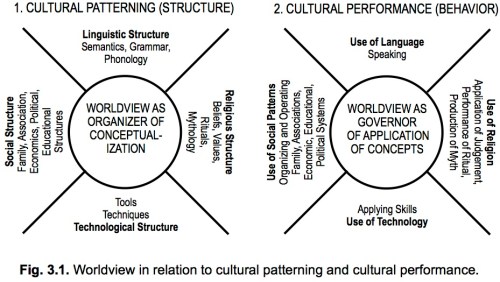
The worldview serves two essential functions: an “organizing” function in relation to a culture’s conceptualizations and a “governing” function in relation to those conceptualizations’ applications:

Kraft conceives of five “major functions” of worldview:
Kraft-model

(1) Explanatory: “to codify the society’s explanations of how and why things got to be as they are and how and why the continue or change;” to embody “for a people, whether explicitly or implicitly, the basic assumptions concerning ultimate things on which they base their lives” (Kraft, 2005, 44).

(2) Evaluational: to serve “an evaluative—judging and validating—function;” to provide “guidelines in terms of which evaluations are made” (Kraft, 2005, 45).

(3) Reinforcing: to provide “psychological reinforcement,” especially manifest in ritual, ceremony, or observances, thus providing “security and support for the behavior of the group in a world that appears to be filled with capricious uncontrollable forces” (Kraft, 2005, 45).

(4) Integrating: to serve “an integrating function” as an ordering of “their perceptions of REALITY into an overall design,” thereby in combination with explanatory, evaluational, and reinforcing functions becoming “a system of symbols that acts to establish powerful, pervasive, and long-lasting moods and motivations in people by formulating conceptions of a general order of existence and clothing these with such an aura of factuality that the moods and motivations seem uniquely realistic” (Kraft, 2005, 46).

(5) Adaptational: to serve an “adaptational” function, “resolving conflict and reducing cultural dissonance . . . in circumstances of cultural distortion or disequilibrium” (Kraft, 2005, 46).

Kraft subsequently elaborates worldview somewhat differently in Anthropology for Christian Witness (1996).  There he defines worldview as “the culturally structured assumptions, values, and commitments/allegiances underlying a people’s perception of reality and their responses to those perceptions” (Kraft, 1996, locs. 1548-1549).  He discusses five characteristics and fourteen functions of worldview.  The characteristics of worldview are (Kraft, 1996, locs. 1625–1687):

(1) Its “assumptions and premises are not reasoned out” but “seem absolute and are seldom questioned”

(2) It provides people with “a lens, model, or map in terms of which REALITY is perceived and interpreted”

(3) It organizes a people’s “life and experiences into an explanatory whole that it seldom (if ever) questions unless some of its assumptions are challenged by experiences that the people cannot interpret from within that framework”

(4) It causes the differences between cultures that are “most difficult to deal with”

(5) “Though we need to treat people and cultural/worldview structuring as separable entities, in real life, people and worldview function together”

In this assumptive, mediatory, integrative, renitent mode, worldviews function to “pattern” human culture (Kraft, 1996, locs. 1698– 1828):

On the primary level of “structuring deep, underlying personal characteristics,” worldviews “pattern”:

(1) Will—ways of making decisions, e.g., individualistically vs. collectivistically

(2) Emotions—use of expression, e.g., publicly vs. privately

(3) Logic and reason—varieties of logic, e.g., linear vs. contextual

(4) Motivation—socially inculcated desires, e.g., prestige, wealth, comfort, freedom

(5) Predispositions—attitudes or outlooks, e.g., optimism vs. pessimism

On the subsequent level of “the assignment of meaning,” worldviews “pattern”:

(6) Interpreting—social agreements about the meaning of cultural forms, e.g., beautify vs. ugly

(7) Evaluating—”feelings” about interpreted meanings, e.g., good vs. bad or right vs. wrong

Finally, on the level of “how people respond to the meanings they assign,” worldviews “pattern”:

(8) Explaining—assumptions concerning the way things are or should be, e.g., the nature of humans

(9) Pledging allegiance—differentiation and prioritization of commitments, e.g., job vs. family

(10) Relating—ways of relating, e.g., competition vs. cooperation or hierarchy vs. equality

(11) Adapting—coping mechanisms, e.g., denial vs. change or fight vs. flight

(12) Regulating—guidelines for steering behavior, e.g., incarceration vs. death or shame vs. guilt

(13) Getting psychological reinforcement—assumptions about what to do in crises or transitions, e.g., ceremonies and rites

(14) Integrating and attaining consistency in life and the way it is structured—application of the same principles and values in all areas of life, e.g., egalitarianism at work affecting male dominance at church

It is clear that Kraft as parsed out his original “major functions” in more detailed fashion, which is beneficial.  Yet, for me his explanation has a certain conceptual ambiguity working against it (possibly because I’m helped by visualization).  For a more concise model, into which Kraft’s insight can be worked, I turn to Paul Hiebert’s work.

Hiebert’s introductory discussion of worldview in Anthropological Insights for Missionaries (1985), which extends his earlier discussion in Cultural Anthropology (1976), defines culture as “the more or less integrated system of ideas, feelings, and values and their associated patterns of behavior and products shared by a group of people who organize and regulate what they think, feel, and do” (Hiebert, 1985, 30).  And like Kraft, he understands worldview as an underlying aspect of culture.  He defines it simply as “the basic assumptions about reality which lie behind the beliefs and behavior of a culture.”  Having described culture in terms of three dimensions—cognitive (knowledge, logic and wisdom), affective (feelings, aesthetics), and evaluative (values, allegiances)—Hiebert specifies that each cultural dimension has corresponding assumptions (Hiebert, 1985, 45–47):

(1) Cognitive or existential assumptions “provide people with the fundamental cognitive structures people use to explain reality,” “furnish people with their concepts of time, space, and other worlds,” and “shape the mental categories people use for thinking” such as “kinds of authority” and “types of logic.”  “Taken together these assumptions give order and meaning to life and reality.”

(2) Affective assumptions “underlie the notions of beauty, style, and aesthetic” and “influence . . . tastes in music, art, dress, food, and architecture as well as they ways they feel towards each other and about life in general.”

(3) Evaluative assumptions “provide the standards people use to make judgements, including their criteria for determining truth and error, likes and dislikes, and right and wrong” and “determine the priorities of a culture and thereby shape the desires and allegiances of the people.”

Hiebert’s model of worldview, which is an iteration of the well-known “culture onion,” initially looks like this:

Hiebert-model-1


The model is instructive.  First, it makes an interesting statement about the relationship of the dimensions: the affective being more interior than the cognitive and the evaluative more interior than the affective.  There is a difficulty in representing the dimensions’ relationship to each other here.  Is the evaluative more fundamental or essential?  Are all dimensions always equally operative or influential?  Kraft’s notion of “sociocultural specialization” might be applied (somewhat differently than he intends; Kraft, 1996, loc. 1584) to indicate how cultures may emphasize one dimension more than another.  Anyhow, the model also indicates clearly the rootedness of “explicit beliefs and value systems” in the implicit dimensions of worldview.  The listing of specific cultural systems in the outer ring is helpful, but it also visually obscures the sense of each dimension having an explicit expression or, from the other direction, of each system featuring both implicit and explicit components of each dimension.  For example, religion has implicit and explicit components of the cognitive, affective, and evaluative dimensions.  Also missing is the sense in which, once explicit, the systems have become cultural manifestations as products, behaviors, and symbols (Hiebert, 1985, 35–37):

Taken together, cognitive, affective, and evaluative assumptions provide people with a way of looking at the world that makes sense out of it, that gives them a feeling of being at home, and that reassures them that they are right.  This world view serves as the foundation on which they construct their explicit belief and value systems, and the social institutions within which they live their daily lives. (Hiebert, 1985, 47–48)

Hiebert, like Kraft, lists some functions of worldview (Hiebert, 1985, 48):

(1) It “provides us with cognitive foundations on which to build our systems of explanation, supplying rational justification for belief in these systems”—”provides us with a model or map of reality by structuring our perceptions of reality”

(2) It “gives us emotional security”—”buttresses our fundamental beliefs with emotional reinforcements so that they are not easily destroyed”

(3) It “validates our deepest cultural norms, which we use to evaluate our experiences and choose courses of action”—”provides us with a map of reality and also serves as a map for guiding our lives”

(4) It “integrates our culture”—”organizes our ideas, feelings, and values into a single overall design”

(5) It (following Kraft explicitly) “monitors cultural change”—”to select [ideas, behaviors, and products] that fit our culture and reject those that do not,” “to reinterpret those we adopt so that they fit our overall cultural pattern.”

These five functions seem to parallel Kraft’s early five functions directly; there is significant agreement here.  Hiebert’s construal makes an important clarification: the cognitive, affective, and evaluative dimensions all together are what worldview comprises, and it is worldview as a whole that provides these functions.  Thus while the explanatory and evaluational functions (to adopt Kraft’s terms) seem to reprise Hiebert’s cognitive  and evaluative dimensions, we may infer that the unified worldview is active in all five functions.  Hiebert’s thinking develops into Transforming Worldviews, published posthumously in 2008.  The initial chapters sprawl, causing the reader (or me, at least) to experience the complexity and multifaceted texture of their subject matter.

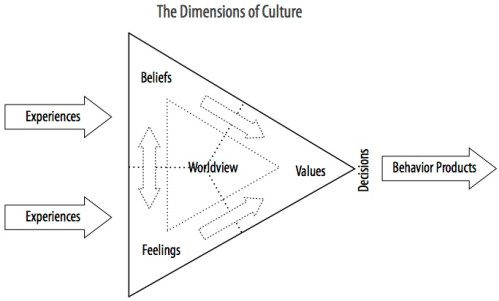
Chapter one surveys the anthropological heritage of worldview, introducing thereby some key concepts that Hiebert will take up.  In the mean time, he sets out a “preliminary definition” of worldview: “the foundational cognitive, affective, and evaluative assumptions and frameworks a group of people makes about the nature of reality which they use to order their lives” (Hiebert, 2008, 25–26).  He now represents worldview graphically within a model of culture:
Hiebert-model-2

The relationship between the three dimensions has been reconfigured.  All three are now seen as equal components, and the dimensions of worldview are now clearly a subset of the dimensions of culture.  The dotted lines are important; they indicate that the dimensions are distinguished “for analytical purposes” rather than being truly separate, and they indicate that the line between worldview and the rest of culture is porous or, as Hiebert might say, fuzzy.  The inner worldview triangle might be taken to mark off the implicit from the explicit, but that would make worldview fully implicit (the fuzziness of the line notwithstanding), which is not the case.  Also, the linear rendering of decisions, behaviors, and products loses the earlier model’s representation of continuity and reciprocity between worldview and social institutions (bidirectional arrows from inside to outside) as well as the various social institutions’ systemic integration (bidirectional arrows around the outer circle).  Still, Hiebert has much more to say about worldview than the graphic captures.

He conceives of worldview both synchronically and diachronically.  Synchronically, he adopts Morris Opler’s notion of themes and counterthemes, to which he adapts Robert Redfield’s universal cognitive categories: time, space, self and others, nonhumans, causality, and common human experience.  Additionally he looks for themes and counterthemes emically identified in one culture to compare with another culture.  Themes allow one to see “how people view the structure of the world.”  But it is necessary to supplement “a diachronic dimension to see how people look at the human story” (Hiebert, 2008, 26–28).

Interestingly, Hiebert recapitulates the functions of worldview in much the same terms but splits “emotional security” and “psychological reassurance” into separate functions, resulting in six functions.  Psychological reassurance in this usage seems to be simply an extension of the adaptational function.  The original five seem sufficient to me.

The second chapter of Transforming Worldviews deals with the characteristics of worldview, which are best viewed in outline form in order to capture the gist of his analysis.  I’m going to create a patchwork of Hiebert’s words and ideas in the outline, quoting him more directly at some times than others, along with my own comments:

I. Synchronic Structures

A. Depth: worldviews underlie the more explicit aspects of culture. Below products, behavior, and speech are myths and rituals that define and establish themes.  Below myths and rituals are systems of beliefs that encode cultural knowledge.  Below systems of beliefs are unseen structures underlying the entire explicit culture—the worldview.  There is an important connection here with both linguistics and psychology.  Depth does not equate to foundationalism, because causality goes both ways.  Surface culture can transform worldview (Hiebert, 2008, 32).  Hiebert depicts depth with this graphic:

Hiebert-model-3

1. Category Formation:

a. Digital and Analogical Sets: the way people form mental categories. Digital sets are well formed or clearly defined with a finite number of categories in a domain.  Associations include the classical laws of thought (Identity, Non-contradiction, Excluded Middle), propositional logic (discussed below), Euclidean geometry, and Cantorian algebra.  Analogical sets are “fuzzy” and have an infinite number of steps between in and out and between one set and another.  All cultures use both well-formed and fuzzy sets.  The difference lies in which is more fundamental to the thinking of the people.

b. Intrinsic and Relational Sets: what defines a set.  Intrinsic sets are defined by intrinsic characteristics—what a thing is.  Extrinsic sets are relational—defined by what a thing is related to.

c. Folk and Formal Taxonomies: Folk taxonomies are high-context and concretely functional in regard to culturally significant properties, such as edible and non-edible nuts.  Formal taxonomies are low-context and highly abstract in regard to the underlying nature of reality.  [Hiebert’s description of category formation is a formal taxonomy.]

2. Signs: the relationship between categories and reality.  One view is that signs point to objective realities.  Another view is that signs are constructs that shape the way people see reality, evoking subjective images in the mind.  Another view is that signs both point to external realities and evoke subjectives images in the mind.  Kinds of signs include discursive language; symbols, whose meaning can be iconic or assigned; performative language; and parametric signs, which point beyond their content.

3. Logics: (note how these are derivative of kinds of category formation)

a. Abstract Algorithmic Logic: propositional or digital logic.  It is abstract because it creates concepts in which the relevant features of certain prototype phenomena have been abstracted from the irrelevant features.  It uses such concepts as units of analysis to reason reductively (in terms of binary oppositions) and mechanistically or formulaically (in terms of necessary outcomes).

b. Analogical Logic: “fuzzy logic.” Not less precise than algorithmic logical but more precise, it is based on analogical or ratio sets that have an infinite number of points between zero and one and between one and two, therefore dealing with higher levels of complexity.

c. Topological Logic: also called analogical logic, with a different meaning than the above type.  Complex realities are examined by comparison with known realities, thus by analogy.  Modern law, reasoning from case to case on the basis of similarities, is analogical.  The root metaphors (Stephen Pepper) of a worldview are related to this kind of logic.  Hiebert finds organic and mechanistic to be culturally universal root metaphors, which lead to two kinds of knowledge: interpersonal and impersonal.

d. Relational Logic: concrete functional logic.  See informal taxonomies above.  [I find this section to be redundant, by the way.]  It it is ironically difficult to describe concrete functional logic abstractly.  So Hiebert works with taxonomic examples, hence the redundancy with category formation.  The difficulty is describing the nature of the reasoning process per se; it is easier to demonstrate its conclusions.  It is critical to see logic and reason here in terms of their function in life.  Whereas most modern people will say a log does not belong with an axe, a hammer, and a saw, because it is reasonable to classify the latter three as tools, other people will say it is far more reasonable to group the axe and the hammer with the log, in order to build something.  The modern mind immediately objects that the point of the exercise is to categorize, not to build.  And here is where the force of relational logic comes to light.  Someone who sees the world primarily through relational logic naturally reasons about everything in more concrete, functional terms.  The request to categorize objects abstractly cannot overrule the operative logic, which is not less logical for being intransigently functional.  This peels back another layer, raising the question of how one determines what is functional.  Modern cultures have got a tremendous amount of function out of reasoning abstractly.  Functionality depends on perceived need, though, and the fact that perception is what worldview is about indicates the systemic nature of worldview and therefore the unbelievable difficulty of discussing one characteristic of worldview apart from all the others, that is, abstractly!

e. Wisdom: evaluative logic.  Assessments are based on the knowledge at hand, the factors involved, and a comparison with previous experiences, rather than by a formula that produces the right results.  (I can’t resist pointing out that Hiebert’s example contrast between algorithmic and evaluative logic is a question about the best way to get from one place to another, asserting the the wise cabby will take into account the time of day, weather, construction, and accidents.  I’m afraid Google Maps is part of a monstrous algorithm machine that takes all of those “wisdom” factors into account.  It can be, actually, very wise to use an algorithm.  I’m not arguing against the value of wisdom as Hiebert sees it; just saying.)

4. Causality: a “toolbox” of different belief systems a culture uses to explain what is happening.  These tools function ad hoc: ordinary people are more concerned about healing and success than ultimate causality, often using serval different explanation systems and treatments at the same time, most of which reside at the folk level, hoping that one of them will work.  Formal explanations (e.g., theodicy) are often a last resort.

5. Themes and Counterthemes: Opler defines a cultural theme as “a postulate or position, declared or implied, usually controlling behavior or stimulating activity, which is tacitly approved or openly promoted in a society.”  Hiebert conceives of root metaphors as basically synonymous with themes.

6. Epistemological Assumptions: assumptions a culture makes about the nature of reality and human knowledge.  Especially given the vagueness of this definition, Hiebert’s single paragraph on epistemology is reductive, but he does have a whole book on the subject (Missiological Implications of Epistemological Shifts).

B. Implicit: As the definition of depth above already asserts, worldviews are mostly unexamined and implicit.  And various points have already indicated that worldview is itself a “fuzzy set.”  The relationship between what is explicit or implicit, overt or covert, express or tacit, asserted or presuppositional, theoretical or pretheoretical is organic, not binary.  On one hand, “it is this implicit nature of worldviews that makes it so hard to examine them.  They are what we use to think with, not what we think about.”  On the other hand, “worldviews can also be made visible by consciously examining what lies below the surface of ordinary thought.”  It is obviously a dilemma to think about what we think with, but that is exactly what Hiebert (for example) is doing, and if we can note how his worldview is operative in the process, that does not invalidate the findings (lest we engage in a cum hoc ergo propter hoc fallacy—yes, I’m using propositional logic!).  But once we’ve granted that we can explicate at least some of the implicit, what is explicated does not cease to be part of worldview.  Therefore, without making a programatic claim about our ability to be absolutely reflexive, it is fair to say that implicitness is not an essential characteristic of worldview, but worldview is, for practical purposes, always more implicit than explicit.

C. Constructed and Contested: “Knowledge systems involve a process of reflection entailing a reorganization of thought.  This reorganization that occurs through the application of mental processes (such as category formation and logic), the formation of alternative models, and the selection of certain models over others after evaluation.  Over time the systems become progressively more adequate.  In short, culture is not the mere sum of sense data.  It is comprised of the gestalts, or configuration of sense data plus memory, concept formation, verbal and other symbolic elements, conditioned behavior, and many other factors.” Subalterns also contest the worldviews of power holders, which tension provokes constant change.

D. More or Less Integrated Systems: “Worldviews are paradigmatic in nature and demonstrate internal logical and structural regularities that persist over long periods of time. . . .  The configurational nature of worldview gives meaning to uninterpreted experiences by seeing the order or the story behind them.”

E. Generativity: Worldviews are not the specific instances of human speech and behavior but rather generate speech and behavior.  Hiebert cites the rules of chess and the rules of a language as examples of generativity, concluding that “worldviews are the elements or rules of a culture that generate cultural behavior.”  He does not make any reference to Ludwig Wittgenstein in this regard, a connection whose importance I will make clear later.

F. Dimensions of Worldview

1. Cognitive Themes: Despite dealing with categories and logic under “depth,” Hiebert notes that they belong in the cognitive dimension.  (This is, in my opinion, a major organization flaw in the book.)  Beyond these, he deals with with the themes and root metaphors mentioned many times heretofore.

a. Time

b. Space

c. Organic/Mechanistic

d. Individual/Group

e. Group/Others

f. This World/Other Worlds

g. Other Themes: Culturally particular themes emically determined.

2. Affective Themes: Hiebert adds little to the short description in his earlier work, but he does provide an interesting taxonomy of affective types in American Protestant worship services, which links differences in mood to differences in architecture, posture, theological focus, central message, and central story.  It is not clear, however, how one might get a handle on affective “themes” on par with cognitive themes.

3. Evaluative Themes: normative assumptions, such as virtues, standards, morals, and manners, though presumably the accent should be on the implicit aspects norming the typically explicit “assumptions” he mentions.

a. Moral Order: Worldviews differ according to what are perhaps best described as moral “centers”: relationship, law, and purity.  Hiebert’s diagram explains the distinctions:

moral-order

I would add that the center amounts to an emphasis.  For example, it seems to me that the interrelation of righteousness, peace, and holiness in the Hebrew worldview makes for a composite center: purity laws affect relationships.

b. Heroes and Villains: This passage bizarrely says nothing about heroes and villains.  The closest Hiebert comes is to say that “evaluative standards determine in each society what an ideal man and woman looks like, what constitutes a good marriage, and how people should relate to one another and to strangers.  At the deepest level, evaluative assumptions determine fundamental allegiances—the gods people worship, the goals for which the live.”  I have to say, this looks backwards.  For one thing, archetypal figures—Heroes and Villains—are arguably more determinative of evaluative standards than determined by them.  I would connect this with the narrative dimension of the diachronic characteristics of worldview below.  For another, fundamental allegiances are arguably more determinative of evaluative assumptions than determined by them.  Both of these observations would seem to be more in line with the section’s thrust: to explain what composes and influences the evaluative dimension, rather than to discuss what the evaluative dimension generates.

c. Parsons’s Evaluative Themes: These are similar to Redford’s themes in that they are assumed to be universal.  They are similar to Opler’s in that they are polar: emotional expression vs. emotional control; group centered vs. individual centered; other-world orientated vs. this-world oriented; emphasize ascription vs. emphasize achievement; focus on whole picture vs. look a specific details; universalist vs. particularist; hierarch is right vs. equality is right.  These evaluative norms are “values” in Hiebert’s discussion of Parsons.  This might be obvious given the semantic correlation, but we are trying to get our minds around what generates values, not what our values are per se.  Here again the organic continuity between implicit and explicit is a factor.  And we are not talking about merely what I value without “living the examined life” but what, in terms of depth, generates and regulates the formation and revision of our explicit values.  It is interesting to compare Parsons’s evaluative list with the cognitive themes listed earlier.  There is some overlap, and certainly some of the cognitive themes are value-generating as well (to reiterate, the three dimensions of worldview are divided heuristically, not hermetically; they function as a whole).  Likewise, emotional expression vs. emotional control would likely be discussed best under the affective dimension.  A comparison with Sherwood Lingenfelter and Marvin Mayers’s “model of basic values” is indicative of the problem (Ministering Cross-Culturally, 2nd ed. 2003).  Their analysis serves to uncover implicit values.  Though these values are an implicit aspect of culture much of the time, they are not the stuff of the evaluative dimension of worldview but rather manifestations of worldview.  A couple of the typical cultural onion models should clarify somewhat.  First, one of the most well-known is Geert Hofestede’s:

Hofstede-model

There are clear echoes of this model in Hiebert’s discussion of Heroes and Villains. And as in the discussion of Parsons, “values” are the core element (“core values” is the popular terminology).  Of course, worldview does not figure in this idea of culture, and it is important to locate Hofstede’s even more well-known dimensions of culture (http://geert-hofstede.com/dimensions.html) within this model.  Hofstede’s definition of values is: “broad tendencies to prefer certain states of affairs over others,” which deal with pairings such as evil vs. good, dirty vs. clean, dangerous vs. safe, forbidden vs. permitted, decent vs. indecent, moral vs. immoral, ugly vs. beautiful, unnatural vs. natural, abnormal vs. normal, paradoxical vs. logical, and irrational vs. rational (Hofstede, Hofstede, and Minkov, 8–9).  A dimension, on the other hand, is “an aspect of culture that can be measured relative to other cultures . . . [that] groups together a number of phenomena in a society that were empirically found to occur in combination” (Hofstede, Hofstede, and Minkov, 31). Though the analytical emphasis is necessarily on the empirical, the purpose of grouping cultural phenomena into an abstract category is to identify an underlying (i.e., implicit) disposition or construct.  As in his model of culture, the practices he empirically examines are rooted in values, and although his dimensions are not listed in his example value polarities, they are identical in both polar structure and function: “power distance (from small to large), collectivism versus individualism, femininity versus masculinity, and uncertainty avoidance (from weak to strong)” (Hofstede, Hofstede, and Minkov, 31).  This is why the analysis of Hofstede’s dimensions of culture looks very similar to the analysis of Lingenfelter and Mayers’s basic values.  Likewise, “Trompenaars and Hampden-Turner identify seven value orientations. Some of these value orientations can be regarded as nearly identical to Hofstede’s dimensions” (Dahl, 2004, 14).  Fons Trompenaars and Charles Hampden-Turner’s model of culture is for my purposes an improvement upon Hofstede’s, as it comes closer to a conception of worldview:

Trompenaars-model

Tellingly, norms and values here are somewhere between the implicit and explicit levels.  Though an improvement, the model still might be more complete.  Concordia University – Saint Paul professor Eugene Bunkowske’s model (http://web.csp.edu/MACO/Courses/573/Microsoft_Word_-_Oni.pdf) represents an attempt from a Christian missiological perspective to conceive of the cultural onion comprehensively.  Here is a composite I created of his conception:

Bunkowske-model

Bunkowske’s model in my view does three things correctly relevant to this aside on Hiebert’s discussion of the evaluative dimension.  One, he places ultimate allegiance at the core of worldview rather than making it a consequence of worldview’s evaluative dimension.  Two, he places “values” on a more outlying level than worldview (so Trompenaars and Hampden-Turner).  Three, he describes the level of beliefs-values-feelings as “evaluative,” reflecting the way (in my reading) Hiebert’s three dimensions work together (a) to regulate the implicit evaluative process and (b) to produce explicit values.  That’s enough for the aside.  In short, these are points I will take into consideration as I attempt to compose a model of worldview.

G. Three Dimensions: “Together, cognitive, affective, and evaluative assumptions provide people with a way of looking at the world that makes sense out of it, that gives them a feeling of being at home, and that reassures them that they are right.  This worldview serves as the deep structure on which they construct their explicit belief and value systems and the social institutions in which they live their daily lives.”

II. Diachronic Characteristics: By comparison, the discussion of worldview’s diachronic characteristics is minimal.  This is the greatest problem with Hiebert’s conception.  Yet, his construal of the diachronic aspect as “narrative knowing” is right: “At the core of worldviews are foundational, or root, myths, stories that shape the way we see and interpret our lives” (Hiebert, 2008, 66; emphasis added).  This is myth in the technical sense:

A myth is the overarching story, bigger than history and believed to be true, that serves as a paradigm for people to understand the larger stories in which ordinary lives are embedded.  Myths are paradigmatic stories, master narratives that bring cosmic order, coherence, and sense to the seemingly senseless experiences, emotions, ideas, and judgements of everyday life by telling people what is real, eternal, and enduring. (Hiebert, 2008, 66)

This critical insight needs to be expanded programatically.  Nonetheless, Hiebert’s intention, in the end, is to create a model for worldview analysis that takes into account both synchronic and diachronic aspects of worldview:

Hiebert-model-4

Thus we have a strong theoretical foundation from the missiological anthropology side, as well as a number of questions and weaknesses.  In conversation with philosophical analysis of worldview, it will be possible to construct an even richer model of worldview.

Cited

Beine, David. “The End of Worldview in Anthropology?” SIL Electronic Working Papers 2010-004 (September 2010): 1–10, http://www-01.sil.org/silewp/2010/silewp2010-004.pdf.

Bunkowske, Eugene W. “The Cultural Onion.” http://web.csp.edu/MACO/Courses/573/Microsoft_Word_-_Oni.pdf.

Dahl, Stephan. “Intercultural Research: The Current State of Knowledge.” Middlesex University Business School Discussion Paper 26 (January 2004): 1–21.

Hiebert, Paul G. Anthropological Insights for Missionaries. Grand Rapids: Baker, 1985.

________. Transforming Worldviews: An Anthropological Understanding of How People Change. Grand Rapids: Baker Academic, 2008.

Hofstede, Geert, Gert Jan Hofstede, and Michael Minkov. Cultures and Organizations: Software of the Mind. 3rd ed. New York: McGraw-Hill, 2010.

Kraft, Charles H. Anthropology for Christian Witness. Kindle ed. Maryknoll, NY: Orbis, 1996.

________. Christianity in Culture: A Study in Biblical Theologizing in Cross-Cultural Perspective. 25th Anniversary 2nd ed. Maryknoll, NY: Orbis, 2005.

Lingenfelter, Sherwood G., and Marvin K. Mayers. Ministering Cross-Culturally: An Incarnational Model of Personal Relationships. 2nd ed. Grand Rapids: Baker Academic, 2003.

Moreau, A. Scott. Contextualization in World Missions: Mapping and Assessing Evangelical Models. Grand Rapids: Kregel Academic 2012.

Trompenaars, Fons, and Charles Hampden-Turner. Riding the Waves of Culture: Understanding Cultural Diversity in Business. Santa Rosa, CA: Nicholas Brealey, 1998.


On Worldview 4 (A Provisional Model)

A Provisional Model of Worldview

I understand worldview to be the narratively determined web of interpretive and evaluative systems that generates and regulates human knowing and doing.  This is a provisional representation of my understanding:

wv-model

Narratively Determined

As Hiebert said, the “core” of worldview is the mythos, which is (ordinarily) a mostly tacit metanarrative about reality.  The mythos is the organizing center of worldview: it integrates and provides coherence to the web of systems that worldview comprises.  It is the continuity of narrative that provides existential assumptions their relatively orderly construal within a worldview.  For this reason, narratively oriented questions such as Walsh and Middleton’s are a powerful tool for explicating worldview.  Their questions are:

(1) Who am I? Or, what is the nature, task and purpose of human beings? (2) Where am I? Or, what is the nature of the world and universe I live in? (3) What’s wrong? Or, what is the basic problem or obstacle that keeps me from attaining fulfillment? In other words, how do I understand evil? And (4) What is the remedy? Or, how is it possible to overcome this hindrance to my fulfillment? In other words, how do I find salvation? (Walsh and Middleton, 35)

N. T. Wright has influentially added: What time is it? (Wright,  467–71).  I think it is equally important to inquire about the epistemological “story” operative in the worldview by asking, in regard to these other questions, How do I know?  The narrative nature of worldview’s core is vitally important for the question of how Scripture operates in the formation of a biblical worldview.  That is, worldview theory establishes narrative theology pragmatically.  The theory, of course, may be wrong.  But if it is right, and I believe it is, then the very nature of human culture places narrative in a status of theological priority.  This calls for the elaboration of both the practical understanding of the worldview mythos and the theological understanding of the worldview(s) canonized in Scripture.

Web of Systems

It is difficult to overcome the limitations of previous models of worldview—they exhibit a challenging balance between insight into a complex phenomenon and uncomplicated visual representation.  Moreover, it is very problematic to find a metaphor or symbol for the essential dual functionality of a worldview: mediation and generativity.  For example, the common metaphor of the “lens” captures only the mediatory functions of perception and organization, but it does nothing to show the generative functions of governing and channeling.  The onion model of culture has difficulty showing the way worldview, in most every theory, interacts with reality; worldview seems insulated under culture’s oniony layers.  But the moment we adopt a linear representation of experiencing reality through worldview with the result of cultural output, as in Hiebert’s later model of culture, we lose the sense in which worldview is part of culture—the sense in which some “products and behaviors” are worldview peeking above the surface and some propositions are actually grammar.

My model is an attempt to represent the “porous” nature of worldview as a system of systems.  If it is systems all the way down, though, that strikes me as a little too mechanical (I’m not sure if for me it’s an issue of root metaphor or aesthetics—probably both). “Web” serves my conceptual purpose, but if there is a metaphor at work in the graphic, it is absorption (either way, I’m mixing my root metaphors—a terrible faux pas, no doubt).  In my model, a culture’s relationship to reality is not defined very concretely: it is situated in reality and contributes to reality.  The “outer” boundary is porous, and the “outer” systems overlap and merge with the extra-cultural reality.  But the “inner” boundaries of the various systems are also porous, so that experiences, once absorbed, soak through and potentially interact with all dimensions of the worldview.  There is an order of “depth,” and a conceivable interiority working itself out from the mythos, but the many dimensions or levels are overlapping and interrelated where the mediated reality is concerned.  So the innermost systems may come to expression on the semiotic level, as linguistic or artistic products, for example.  Or mathematical symmetry may be beautiful rather than just correct.  If William James realized “everything here is plastic,” I’m suggesting that everything here is porous.

Interpretive and Evaluative

Granting the ambiguity of the porous boundary between the inner two systems and the outer semiotic system, I conceive of the two primary functions of worldview to be interpretation and evaluation.  The relationship between these two is important, though, and I think it is a little different than Hiebert’s three-dimensional model.  It seems to me that the basic cognitive presuppositions and affective predispositions are necessarily antecedent to the formation of evaluative assumptions.  Comparing the different conceptions of worldview makes it clear, to me at least, that evaluation is undertaken in relation to everything; it is not a dimension alongside cognition and affection but a function that depends upon them.  Thus, affective predispositions condition evaluations of beauty or cognitive presuppositions warrant evaluations of truth.  Category formation or aesthetics are prerequisites of evaluation, and I emphasize again the holistic notion of the interpretive function: logic, for instance, can have a highly aesthetic nature—an argument can be lovely or consonant; a piece of art can be convincing in a way that cannot be considered purely arational.  Our understandings give us feelings, and our feelings shape our understandings.  These basic interpretive dynamics empower evaluation and the formation of both implicit and explicit values.

Some of the functions mentioned by other authors are not functions so much as characteristics.  The reinforcing, integrating, and adaptational functions on which Kraft and Hiebert agree are, in my view, merely consequential of the systemic nature of worldview, in a way significantly different than the interpretive and evaluative functions.

Generates and Regulates

Interpreting and evaluating are the primary functions of systems within worldview; generating and regulating human behavior are worldview’s secondary functions as a whole: the total web generates and regulates.  Of course, this is only helpful to state conceptually.  In life, the relationship between the two kinds of functions is necessarily cyclical.  Heuristically, though, we can see that “subsequent” to interpretation and evaluation of reality, people act accordingly.  What Hiebert calls “associated patterns of behavior and products,” which I characterizes as semiotic systems, are generated by and continuously governed by the worldview.  It is a mistake to attribute to worldview only or primarily a “viewing” function, despite its name.  I affirm, then, the characteristic of generativity but want to move it to the status of function.  Furthermore, beyond generating behavior, I emphasize the regulatory or grammatical function at work.  Worldview is indeed the channel that determines the course along which the semiotic river can flow.

Human Knowing and Doing

Here I might say “culture,” but worldview is a part of culture, not something else that generates and regulates it.  How, then, to characterize the external systems that result from the internal systems of culture?  I want to emphasize the two basic dimensions of human interaction with reality, which are the social embodiment of worldview.  On one side is language, the coding of thought, and the production of systems of determinations that it permits—such as relationships, explicit belief systems, and plans.  On the other is action, the physical relationship with the world, and the material creativity it permits—such as labor, art, and technology.

What I’m Not Saying

I do not include “systems of belief” at any point.  I think “belief” is confusing at this point in the conversation.  Some beliefs aren’t believed but assumed.  And the word is too general: I can have beliefs about or in connection to virtually every system in the diagram.  I would include explicit belief systems, as in relatively systematic interpretations or conclusions about reality, within the semiotic system of determinations.  Otherwise, I think the terminology has lost its helpfulness.  Also, I avoid “assumptions.”  It is also too vague in English usage.  Of more consequence, I think the “basic assumptions about reality” are embedded in the mythos, and worldview is more comprehensive than just assumptions about reality.  It is also presuppositions and predispositions that determine how we perceive reality, in order to make assumptions—and I’m not referring to consciously making assumptions, which is one possible meaning (hence, the term is too vague).  If I might construe making unconscious or tacit assumptions as part of theorizing, then the point is that worldview includes some pretheoretical components as well (e.g., category formation).  Though I conceive of the outer dimension semiotically, I think it’s more communicative to leave it at “knowing and doing.”  Finally, though I think there is much to be gained by the biblical metaphor of “heart,” the concept per se does not require it definitionally.

Cited

Walsh, Brian J. and J. Richard Middleton. The Transforming Vision: Shaping a Christian World View. Grand Rapids: IVP, 1984.

Wright, N. T. Jesus and the Victory of God. Christian Origins and the Question of God. Vol. 2. Minneapolis: Fortress, 1996.

Are Churches of Christ Evangelical?: An Epistemological Question (Part 3)

Epistemological Priority

In the lengthy quote last post, Hughes notes the similarities between fundamentalism and Restorationism that make their distance strange. If I’ve argued correctly that conservative evangelicals (eventually fundamentalists and neo-evangelicals) and Churches of Christ were actually nearly identical in regard to the eschatological ambivalence that has characterized them on the level of worldview, then their distance is even more surprising. Hughes’s description of their epistemological commonality is incisive: “Churches of Christ, like fundamentalists, had built their theological house squarely on the Bible, read the Bible from a decidedly Baconian perspective, and categorically rejected Darwinian evolution, biblical criticism, and all other aspects of modernity that seemed to undermine the authority of an inerrant biblical text” (Hughes, Reviving, 255). The biting irony of these shared commitments is that they are the very ones that drove the ecclesial sectarianism of the Restoration Movement: their commonality is what kept them apart.

By the time of the Civil War, a sizable segment of the Stone-Campbell movement held that the true Church of Christ had at last been restored to the earth, understood the precise contours and boundaries of that church, remained convinced that they and they alone constituted that church, and grounded all these notions in a Baconian worldview. (Hughes, Reviving, 63)

Unfortunately, Hughes’s presentation of the origin of this ecclesial sectarianism obscures the essence of the Stone-Campbell movement, that is, what constituted the basic unity of Stone and Campbell and what ultimately determines Churches of Christ’s theological similarity to and doctrinal difference from evangelicalism.

The above quote describing the sectarianism of the “Baconian worldview” is the conclusion of Hughes’s chapter 3: “The True Church and the Hard Style: Radicalizing Alexander Campbell (Part I).” It is this ecclesial sectarianism that Hughes attributes to Campbell and not to Stone when he says that “many who opposed the premillennial position of R. H. Boll simply exchanged the sectarian posture of Stone for the sectarian posture of the radicalized Alexander Campbell” (Hughes, Reviving, 158). In Hughes’s argument, while Stone was an “apocalyptic sectarian” (Hughes, Reviving, 106–113), meaning his principal impulse was separation from the world and its values, early Campbell’s sectarianism was based upon the nature of the “clear, self-evident essentials of the true Church of Christ” (Hughes, Reviving, 27). Hughes’s contrast between the two runs throughout Reviving the Ancient Faith but is clearest in chapter 5 of Reclaiming a Heritage: Campbell’s Baconian worldview has proven untenable as the restoration ideal, and Stone’s apocalyptic worldview is the alternative that should replace it. The epistemological combination of Baconian method and Lockean representationalism mediated through Scottish Common Sense Realism was what determined the self-evident nature of Campbell’s ecclesiology and the basis for unity (Hughes, Reviving, 12, 26, 30–32). Fanning’s appropriation of this combination is especially indicative:

From Locke, Fanning learned that one should simply receive on one’s mind the impress of revelation, unmutilated by human opinion or tradition. From the Baconian tradition, he learned that one should read the Bible as though it were a science book, always sensitive to the facts, and that one must gather all the facts on any subject before drawing any final conclusions. On this basis, he determined that the project of restoring primitive Christianity was simply a matter of following the Book in Baconian/Lockean fashion. (Hughes, Reviving, 68)

Hughes demonstrates that the later Campbell reacted to the sectarianism of his followers as they “radicalized” the application of this epistemology (Hughes, Reviving, 37–44), leading him to set a course toward big-tent Protestant American Christendom that carried the Disciples into the ecumenical movement (Hughes, Reviving, 45, 55–56).

For his part, Stone was unhappy that “many of his own people increasingly placed biblical knowledge, religious controversy, and debate above ‘godliness, piety, and brotherly love'”:

Finding this strong ecumenical emphasis in Stone, many historians, especially within the tradition of the Disciples of Christ, have interpreted Stone chiefly as an apostle of unity and a harbinger of the modern ecumenical movement. This reading of Stone renders him little different from the older, more mature Alexander Campbell—a progressive ecumenist, uniting all Protestants in on grand “common Christianity.” Such a view makes it easy to understand how the Stone and Campbell movements could have united as easily as they did at Lexington in 1832.

But such a reading misses altogether the genius of Barton W. Stone, because it ignores a final theme in Stone in which every other aspect of his thought was deeply rooted: his apocalyptic worldview. If we appropriately take into account Stone’s apocalypticism, we can see that he could never have favored a vapid ecumenism, as though one denomination were just as good and as biblical as another. Quite the contrary. Stone always insisted that all denominational structures were equally fallen and therefore equally wrong; together they constituted what Stone described as “Babylon” and “a wilderness of confusion.” He allowed that there were authentic Christians within the denominational “Babylon,” to be sure, be he routinely called on these Christians to abandon “Babylon” and unite on the New Testament alone. He believed that once all Christians abandoned “Babylon,” all denominational structures would collapse into the dust.

In Stone’s view—and this is the critical point—the collapse of denominational structures and the final triumph of primitive Christianity would characterize the millennium, no the present fallen age. Stones willingness to fellowship with people from a variety of denominations was a measure adapted only to a fallen world. He believed that in the millennium there would be only one true Church of Christ, governed by Jesus Christ himself. (Hughes, Reviving, 105–6)

Thus, for Hughes, Campbell is responsible for both the ecclesial sectarianism of a Baconian worldview and vapid ecumenism, while Stone is merely a cultural sectarian, of which his rhetorical, moderated ecclesial separatism was just an extension.

The problem with this reading is that it minimizes what, for Stone, it meant to “unite on the New Testament alone” and for one denomination not to be “as biblical as another.” Stone was not as thoroughly “Baconian” in the sense that Campbell had explicit formation through Bacon, Locke, and Common Sense Realists, but their essential platform—why they “united as easily as they did at Lexington in 1832″—was literal-logical biblicism. In fact, the merger was not easy, but the threat of proving the Bible to be an inadequate basis for unity compelled Stone and Campbell to gloss over significant differences by simply affirming biblical words and phrases (McKinzie, 41–43). Without dismissing Hughes’s insight about the priority of values and ethics in Stone’s apocalyptic theology, it is fair to say that Stone’s worldview included an epistemology every bit as conducive to ecclesial sectarianism as early Campbell’s—in fact, the same epistemology at root. Stone distinguished between the biblical church and the unbiblical denominations by reading the New Testament literally and logically, with the expectation that truth would present itself directly to his perception without impediment. The Common Sense approach to Scripture is what became radicalized in the Stone-Campbell platform.

Thus, Fanning is indeed an ideal representative of the Stone-Campbell synthesis. The Baconian/Lockean method explicit in Campbell combines seamlessly with the apocalypticism of Stone, manifesting a total sectarianism that identifies all human organization as unbiblical. While the wealthy, erudite, socially mobile Campbell never shared Stone’s cultural sectarianism, their shared radical biblicism compelled their followers to an ecclesial sectarianism that neither ultimately intended. Their epistemology was where their personal worldviews overlapped sufficiently to create the uneasy synthesis of divergent eschatologies, among other differences. The Churches of Christ lost their apocalyptic current over time, but what remained was that which the two founders had always shared, that which was always the practical substance of the Restoration plea: a hermeneutic of radicalized Common Sense biblicism. (I’ll nuance the particulars of RM hermeneutics later.)

As Hughes said, fundamentalists (and less reactionary conservative evangelicals for that matter) also “read the Bible from a decidedly Baconian perspective.” Marsden makes this connection even more specifically in terms of both Baconianism and Scottish Common Sense Realism:

The fundamentalist worldview starts with the premise that the world is divided between the forces of God and of Satan and sorts out evidence to fit that paradigm. Nevertheless, fundamentalist thinking also reflects a modern intellectual tradition that dates largely from the Enlightenment. Fundamentalist thought had close links with the Baconian and Common Sense assumptions of the early modern era. Humans are capable of positive knowledge based on sure foundations. If rationally classified, such knowledge can yield a great deal of certainty. Combined with biblicism, such a view of knowledge leads to supreme confidence on religious questions. Despite the conspicuous subjectivism throughout evangelicalism and within fundamentalism itself, one side of the fundamentalist mentality is committed to inductive rationalism. More of this in the subsequent chapters.

This commonsense inductive aspect of fundamentalist thinking, rather than being anti-intellectual, reflects an intellectual tradition alien to most modern academics. What is most lacking is the contemporary sense of historical development, a Heraclitean sense that all is change. This contemporary conception of history invites relativism or at least the seeing of ambiguities. Fundamentalists have the confidence of Enlightenment philosophies that an objective look at “the facts” will lead to the truth. (Marsden, 117-118; see also 127–29; 162; 164; 173)

The “apocalyptic worldview” of premillennialists is in no way contrary to or alternative to this “Baconian worldview” (and here we see one of the problems of Hughes’s loose use of “worldview”); the apocalyptic and the Baconian are merely components of one worldview. In fact, because of the anti-progressivist tendencies of apocalyptic, the particular use of Bacon via Common Sense “plus popular mythology concerning proper scientific procedure and verification” (Marsden, 167) is particularly suited to premillennialism (Van Wart). In the progressivist strain of Campbell’s tradition, epistemology continued to develop with the insights of modern thinkers, whereas epistemological entrenchment marks the anti-modernist Fanning-Lipscomb tradition just as it has the fundamentalist tradition.

At all odds, Stone and Campbell were swimming in the wider current of American Christianity here as well. It is no use claiming that Stone did not have a Baconian/Common Sense epistemology because it was not as explicit as Campbell’s. Worldview is more tacit than explicit, and the shared worldview of American Protestants included an “empiricist folk epistemology”:

Fundamentalists and kindred religious movements have made strong claims to stand for common sense. Such popular appeals reflect the nineteenth-century American evangelical heritage where Scottish commonsense realism was long the most influential philosophy.

The Bible, according to the democratic popularization of this view, is best interpreted by the naive readings that common people today give it. “In ninety-nine out of a hundred cases,” wrote Reuben Torrey, “the meaning that the plain man gets out of the Bible is the correct one.” In modern America common sense is infused with popular conceptions of straightforward empirical representations of what is really “out there.” Mystical, metaphorical, and symbolical perceptions of reality have largely disappeared. Instead, most Americans share what sociologist Michael Cavanaugh designates an “empiricist folk epistemology.” (Marsden, 165-166)

Given this commonality, apart from the simple fact that Churches of Christ explicitly denied the Christianity of “denominations,” I suggest the explanation for the historical distance between evangelicals and Churches of Christ is practically threefold:

(1) Stone and Campbell radicalized the Baconian/Common Sense epistemology in a particular, extremist hermeneutical program. “What distinguishes the Stone-Campbell movement from other primitivist efforts is a willingness to move further and more consistently in these directions” (Noll, 14). The extremism of the Churches of Christ as heirs of this program does not dissolve the fundamental commonality with evangelicalism but merely highlights that the real issue is difference in quality rather than difference in kind.

(2) The Stone-Campbell hermeneutical program acquired further particularity through the application of the Reformed regulative principle in combination with a subjective use of “necessary inference” that resulted in an inconsistent hermeneutics of prohibitive silence. This hermeneutics was non-negotiable for Churches of Christ and became the ultimate test of faithfulness. John Mark Hicks puts it this way: “The combination of an inductive-deductive Baconianism, a Reformed hermeneutic. . . and a primitivist (restorationist) vision shaped the Churches of Christ. This combination meant that we practiced a Baconianism on steroids because our every deduction became, in effect, a command and every command became a line in the sand” (Hicks, “Stone-Campbell Hermeneutics III”; emphasis added).

(3) The Stone-Campbell hermeneutical program became calcified in particular conclusions and practices that are tests of faithfulness evangelicalism does not hold. These practices are not un-evangelical per se but are for Churches of Christ exclusive. Furthermore, they have become the explicit identity markers of early twenty-first century Churches of Christ attempting to navigate postmodern epistemological fallout (“A Christian Affirmation”), further absolutizing them over against evangelical identity. Of course, there are highly sectarian evangelicals that have done much the same thing.

The difference is not fundamental. And it has been reduced significantly in the last fifty years because of the revival of scholarship among both fundamentalist and Churches of Christ. The remarkable coincidence of that scholarly renaissance is yet another indication of their commonality. In fact, what Hughes recognizes as LeMoine Lewis’s “pivotal importance” in catalyzing graduate education in Churches of Christ (Hughes, Reviving, 311) is the same moment in history that Rudolph L. Nelson identified in his article “Fundamentalism at Harvard.” There he discusses fundamentalists accepted to Harvard’s divinity school in the 1940s and 1950s. Interestingly, he first focuses on “self-acknowledged Fundamentalists,” who were “at least twelve.” The ambiguity of “at least” may catch one’s attention, especially since Nelson goes on to list fifteen scholars. Among the three outliers, undoubtedly, are “Jack P. Lewis, professor of Bible at Harding Graduate School of Religion (Ph.D., 1953); Lemoine Lewis, professor of Bible and church history at Abilene Christian University (Ph.D. granted in 1959 but all class work done in 1940s)” (Nelson, 80–81). The third outlier is probably John Gerstner, a Presbyterian. Mark Noll’s rendition of Nelson’s research, in Between Faith and Criticism: Evangelicals, Scholarship, and The Bible in America, lists only twelve, excluding the Lewis brothers and Gerstner (Noll, 97–98). While evangelicals naturally equivocate on the place of Churches of Christ scholars among their ranks in the 1950s, they were clearly caught up in exactly the same “reawakening of evangelical intellect” (Noll, 98). Also germane to my argument are the “ten or twelve men of similar background . . . matriculating at the [Harvard] divinity school during this time, working at the master’s or bachelor’s level” (Nelson, 80), among whom would have been “LeMoine’s boys” (Hughes, Reviving, 311).

In retrospect, history suggests that evangelical fundamentalists and Churches of Christ were swimming in the same cultural current, possessed of the same worldview. Their common American experience and shared epistemology were essential to this worldview, which manifested in an identical early rejection of higher criticism and an abiding anti-intellectualism, or at least overwhelming populism. As postmodernity has demonstrated, shared epistemology cannot overcome the disparity of interpretations that diverse hermeneutics produce, so we should not be surprised by surface-level disagreements between evangelicals and Churches of Christ. By surface-level, I do not imply insignificant, because hermeneutics are significant—they are determinative of important practical outcomes. Rather, my point is that beneath the surface, the sameness was real, and this sameness was the pragmatic basis for the theological rapprochement that took place. As evangelical and Churches of Christ scholars met in the same intellectual formation, forging a new intellectual leadership, the effect was the reduction of hermeneutical differences. Both were reoriented toward a more rigorous historical-critical methodology that inevitably reduced the surface-level differences. This happened while many in Churches of Christ, wracked by the anti-institutional controversy, grew disenchanted with the traditional hermeneutics (Hicks, “Stone-Campbell Hermeneutics VI”). (Subsequently, the academy has hosted the intentional redefinition of the Restoration plea, more on which later.) The result has been, on one hand, a marked lack of a developed (and shared) hermeneutical alternative among “progressive” congregations—which is in my estimation the root cause of Churches of Christ’s ongoing “identity crisis”—and on the other hand, the effective adoption of historical-critical exegesis, mediated primarily through homiletics, as the ad hoc hermeneutics among ministers educated in Churches of Christ universities, especially our MDiv and other ministry programs. This has combined and lived in tension with our calcified identity markers, which have often been impervious to an otherwise accepted exegetical rigorousness.

Since 1950, the growing tide of evangelical publications and other media, from technical biblical commentaries to popular works and from radio to internet, has also been a powerful force in closing the surface-level gap. The generically evangelical quality of Max Lucado’s highly popular books from 1985 on both symbolized and accelerated the trend. The result has been the emergence of another point of significant overlap rooted in historical worldview commonality.

Disputes over instrumental music and mission societies during the late 1800s in particular may obscure the degree to which the underlying conflict was deeply related to the inerrancy conflict in wider evangelicalism as classic liberal theology emerged (see, e.g., Eugene Boring’s comparison of McGarvey and Willett; Boring, ch. 6). Fundamentalists and evangelicals both emerged on the side of inerrancy, which was an expression of their shared epistemology.

As hermeneutical differences dissolved under the influence of the intellectual revival last century, so did the absolutist defense of inerrancy—a dispute reinvigorated among evangelicals in the 1970s (Dayton) that continues today. While the question is far from resolved, the renewal of anxiety over the way in which the Bible mediates truth marked an underlying epistemological destabilization shared by evangelicals and Churches of Christ alike. For both groups the issue is as much about populism as anything else: the degree to which the Bible says what it means directly and without the aid of critical scholarship, the degree to which the words of Scripture are the words of God himself speaking directly to the common reader.

In the heat of controversy over inerrancy, infallibility, inspiration, and authority, it seems to me that a new tacit consensus has been forged in popular evangelicalism, in which I include the average urban or suburban Church of Christ. In lieu of living out of an integrated epistemological center, inerrantists and infalliblisits alike, as essentially conservative sola scriptura Christians, function in ecclesial life on the basis of a nebulous foundational epistemological commitment to biblical perspicuity. This, in highly indefinite terms on the lay level, is the meaning of revelation or inspiration. It is not simply that God’s Spirit speaks directly through Scripture, though the charismatic movement from the 1960s on has pulled popular devotional reading further in that direction. It is that the Bible’s meaning is available plainly and clearly to the reader regardless of historical, cultural, translational, or text-critical considerations, much less hermeneutical considerations beyond exegesis. This is what remains of Common Sense epistemology after postmodernity has eroded other particularly Lockean and Baconian commitments. In the mode of hyper-individualism, “what it means to me,” though not necessarily about my tabula rasa or the atomization of empirical truths for the induction/construction of the system, is about my ability to interface with the Bible and come away with a truth, whoever I am. Perspicuity is the epistemological priority that evangelicals and Churches of Christ share: the Bible exercises its authority by providing plain, clear propositional truths to the individual.

In my next post, I will clarify what I mean by worldview, evangelical, the Restoration plea, and how these lead me to the belief that the future of theology in Churches of Christ should be missional.

Boring, M. Eugene. Disciples and the Bible: A History of Disciples Biblical Interpretation in North America (St. Louis: Chalice, 1997).

Dayton, Donald W. “The Battle for the Bible: Renewing the Inerrancy Debate.” Christian Century (November 10, 1976): 976-980, http://www.religion-online.org/showarticle.asp?title=1823.

Hicks, John Mark. “Stone-Campbell Hermeneutics VI — Appreciation and Critique.” John Mark Hicks Ministries. http://johnmarkhicks.com/2008/06/01/stone-campbell-hermeneutics-vi-appreciation-and-critique/.

________. “Stone-Campbell Hermeneutics III — Baconian Hermeneutics and Churches of Christ.” John Mark Hicks Ministries. http://johnmarkhicks.com/2008/05/29/stone-campbell-hermeneutics-iii-baconian-hermeneutics-and-churches-of-christ/.

Hughes, Richard T. Reclaiming a Heritage: Reflections on the Heart, Soul, and Future of Churches of Christ. Abilene: ACU Press, 2002.

________. Reviving the Ancient Faith: The Story of Churches of Christ in America. Grand Rapids: Eerdmans, 1996.

Marsden, George M. Understanding Fundamentalism and Evangelicalism. Grand Rapids: Eerdmans, 1991.

McKinzie, Gregory E. “Barton Stone’s Unorthodox Christology.” Stone-Campbell Journal 13, no. 1 (Spring 2010): 31–46.

Nelson, Rudolph L. “Fundamentalism at Harvard: The Case of Edward John Carnell.” Quarterly Review 2. no. 2 (Summer 1982): 79–98.

Noll, Mark A. Between Faith and Criticism: Evangelicals, Scholarship, and The Bible in America. 2nd ed. Vancouver: Regent College, 2004.

Are Churches of Christ Evangelical?: A Historical Question (Part 2)

Richard T. Hughes’s Reviving the Ancient Faith: The Story of Churches of Christ in America is rightly recognized as the premier reference point in Churches of Christ historiography.  Hughes’s analysis is insightful and compelling.  Yet, his slant merits some critique.  In particular, his underlying acceptance of the church-sect typology popular in mid-twentieth century sociology colors his argumentation.  This naturally bears significantly on my question about the Churches of Christ’s theological relationship to mainstream evangelicalism.  Hughes writes:

At the outset of this book, I suggested that the central story of Churches of Christ over the course of almost two centuries was its slow evolution from sect to denomination.  A sect is by definition estranged from the culture in which is lives and from the religious bodies that reflect the culture’s values, and it typically stands in judgement on both.  A denomination, on the other hand, has made its peace both with the dominant culture and with the larger Christian community. (Hughes, Reviving, 254)

At work here are definitions rooted in the church-sect typology but with particular emphasis on the issue of the religious group’s relationship to the culture’s values.  In the typology per se, the relationship to the culture is one important factor but not the overruling definitional issue.  Hughes’s emphasis seems to derive from his focus on the tradition of Barton Stone’s “apocalyptic worldview,” which he defines as “an outlook on life whereby the believer gives his or her allegiance to the kingdom of God, not to the kingdoms of this world, and lives as if the final rule of the kingdom of God were present in the here and now.  Such a perspective inevitably generates a countercultural lifestyle” (Hughes, Reviving, xii).

It is worth noting that, outside the church-sect typology, that is to say, in common English usage, denomination has a less specific meaning:

a religious organization whose congregations are united in their adherence to its beliefs and practices (http://www.merriam-webster.com/dictionary/denomination)

a religious group that has slightly different beliefs from other groups that share the same religion (http://dictionary.cambridge.org/dictionary/british/denomination_1?q=denomination)

Likewise, sect has a broader usage:

a : a dissenting or schismatic religious body; especially : one regarded as extreme or heretical; b : a religious denomination (http://www.merriam-webster.com/dictionary/sect)

a religious group with beliefs that make it different from a larger or more established religion it has separated from (http://dictionary.cambridge.org/dictionary/american-english/sect?q=sects)

A denomination, then, is merely a religious subgroup with distinguishable beliefs and practices.  A sectarian denomination is a separatist religious subgroup, meaning it defines itself over against those from whom it separates.  The trick here is to recognize the paradox of the definition: the sectarian claims not to be a subgroup but rather to be the only group truly representative of the religion.  Thus, while the religious outsider and the non-sectarian denomination both describe the religion in broad terms, the sectarian describes the “true religion” in terms of the particular issues over which he separates from the mainstream.  Returning to Hughes’s characterization of the Churches of Christ, he is right to identify Churches of Christ as separatist and therefore sectarian, but I think he confuses the issue (1) by overdrawing the distinction between sect and denomination, and (2) by equating the sectarian nature of the Churches of Christ exclusively with the apocalyptic worldview.  A denomination may be sectarian in the basic sense whether it has capitulated to the dominant culture or not.  Yet, because Hughes uses sectarian in the sense of cultural separatist, and because evangelicalism has experienced church splits and separatist retreats over issues closely connected to cultural changes, it is necessary to distinguish between ecclesial sectarians, cultural sectarians, and the combination of the two.

The problem, demonstrated primarily by Hughes’s vague use of worldview, is that the Churches of Christ’s relationship to the culture is more complicated than his use of the church-sect typology can represent.  Because his thesis about the apocalyptic worldview is the heart of his historical analysis, this a major issue.  That he conceives of the major historical dynamics in terms of worldview is his most important insight; that he fails to work out the implications of worldview is the book’s greatest weakness.  All together, though, he has pointed us in the right direction.

In this post, I will try to demonstrate that, despite unique influences and periodic emphases, evangelicals and Restorationists have been adrift in the same worldview waters from the beginning.  In particular, I want to discuss how a marked eschatological ambivalence has characterized both groups because of worldview issues deeper than surface-level articulations by any given spokesperson at any given time.

Eschatological Ambivalence

Considering the relationship between the Churches of Christ and evangelical fundamentalism, Hughes comes very close to my point in these posts.  I need to quote him at length to make the comparison clear:

In some respects, this [sect-to-denomination] transition is astounding, especially in light of the distinctly counterculture dimension of the Stone-Lipscomb tradition in the nineteenth century.  While it is difficult to identify all the factors that facilitated this transition, it is possible to point out certain benchmarks along the way.

Of all those benchmarks, none was more crucial than the ideological alliance that Churches of Christ made with the fundamentalist movement following World War I.  Ideological is a key word in this context, for while Churches of Christ supported much of the fundamentalist agenda, they refused to ally themselves in any formal sense with the fundamentalist movement itself.

This ambiguous relationship is, in some respects, surprising.  One might expect that Churches of Christ would have supported the fundamentalist movement at every step along the way.  After all, Churches of Christ, like fundamentalists, had built their theological house squarely on the Bible, read the Bible from a decidedly Baconian perspective, and categorically rejected Darwinian evolution, biblical criticism, and all other aspects of modernity that seemed to undermine the authority of an inerrant biblical text.

Yet, Churches of Christ stood aloof from the fundamentalist movement, especially during the movement’s earliest years (1910–1918), and they did so for two principal reasons.  First, fundamentalism in that period often connected itself to dispensational premillennialism—a perspective that mainstream Churches of Christ found abhorrent, as we have seen. . . . Second, most in Churches of Christ, steeped in a highly exclusivist perspective, remained convinced that fundamentalists, connected as they were with a variety of sects and denominations, were pseudo-Christians at best. . . .

Fundamentalists and Churches of Christ: A Common Worldview

In spite of all this, however, Churches of Christ and fundamentalists increasingly had a common worldview and common cultural concerns, especially following World War I.  It was not simply that Churches of Christ suddenly moved closer to the historic tenets of fundamentalism; rather, fundamentalism and Churches of Christ both underwent a massive cultural reorientation in the aftermath of World War I.  For all their dissimilarities, the reorientation brought Churches of Christ and fundamentalists into a common orbit of cultural concern.

George Marsden has described the postwar reorientation of fundamentalism in substantial detail in his landmark study Fundamentalism and American Culture.  Like Barton Stone, most fundamentalists descended from a distinctly Calvinist heritage and concerned themselves preeminently with the question of God’s sovereignty over human culture.  In the late nineteenth century, faced with the rise of Darwinian evolution, biblical criticism, and the new psychology that explained God chiefly in terms of human need, many of these Calvinists saw little evidence of God’s rule over American culture.  They saw instead a yawning chasm separating the kingdom of God from the world in which they lived.  Marsden explains that, prior to World War I, many Calvinists embraced distinctly premillennial perspectives, stood separate and apart from politics and culture, found their identity exclusively in their allegiance to the kingdom of God (which they viewed as transcending all the kingdoms of this world, the United States included), and maintained a profoundly pessimistic outlook regarding human progress in science, technology, and politics.  In a word, the fundamentalist worldview prior to World War I often resembled rather remarkably the worldview I have described in this book as the Stone-Lipscomb heritage within Churches of Christ.  (Hughes, Reviving, 254–256)

Hughes is right that Churches of Christ and fundamentalists share a common worldview and that two groups did not “suddenly” acquire this commonality, but it is not the case that they came into a common cultural orbit only after World War I.  They were always in the same orbit.  The rest of Marsden’s historical analysis of evangelicalism and fundamentalism read alongside Hughes’s work clarifies this fact.  The contrast that Hughes draws throughout Reviving the Ancient Faith between Campbell’s postmillennialism, optimism, ecumenism, and church-centrism on one hand and Stone’s incipient premillennialism, pessimism, cultural sectarianism, and kingdom-centrism on the other is in large part the same internal schism that marks the history of evangelicalism.  In other words, while Restorationism’s particular agenda developed out of evangelicalism, from the perspective of worldview analysis the movement did not leave evangelicalism.  Stone, as an important catalyst of the Second Great Awakening, which marked the grassroots expansion of American evangelicalism, did not carry away a unique perspective to the Restoration Movement.  Rather, he carried into the Restoration Movement an important dimension of the evangelicalism he helped form.  Likewise, Campbell carried the progressivist postmillennialism of American Christianity, which also marked early twentieth-century evangelicalism, into the Restoration Movement.  The combination of the two is not unique but rather extremely representative of the eschatological ambivalence that marks the worldview that evangelicals and Restorationists share.  This is why the splits that Hughes traces in connection with the two founders’ differences mirror liberal/evangelical and evangelical/fundamentalist divisions.

Moreover, ambivalence—two contradictory impulses defining the whole—is the key to understanding why it is ultimately futile to consider “Stone’s worldview” apart from “Campbell’s worldview” after the first generation of the Restoration Movement.  As Hughes puts it, Tolbert Fanning “is a classic example of how Churches of Christ in the mid-nineteenth century built their theology . . . from the competing and sometime contradictory perspectives of Alexander Campbell and Barton W. Stone” (Hughes, Reviving, 117).

Fanning’s apocalyptic worldview differed from that of Barton W. Stone in the extent to which Fanning had absorbed the rational and technical perspectives of Campbell.  Stone viewed the kingdom of God as a transcendent reality standing in judgement on human creations and institutions that would not be completely realized in this world until the end of time.  Fanning’s extreme rationalism led him to particularize the transcendent in ways that had been foreign to Stone.  As a result, he virtually identified the kingdom of God with the Church of Christ he know in Tennessee and the Mid-South. (Hughes, Reviving, 119)

And “if [David] Lipscomb was a Campbellite who turned Campbell’s biblicism toward legalism, he also stood squarely in the Stone-Fanning tradition of separatism, apocalypticism, and apoliticism” (Hughes, Reviving, 121).

There has always been an uneasy synthesis in the Restoration Movement that engendered conflicts and divisions.  But maintaining that tension was not possible because of the herculean effort of a few influential leaders.  It was possible, in the first place, because the worldview at work on the level of the movement (not the individual) was never a purely Stoneite or Campbellite.  It was an amalgam that constituted American Protestantism at large: a conflict between optimism and pessimism, progressivism and primitivism, all combined with diverse epistemologies.

Thus, in the wake of the Darwinian paradigm shift, the rise of biblical criticism, and the Civil War, the split between Churches of Christ and Disciples does not just parallel the split between conservative and liberal Protestants: it is the same division.  The intellectualist/populist, wealthy/poor, North/South, and rural/urbanizing divides exist across the board.  If the fact that later Churches of Christ would reject R. H. Boll’s full-fledged dispensational premillennialism obscures the degree to which Churches of Christ were culturally identical to protofundamentalists at the end of the nineteenth century, Hughes at least makes it clear that the Stoneite tradition of incipient premillennialism was very influential at that time and continued to be as the fundamentalist coalition emerged in the early twentieth century.

The rise of premillennialism after the Civil War was the corollary of broad disillusionment with the optimistic, postmillennial vision of American Christianity, as it had significant power to explain the apparent failure of Christian America (Marsden, 22, 39).  While it might seem that Churches of Christ and evangelicals were at that time passing each other by—in retrospect Churches of Christ were moving toward rejecting the Stoneite tradition just when the sectarian, countercultural dynamic of evangelicalism was becoming more prominent—the bigger picture justifies a different conclusion.  Both groups were moving inexorably toward cultural accommodation, and both groups were negotiating the ambivalence of their eschatologies in the process.  It is vital to see the general thrust— not the doctrinal details—of their eschatologies as extensions of worldview.  The paradox of evangelical fundamentalism is in fact a matter of worldview assumptions that are quite contrary to explicit doctrine:

This political-cultural side of the heritage reflects not at all the premillennialism that was taught in twentieth-century fundamentalism but rather a residual postmillennialism that had dominated nineteenth-century evangelicalism. In this view America has a special place in God’s plans and will be the center for a great spiritual and moral reform that will lead to a golden age or “millennium” of Christian civilization. Moral reform accordingly is crucial for hastening this spiritual millennium. Fundamentalists today reject postmillennialism as such, but generically postmillennial ideals continue to be a formidable force in their thinking. Such ideals now appear not so much as Christian doctrine but as a mixture of piety and powerful American folklore. (Marsden, 112)

The eschatological shift within evangelicalism was in part about disillusionment because of the modernization of America, but it was not ultimately an abandonment of the tacit belief that the society as a whole should become Christian.  “Lingering aspirations to a wider social, spiritual, and moral influence” were part still part of the mentality of 1930s separatists (Marsden, 68), which eventually found expression in both the revivalism of Billy Graham’s “positive fundamentalists” (Marsden, 70) and in the later rise of the Moral Majority.  The means, not the goal, was in doubt. Formerly the means was to be the dominant culture.  With the rise of secular modernity, the means in its most radical form became a vision of apocalyptic fiat, that is, a premillennial rein.  Yet, it was never merely that—never simply a passive waiting game, because the aspiration of influence, as Marsden calls it, remained a part of the worldview iceberg beneath the surface.  Separatist evangelicals who rejected the modernist socialization of liberal Protestants, then, (1) conceived of influence within a zeitgeist of pessimism about American culture, (2) found influence to be congruent with the expectation that the Second Coming would establish Jesus’ reign over against the dominant society, and (3) did not conceive of influence necessarily in terms of direct participation in government.  Thus, the way in which separatist premillennial groups would achieve making America into an “outpost of the kingdom” (Hughes, Reviving, 256) was up for negotiation, but it certainly didn’t preclude being separatist and premillennial, and it certainly didn’t require capitulation to the dominant culture.

But perhaps what lacks for real clarity on this point is to define what capitulation might mean.  Again, neither being the dominant culture nor being somehow an outpost of the kingdom to influence the dominant culture (logically for the purpose of transforming it to be a different dominant culture) in any way imply cultural assimilation, compromise, or, in missiological terms, syncretism.  While influence may be distorted in those directions, as I would say, for example, is the case with the Moral Majority, that is not what it means in the framework of a kingdom outpost.  So, in Hughes’s terms, what does it practically mean to “reflect the culture’s values” and to “make peace with the dominant culture” or, alternatively,  not to have “allegiance to the kingdoms of this world” and to have a “countercultural lifestyle”?  If these are absolutes in the Stoneite tradition, then “apocalyptic worldview” must include a conception of “culture” and “society” as inherently irredeemable and somehow ontologically other than the society formed of Christian persons.  Of what, then, would the church’s influence in the world consist?  The most pessimistic, apocalyptic outlook must allow the possibility that the church’s influence might transform society or else deny the power of the gospel.  The question is, transform it how?

The way the Stoneite tradition reconciled pessimism with the power of the gospel was to conceive of the church’s influence separatistically.  Conversion is extraction of a person for influence rather than introduction of influence into the person’s situation.  Transformation happens in the realm of the church over against the realm of society.  If it seems that the church is the same people that form part of society, that is not the reality, because they belong to a different kingdom.  The church is equated with the kingdom, therefore the church cannot exist simultaneously as a part of another society.  Hughes is wrong to characterize Fanning’s view as a move beyond Stone—Stone also equated the church and the kingdom.  In an article entitled “The Kingdom of Heaven, or Church of God” (which is strong evidence by itself), Stone writes:

Should it be asked, “Who constitute this kingdom? or what is the character of its members? The answer is easy; they are those, who have the properties and marks of this kingdom, they are all righteous, they have the peace of God ruling in them, and the joys of the Holy Spirit. None else are recognized as members of this kingdom. (Stone, 29)

Perhaps he thinks of “membership” in the kingdom as one thing and the kingdom itself as another?  That is not the case:

To be born again, is, to be baptised in water; and to be born of the Spirit, is, to be saved by the renewing of the Holy Spirit. Were it possible for an unrenewed soul to be admitted into the kingdom of righteousness, peace and joy in the Holy Spirit, could he see, or enjoy it? could he relish its spirit and enjoyments? Impossible. “For what fellowship hath righteousness with unrighteousness? and what communion hath light with darkness? and what concord hath Christ with Belial? or what part hath he that believeth with and infidel? and what agreement hath the temple of God with idols?” With such a person there could be no fellowship, no enjoyment. Attempting to admit into the church such members has been one cause of her glory departing from her, of that discord, strife and division, which had so long disgraced her in the eyes of the world. O when shall Zion’s glory be restored! One thing is certain, her glory will not be restored till a reformation of these evils be effected– till the church be purged from idolatry, or the service of mammon–from seeking the friendship and honor of the world–from union with the States and Kingdoms of the world–from the vain desire and work of legislating, in order to check and destroy the reigning corruption of mankind–from the vain attempts to have better laws, and better rulers in the civil government to the neglect of the king and kingdom of peace. Had half the Zeal been expended in the cause of christianity, which of late has been spent by religious professors in state politics, religion would have raised her drooping head, and smiled in hope of better times.

Paul to the Corinthians, Epis: 12 chap. beautifully describes the members of the church or kingdom of heaven. “For by, or in one spirit are we all baptised into one body, and have been all made to drink into one spirit.” In Eph, iv 4 v 6. “There is one body, and one spirit, even as ye are called in one hope of your calling. One Lord, one faith, one baptism, one God and Father of all, who is above all, and through all, and in you all.”

Where, O Where is this church or kingdom, in which these things are, and which is thus shining! We long to see it–We long to see the world, attracted by her light, flowing to her, and joining with her to glorify our Heavenly Father. (Stone, 29–30; emphasis added)

It is clear that the church and the kingdom are synonymous in Stone’s usage.  Thus, while Hughes may be right in a very nuanced sense to say that Stone’s ethics were grounded “squarely in their anticipation of the final triumph of the kingdom of God” (Hughes, Reviving, 111), it is also true that Stone believed the church is the kingdom and, therefore, conceived of the church’s ethics as participation in the kingdom’s presence as an alternative body politic incompatible with the inherent ethics of “States and Kingdoms of the world.”  For Stone, it was pointless to attempt to “check and destroy the reigning corruption” through legislation, because the kingdom is other.  Influence, then, is not the church transforming the kingdoms of the world but rather the church “attracting by her light,” prompting an exodus from the kingdoms of the world, thereby forsaking their practical functions, such as legislation, to “flow into” the “church or kingdom.”

As is clear in Fanning’s conception, this version of sectarianism is a generalized anti-institutionalism: denominations and secular governments are lumped together because all originate from human wisdom:

These great men of God split with Romanism, Protestantism, and all other forms of human organizations, simply upon the ground that they had lost all confidence in institutions originating in the wisdom of men to save the lost and elevate society to the state of purity required in the New Testament. (Fanning; emphasis added)

But this pessimism about human capacity to create organizations that might “elevate society” is offset by optimism about the church’s ability to do just that:

It is our rejoicing that we have no denomination, party, or creed to defend, and no plans, expedients, or organizations that have arisen, in our wisdom and discretion, to foster. Still, our [534] distinctive position is not negative. Nay, verily; we humbly claim to be the Lord’s freedmen; and, confidently believing that the Church built upon the rock–“the pillar and support of the truth”–has so far weathered the storm of factious opposition, that it will finally triumph over his Satanic majesty’s expedients, we therefore aspire to nothing beyond membership in the body of Christ. All who believe through the apostles’ words we claim as our brethren; and we will have fellowship on no other terms. Believing that all things which pertain to life and godliness are furnished in the Scriptures, we take the Bible, in good faith, as our only creed, and ask no one to believe or do any thing of a religious character for which we have not “a thus saith the Lord.” Not only do we regard the Church of God as competent for all spiritual work, but that the adoption of any other organization for such service, as most displeasing to heaven and injurious to man. (Fanning; emphasis added)

It is important to note that Fanning does not relegate “spiritual work” to the realm of ecclesiology rather than politics:

If God is true, his purposes can not fall; and if the Spirit’s teaching affords the only authority to which we can confidently look, it is our exalted privilege to believe that the time is not far distant when the problem of self-government, civil and ecclesiastical, will have been worked out–when, from the utter failure of worldly-wise organizations for spiritual labor, the Church of Christ, will shine forth “fair as the moon, clear as the sun, and terrible as an army with banners.” Then, and not until then, will her true mission be acknowledged. (Fanning; emphasis added)

Fanning sees civil self-government as doomed to fail in its attempt at spiritual labor.  That is, the church, which is the kingdom, is the alternative political structure that will replace the institutions of civil government in precisely the functions they currently attempt to fulfill.  Any institution or organization not based upon the explicit teachings of the Bible is illicit and will be replaced by the church, which is the kingdom that Christ already rules though the legislation of Scripture.  Thus, if one wonders why in Stone’s mind the church is necessarily other—why his ethics apparently cannot be legislated within American democracy—at least for Fanning the answer is that, because the church is the kingdom, the biblical pattern of church organization is also the only acceptable pattern of political organization.  All other organization is human innovation.

While protofundamentalist tendencies during the post-Civil War era of cultural disillusionment were not constrained by biblical patternism, they were similarly a mixture of spiritual salvation out of the world and church as an alternative institutional presence in the world.  For example, Dwight Moody’s premillennialism meant Christianity was a lifeboat for “saving souls out of a wrecked world” (Marsden, 21), and his followers were simultaneously the impetus behind the rescue mission movement, which, “serving the down-and-out with food, lodging, and the gospel, provided one of the important new institutions of the era” (Marsden, 28).  The dominant society was wrecked, and the saved were coming out of it, but action in society was not out of the question.  It simply required the church to act apart from the dominant structures.

The disassociation of conservative evangelicals from American political and social institutions intensified as theological liberals set greater expectations upon them.  The notorious conservative rejection of the “social gospel” at the turn of the twentieth century was propelled by the association of higher criticism with progressive politics, through liberal acceptance of both.  The modernization of American society, including government, already justified conservative pessimism.  The fact that the same people who were willing to question the inerrancy of the Bible were also willing to equate the secularized government with a supposedly Christian social agenda placed both the government and the social agenda under further suspicion.  This led to an ecclesial sectarianism with cultural implications: churches began to split over theological issues, especially modern scholarship, but that split corresponded with divisions over the church’s affiliation with progressive social policies.  Of course, this did not necessarily equate to cultural sectarianism, that is, strict social and political noninvolvement.  Rejecting the liberals’ social agenda, many conservative Christians became politically conservative, not apolitical.  The more important upshot was the spiritualization of the gospel.  For many, “social gospel” came to mean any version of the gospel in which salvation was not purely spiritual “soul saving.”  And naturally, the more individualistically spiritual the church’s concerns, the less Christianization of social and political structures was in view.

Up to World War I, then, one of the primary worldview dynamics of evangelicalism and Restorationism was an internal tension between optimism and pessimism, which was not overruled by any one eschatological articulation.  Both groups began the nineteenth century in a stream of American optimism and postmillennial expectation.  Restorationism is uniquely marked by the prominence of Stone’s early premillennial pessimism, but the pessimistic turn in American culture, which begot the premillennial turn in evangelicalism, began during Stone’s lifetime.  Additionally, Stone’s perspective was not the only one active in the Restoration movement.  In the latter third of the century, the influential voices of Fanning, Lipscomb, and James A. Harding gave Stone’s cultural sectarianism a conspicuous status in the movement at precisely the same time that conservative evangelicals were coming to believe the social establishment had been compromised and “‘Christian civilization’ had always been an illusory ideal” (Marsden, 39).  Though Stone and his disciples would always have claimed it was illusory, there is no basis to generalize theirs as the true or primary understanding of the Restoration Movement as a whole.  Lipscomb was clearly writing to Restoration churches in the 1866–67 Gospel Advocate articles that became Civil Government (1889).  In order to convince churches with a postmillennial outlook, “Lipscomb flatly rejected the postmillennial suggestion that God would re-establish his sovereignty over the earth “by the conversion of all the people, and the civil government will then be manned by Christians” (Hughes, Reviving, 127).  This postmillennial conception of influence upon civil government—the same one evangelicals were renegotiating—was strong enough among Restoration churches to merit the full force of Lipscomb’s pen.  Yet, his extreme position was idiosyncratic for many (Hughes, Reviving, 134).

Hughes identifies World War I as the turning point at which Churches of Christ lost their apocalyptic worldview:

Their division from the Disciples, costing them both members and property, already had relegated Churches of Christ to a degree of social marginality.  Retention of their historic commitment to pacifism would have marginalized them yet further.  Facing that prospect, many member of Churches of Christ elected to support the American involvement in the war.

However—and here one finds the fundamental issue—they could not support the war and at the same time cling to the apocalyptic/pacifistic perspective of the Stone-Lipscomb tradition.  To support the war, they needed a theology far more progressive, far more amenable to militarism, far more centered on the concerns of the world, and far less focused on the coming kingdom of God.  Such a theology was ready at hand.  The rational, progressive primitivism of Alexander Campbell was as much a part of their heritage as the apocalypticism of Barton W. Stone.  All that remained was for the former to triumph over the latter.

This suggests that R. H. Boll, consumed as he was with sectarian, premillennial perspectives, was simply the wrong man in the wrong place at the wrong time.  As pacifism grew increasingly objectionable to Churches of Christ throughout the war, apocalypticism—which provided the theological foundation for pacifism—came increasingly under attack.  (Hughes, Reviving, 146)

Yet, while Hughes’s assessment is penetrating, here as well the broader culture featured the same general dynamic.  The conservative evangelicals disillusioned with “modern progress” and taken with premillennialism faced the same pressures to conform to nationalism and the “overwhelming patriotic impulse that swept the country” (Marsden, 51).  As with Churches of Christ’s rejection of Boll’s premillennialism:

At the University of Chicago Divinity School, for instance, dispensational premillennialism (which rejected the equation of the progress of the kingdom and the progress of democratic society) was considered subversive to the war effort and subjected to scathing attacks. Such pressures soon brought almost everyone into line with extravagant avowals of their patriotism. (Marsden, 52)

Furthermore, “the war had accelerated and brought out into the open the secularization that had been growing in American life” (Marsden, 55).  Altogether then, “World War I had produced among many conservative evangelicals both a sense of crisis over the revolution in morals and a renewed concern for the welfare of civilization” (Marsden, 59).  Among conservative evangelicals who had in recent decades begun swimming against the optimistic current of liberal Christian and secular culture, the war acted as rapids that inexorably pulled many back into a fight for Christian America and surfaced latent aspirations of influence.  So arose the quintessential fundamentalists of the 1920s, vying for and ultimately failing to attain socio-political clout.

From then on, a continual vacillation has marked conservative evangelicalism, evincing an as yet unresolved eschatological ambivalence.  While defeated fundamentalists passed into a decade of both ecclesial sectarianism (a marked exit from mainline conservative churches) and socio-political retreat, time would quickly tell that the latter was ultimately an ambivalent cultural sectarianism.  By the early 1940s, some fundamentalists were ready to live without broader cultural alliances, some were reorganizing for the fight, and some were emerging as “positive fundamentalists” or “neo-evangelicals” who hoped a tempered fundamentalism “could still be a formidable force in American culture and a challenge to the dominant trends toward secularism in the West” (Marsden, 64).  Neo-evangelicals challenged premillennialism, along with the anti-intellectualism and the neglect of social issues that were historically bound with it.  These tensions combined with growing discomfort about Billy Graham’s “move toward the respectable centers of American life” to create a “definitive split” in 1957 between neo-evangelicals and “hardline fundamentalists”  (Marsden, 73).  Neo-evangelicals, now essentially mainstream evangelicals, continued in the grip of eschatological ambivalence as the 1960s fomented another conflict over the social gospel, which has not yet fully been resolved.  Finally, the 1970s saw the appearance of the Moral Majority from the ranks of hardline fundamentalists, highlighting the enduring tension within evangelicalism between firm premillennial convictions and fierce political participation.

Churches of Christ during the post-World War I period were, according to Hughes, busy rejecting Boll’s premillennialism, capitulating to the culture, and exchanging cultural sectarianism for purely ecclesial sectarianism:

Those who helped lead Churches of Christ in the 1930s and 1940s toward full participation in political and cultural affairs were almost always people whose roots ran deeply in the soil of the Stone-Lipscomb tradition or who had been shaped by the ideals of that tradition at some point along the way.  Buy how could that be?  After all, apocalyptic pessimism regarding human progress had stood at the heart of that tradition since the days of Barton W. Stone.

The answer lies in the fact that, when the explicitly apocalyptic dimensions of the Stone-Lipscomb tradition began to erode int he period after World War I, those with roots in this tradition typically went one of two ways.  Many who opposed the premillennial position of R. H. Boll simply exchanged the sectarian posture of Stone for the sectarian posture of the radicalized Alexander Campbell.  Where they had once arrayed themselves against the world and its values, they now arrayed themselves against the surround denominations. . . .  Others took a different path.  Refusing to fight premillennialism, but at the same time finding the apocalyptic perspective increasingly irrelevant to the world in which they lived, they shifted their focus to another aspect of the Stone-Lipscomb tradition: the emphasis on faith in a sovereign God.  Severed from its apocalyptic underpinnings, however, this faith quickly became faith in self, faith in nation, faith in the economy, an faith in God to sustain the American system.  In suppressing their emphasis on the coming kingdom of God, these people suppressed as well their sense of divine judgement on human progress and potential.  Ironically, in this fashion they often replaced pessimism regarding this world with faith in faith or the power of positive thinking. (Hughes, Reviving, 158–59)

In truth, the two tendencies Hughes describes were probably both found in most Churches of Christ at the time.  Certainly few if any were unmarked by the strong ecclesial sectarianism he, perhaps uncharitably, lays at the radicalized early Campbell’s feet.  In my estimation, the way the nineteenth century’s eschatological ambivalence worked itself out in the twentieth century Churches of Christ after the Boll controversy is essentially as vapid amillennialism.  As Hughes describes well, the old current of cultural optimism manifests as vague nationalistic humanism.  And, despite the rejection of the premillennialists who championed it, Churches of Christ fully embraced the spiritualized gospel at the turn of the century (Hughes, Reviving, 278).  Hughes quotes Buster Dobbs as a classic example of the Churches of Christ position during the 1960s, when evangelicals were redrawing battle lines over the social gospel:

The gospel of Jesus places the emphasis on the individual.  The social gospel puts the emphasis on the community.  The gospel of Jesus teaches soul salvation.  The social gospel proclaims a community salvation.  The gospel of Jesus encourages an emphasis on heaven and not on earth.  The social gospel employs all of its energy in worldly, not heavenly interests. (Hughes, Reviving, 280)

As one might expect from the spiritualized gospel’s historical development, such a statement is necessarily eschatological.  It is not premillennial, but it is every bit as escapist and otherworldly as the most premillennial theology could be.

Here I want briefly to challenge Hughes’s attribution of the spiritualized gospel among Churches of Christ in part to “the collapse of the apocalyptic vision of Stone and Lipscomb” (Hughes, Reviving, 280).  I would suggest, rather, that the Stone-Lipscomb tradition’s trajectory—through Boll’s dispensational premillennialism as its heir apparent (Hughes, Reviving, 142–43)—was the same as evangelical premillennialism’s: a spiritualized gospel.  It was Campbell’s progressive optimism that, in the wider culture, fostered the social conscience of liberal Christians who rejected the spiritualized gospel.  That heritage continued primarily with the Disciples.  Already in the Stone-Lipscomb tradition, the disavowal of involvement in political and social structures limited the scope of social ethics.  Though Hughes is wont to demonstrate the ethical implications of Stone’s endeavor to live “as if the final triumph of the Kingdom of God were complete” (Hughes, Reclaiming, 73)—as in the case of voluntarily emancipating slaves (Hughes, Reclaiming, 81–87)—I find it difficult to argue that Stone or Lipscomb would have done much for the cause of civil rights in the 1960s.  The spiritualized gospel has its roots buried in the dualism inherent in the Stoneite eschatology.  Stone’s view of the kingdom has some wonderful implications, which Hughes does well to highlight in his effort to “reclaim a heritage,” but the “apocalyptic worldview” ultimately has some troubling limitations that prevent me from accepting it as the best vision of restoration.  Its spiritualistic tendencies are among those limitations.

In any case, the Churches of Christ ultimately resolved the tension between its premillennial and postmillennial impulses by radicalizing its ambivalence in the form of an amorphous eschatology that is vaguely evangelical in its spiritualism, with tinge of nationalism and a touch of humanism.  It is pessimistic insofar as Christians are basically waiting for heaven and optimistic insofar as God’s will is done in the church’s obedience but mostly not much of either.  Granting that much of evangelicalism has a stronger premillennial sense, bolstered by popular influences such as the Left Behind series, a significant portion of mainstream evangelicalism may still be in practically the same situation as the Churches of Christ: an ambivalence grown into uncertainty and even apathy.

In my next post I hope to give a similar account of the worldview commonality between evangelicals and Churches of Christ in regard to epistemology.  Then I plan to clarify what I mean by worldview and summarize my conclusions, leading to an explanation of how missional theology addresses issues related to our common worldview.  In regard to our ambivalent eschatology, I will eventually discuss how missional theology addresses those of us who basically don’t know what the future kingdom of God means for the present, including how we conceive of influence in society.

Cited

Fanning, Tolbert. “The Mission of the Church of Christ.” The Living Pulpit of the Christian Church: A Series of Discourses, Doctrinal and Practical, edited by W. T. Moore, 517–536. Cincinnati, OH: R. W. Carroll & Co., 1868.

Hughes, Richard T. Reviving the Ancient Faith: The Story of Churches of Christ in America. Grand Rapids: Eerdmans, 1996.

Hughes, Richard T. Reclaiming a Heritage: Reflections on the Heart, Soul, and Future of Churches of Christ. Abilene: ACU Press, 2002.

Marsden, George M. Understanding Fundamentalism and Evangelicalism. Grand Rapids: Eerdmans, 1991.

Stone, Barton W. “The Kingdom of Heaven, or Church of God.” Christian Messenger 11, no. 1 (September 1840): 28–30.

Are Churches of Christ Evangelical?: An Open Question (Part 1)

The question remains open, first because everyone has such a hard time defining “evangelical,” and second because evangelicals aren’t sure they want to claim us, and we’re not sure we want to be claimed.  Yet, I find the most relevant answer in a sociological, descriptive mode that doesn’t have any regard for what anyone involved wants.  Just as Churches of Christ don’t get to claim not to be a denomination just because they don’t want to be one, because that’s not the way language works, neither do we get to claim to be or not to be evangelical on the basis of desire.  In other words, there are some objective criteria that make us pragmatically evangelical.  Of course, this is where the problem with defining evangelical becomes primary.  While I plan to adopt a particular definition of evangelicalism for argument’s sake, my focus here is actually on other criteria: those a historical description of culture reveals.

I begin with a comment I left on Roger Olson’s post “Are Restorationists (Churches of Christ/Independent Christians) ‘evangelicals?’” in Dec. 2011:

I think that there is a major caveat to mention here. While the “majority” of CofCs are rural, traditional, and fit the profile of the hardline baptismal regenerationist, Roger’s observation in the post that the position is possibly changing quickly has to be confirmed. The rapid rate of decline among traditional CofCs has coincided with the deep-delving critical self-reflection of the last few decades, led by ACU profs. and the like. If we’re not counting heads, from my perspective as a native of a very middle-of-the-road stream of CofC life, these thinkers are certainly the most influential voice in a discussion about whether Restorationists are evangelical. And if we are counting heads, the shift is happening very quickly anyway.

Yet, as you (Roger) have repeatedly emphasized, the issue is the definition of evangelicalism. So, if the question is whether this “mainstream” CofC holds to the view of baptism that qualifies as faith+, the answer is . . . it depends on whom you’re talking to and just how you parse out the semantics. At least on the face of it, while many would have no desire whatsoever to label themselves evangelical, they would have a strong desire to affirm salvation by grace alone through faith alone. And this is why I don’t find your question “do they want to call themselves evangelical” to be a very helpful litmus—because the issue (in your post/book) is actually how they fit certain criteria, and, by and large, they do want to fit those criteria (again, “they” is the mainstream). As I think the book referenced various times in these comments, Evangelicalism and the Stone Campbell Movement (which is actually two volumes) demonstrates comically, the answer may actually be that CofCs are evangelical whether they want to be or not. (If these volumes are representative, it seems that Christian Churches are far more inclined to be evangelical.)

A few other observations while I’m at it (thanks for the post–it’s very engaging!). McKnight’s observation about the puzzling “spread into the mainline” is actually very relevant to this discussion. Precisely because CofCs (you’ll have noticed I’m not trying to speak for all Restorationists) have had no interest in being evangelical or anything else defined by a particular set of positions (not that they don’t have their own, but this sort of discussion of “are we [insert label]” is just what Restoration was about avoiding by virtue of literal-logical biblicism) allowed for a paradoxical sort of theological freedom. Admittedly, the movement swam in the same cultural waters as everyone else and split down the middle basically along the lines of the liberal/fundamentalist divide in the early 20th century. But the freedom from imperatives not to go in one direction or another (referencing McKnight’s comment) actually allowed for a kind of early post-liberal/post-conservative thought in serendipitous moments. So more than moving in a particularly mainline Protestant direction, some have been more “liberal” in the same sense that post-conservatives are more liberal. This is, I believe, largely because we were not especially committed to a conservative agenda in the programatic way that most evangelicals are/were. The result is a strange hybridity that encompasses a good deal of conservatism and a very strong kinship with evangelicals but makes room unselfconsciously for more liberal kinds of theological moves on a micro level (but among influential, i.e. academic, voices). That’s a shot at explanation, at least.

Speaking for myself, that kind of freedom of thought is what I feel anxious about losing when the question arises as to whether I “want to be” an evangelical. As you mentioned just below, some of that reaction is specifically to characteristics of neo-fundamentalist evangelicalism. So, perhaps you would make the same caveat that I did above—they may be the majority (? it sure feels that way) but they don’t get to define the whole. My anxiety arises, however, because the CofC (being largely southern) is succumbing rather unconsciously to the pull of cultural evangelicalism, which is strongly colored with the “takeover” you mention. In other words, the degree to which the mainstream CofC is evangelical is less a matter of its intentional conformity to your book’s criteria or the quadrilateral or whatever; and more a matter of cultural assimilation. Sure, that’s not the definition you’re working with, but it is actually how many arrive at the positions you do want to use, as JR said, by virtue of the same devotional literature, music, media-hyped culture wars, etc. This is far from all bad. If I could caricature a little, there are no few middle-aged CofCers who have woken up, walked into Sunday Bible class, and found themselves quite mysteriously discussing their interpretations in a far less sectarian, semi-pelagian mode.

So, when I consider whether I want to be evangelical, it’s virtually impossible for me to contemplate that possibility apart from the real-world implications of that direction for the congregations I know—pop-evangelicalism is evangelicalism. As a whole, they aren’t implications that appeal. Add to this the preference for “freedom” to revisit conclusions such as the place of baptism (I like the reference to N. T. Wright above—exegetical theology continues to nuance/challenge systematic conclusions) or to reflect critically on 4th century Greco-Roman-world credal formulations, and I’m very hesitant to say yes. The CofCs are getting over biblicism, and doing so while maintaining a healthy skepticism toward pat positions from the outside (not saying evangelicals can’t have healthy skepticism, but it is different for a committed insider) places us in a position for really fruitful biblical theology as a movement (idealism, I know…). Finally, considering the best impulses of the Restoration Movement, which were toward a very big-tent Christianity (alas for derailing), there is narrowness in the self-definition “evangelical” (with all due respect, truly) that isn’t what we’re (theoretically) about. And if the label “evangelical” isn’t being used in the sense of “faithful Christian,” then my question is, why would I want to be labeled as such—what do I gain?  If it’s the approval of a large, influential association or getting to be “in” with those who define American conservative Christianity, I can’t say that motivates much. But I may well be missing the point.

Now, if you’re asking whether I want to be a post-conservative, theologically substantive, kingdom-oriented follower of Christ, then the answer is absolutely.

Finally, getting back to the descriptive notion of evangelical, there is an important though somewhat accidental sense in which CofCs are shown to be evangelical in regard to the question about baptismal theology. The entire question, in both the post (I think) and throughout the comments, is in reference to what one might argue to be a defining characteristic of evangelicalism—namely, a particular view of salvation. The question is about whether one is “saved” by God at immersion or only “saved” by grace through faith. But the reference is to a soteriology that both hold in common, which is fixated on personal forgiveness and salvation from sin and hell. I get that it’s important for evangelicals to uphold grace-alone/faith-alone and for CofCers to be committed to textual statements about baptism, and there is nothing wrong with splitting hairs when they matter, but it is splitting hairs when you step back and see the commonality regarding what the religion as a whole is about (which is why, sociologically, I think there is no way CofCs don’t get labeled as evangelical).

As I said then, the big picture of our placement in both the historical culture wars and the current stream of evangelical culture should be what answers the question.  Most discussions of other criteria focus on doctrinal particulars, which are important—and I think that the Churches of Christ mainstream can meet those criteria adequately.  But the more important point is why they can meet them, and the reason is that they have shared and do share the same worldview.  And the implicit aspects of worldview are far more powerful for life—that is, pragmatically—than the articulations of doctrinal nuances.

Historically, we shared the same worldview and worldview conflicts as other American Christians.  Presently, we engage with evangelical worldview formation on both popular and academic levels.  More on this in the next post.

Here is why it matters: One, Richard Hughes has dealt very influentially with the meaning of restorationism in relation to evangelicalism.  It is now impossible to proceed responsibly toward a theological vision for Churches of Christ, if it is to be distinctively rooted in restoration as I believe it should, without addressing Hughes’s construal of the authentic restorationist worldview.  It is both helpful and problematic for reasons I will discuss subsequently.  Two, there is no way to engage missional theology without understanding the evangelicalism to which it is principally addressed—and why, being addressed to them, it makes so much sense for Churches of Christ.  Our common worldview is the reason that missional theology meets the same need among evangelicals and Churches of Christ.  Pragmatically, as missional theology addresses us, we find ourselves standing on exactly the same ground.

God Did Not Abandon Jesus

In how many sermons, in how many assertions, in how many minds this week has the belief that God abandoned Jesus on the cross overpowered the real message?

For Christians, what we say about the cross must be among the weightiest matters. More specifically, what we say the cross reveals about God is of absolute importance. That so many congregations makes central to their theology of the cross the idea that God abandoned Jesus is an error of massive proportions. No, that is an understatement. It is an unmitigated tragedy.

Jesus cries, “My God, my God, why have you abandoned me?” (Psalm 22:1). Did God abandon Jesus?

I repudiate the notion altogether.

“He did not ignore him; when he cried out to him, he responded” (Psalm 22:24).

The cross is the moment when God With Us screams out the meaning of his identity, not the moment when God With Us suddenly becomes God Left Us. In this last, most terrible moment, when Life takes death into himself, he stays. This is the very meaning of God’s faithfulness. The Father does not abandon when things are their ugliest. There is no compulsion in the divine being that makes him unable to bear the sight of sin or forces him to turn his back. He is not that father. He is not that god.

The incarnation comes to its climax in death, and its purpose comes to completion only if the Word who was God and took on flesh is God in that moment. “Our great God and Savior Jesus Christ, who gave himself for us” (Titus 2:13–14) did not abandon himself. He did not turn his face from sin and death—he did not find in his moment of deepest humanness that humanity’s brokenness was too repugnant to tolerate. No, he took it. He bore up under the full extent of its horror and repulsiveness, and he made it die with him. This is accomplished because Father did not abandon Son.

Did God experience godforsakenness? Yes. He entered completely into humanity’s experience of sin and death, thereby knowing the meaning of the Psalmist’s cry of desperation, his feeling of godforsakenness. This is the mystery of the cross: that life endured death to conquer it, that glory was humiliated to become more glorious, that God tasted godforsakenness to prove his presence. But God no more abandoned Jesus than God abandoned the Psalmist. He has never forsaken us for one moment. The cross and resurrection are the final word: he never will.

My family was reading some children’s Bible last night whose “translation” was laden with the typical nonsense. It says:

“Papa?” Jesus cried, frantically searching the sky.
“Papa? Where are you? Don’t leave me!”
And for the first time—and the last—when he spoke, nothing happened. Just a horrible, endless silence. God didn’t answer. He turned away from his Boy.

My six-year-old daughter’s response was immediate: “That’s not very nice.”

My only response was, “No, if it were true, it sure wouldn’t be.”

We can’t have it both ways. The cross is either God’s message of love despite our sin or his message of abandonment because of our sin. He is either dealing with sin by taking its consequences personally or he is turning away from sin so his divinity doesn’t get dirty.

I can understand the logic of the abandonment claim. It is the same logic that makes sense of the theological construct called substitutionary atonement: God can accept the sinner only if he has no sin. The sin has to be transferred like an account balance to the substitute, Jesus, so that God can turn his back on Jesus instead of the sinner. I can understand that logic; I just can’t understand why anyone thinks it coheres with the biblical narrative. The story of Scripture is the story of God refusing to abandon us despite our sin, of his promise and purpose being stronger than our unfaithfulness, of his holiness dissolving impurity rather than being threatened by it. Jesus touches someone who is unclean, and they become clean; he does not turn away from them until they are clean enough to accept. His holiness does not remain separate from sin; it confronts sin. God is not so holy that he can’t stand to be near sin; he is so holy that he conquers it.

I fear that Christians falsely believe they gain a sense of how God deals with sin by this objective scheme of transferred guilt, thereby failing to hear God say at the cross precisely that he will not abandon the guilty. If we gain a little by pulling Isaiah 59:1–2 from its context in order to make sense of Psalm 22:1 pulled form its context (or Jesus’ words pulled from their context), we lose so much more by being unable in the end to say:

I will declare your name to my countrymen!
In the middle of the assembly I will praise you!
You loyal followers of the Lord, praise him!
All you descendants of Jacob, honor him!
All you descendants of Israel, stand in awe of him!
For [because] he did not despise or detest the suffering of the oppressed;
he did not ignore him;
when he cried out to him, he responded.
(Psalm 22:22–24)

How could we praise God for abandoning Jesus in his most desperate moment? Even my six-year-old knows there is no love in a father who would do that.

“Let all the people of the earth acknowledge the Lord and turn to him” (Psalm 22:27) because he is God With Us, through death and beyond it.

The Forgotten Ways: Ch. 5

The Missional-Incarnational Impulse

The ideas that Hirsch presents in this chapter have been widely debated among those interested in the “missional” conversation.  Missional is a notoriously cliché as well as ambiguous word, and incarnational has seen its share of misuse and critique in recent years.  For my part, these words, properly defined, evoke some of the most important theological concepts the church can take from Scripture.  I like the way that Hirsch places them together, because the hyphen represents the theological coherence beween the two ideas, yet he must nuance them in order to clarify the difference that makes them less than synonymous. This exercise brings us one step further from ambiguity and misuse.

This is important not only for practical reasons related to movements, but because so much of the theology of mission and incarnation is focused and concentrated in this impulse.  The missional-incarnational impulse is, in effect, the practical outworking of the mission of God (the missio Dei) and the Incarnation.  It is thus rooted in the very way that God has redeemed the world, and in how God revealed himself to us. (128)

Essentially, this is the theological way of talking about contextualization.  As I’ve said before, the missional church movement is fundamentally about applying missiology to Western contexts.  While the failure to contextualize, says Hirsch, “is easier to spot in the middle of Africa, we do the same thing all across the now highly tribalized West” (137).  The theological pillars of missio Dei and incarnation impel us to do mission in a contextualized manner.

“God’s sending” climaxes in the Word dwelling among us, making the line between missio and incarnation very thin.  Yet, Hirsch makes a heuristically helpful distinction.  Missional he conceptualizes as the outward impulse that has in view the gospel’s impact upon the broader culture; incarnational is about identification, relationship, and availability that results in “a deeply personal feel” and “credibility” (137).  Thus, he characterizes the missional impulse as “outward seeding and spreading” and the incarnational impulse as “embedding and deepening.”  This corresponds roughly to the difference between contextualizing the message and contextualizing the church.  They are very tightly intertwined—inseparable, in fact—but they are different issues missiologically. Hirsch states it like this:

Whereas the missional impulse means that we will always take people groups seriously as distinct cultural systems, the incarnational impulse will require that we always take seriously the specific culture of a group of people—seriously enough to develop a community of faith that is both true to the gospel and relevant to the culture it is seeking to evangelize.  This is what is meant by contextualizing the gospel and the church. (140)

The major problem with the chapter is the one that usually arises when it comes to contextualization: accommodation.  Cultural identification and participation can lead to a failure to critique the culture as the gospel requires.  This tendency is visible in Hirsch’s proposal when it comes to criticizing non-missional-incarnational approaches.

When we frontload mission with a certain culturally bound model of the church, we cannot avoid simply imposing a prefabricated notion of church on a given community.  Subsequently, the church always remains somewhat alien within the broader community.  Far more powerful is the approach that indicates we must seek to develop genuine Jesus communities in the midst of a people, communities that seek to become an actual functioning part of the existing culture and life of that people group.  A genuinely missional form of church will seek to understand from the inside the issues that a people group faces: what excites them, what turns them off, what God means for them, and where they seek redemption.  It will seek to observe and understand the social rhythms as well as relational networks of the people group it is trying to reach.  It seeks to appreciate where and how they meet, what such gatherings look and feel like, and then it will try and articulate the gospel and the faith community into these groups in such a way as to be a genuine part of the culture, not something artificial and alien to it. (140)

I have no objection to the general sentiment.  But not allowing for the church to be even “somewhat alien” is problematic.  The Incarnation does lead to the cross, after all.  No amount of contextualization can obviate church’s status as “aliens and strangers” (1 Pet).  It is possible the Hirsch means nothing more than “artificial” when he says “alien,” as the last sentence quote above suggests.  Yet, what other word should we use to describe the mis-fit of kingdom communities in the midst of untransformed cultures.  It will not do to pit being a “functioning” and “genuine part of the culture” against being “resident aliens” in that culture (see Stanley Hauerwas and William H. Willimon, Resident Aliens).

Part of the problem is that the missional-incarnational approach is defined reactively—by what it is not.  The “impulse” is not just to live out of the missio Dei and the Incarnation but also not to live out of the institutional, attractional Christendom approach to church.  Thus, Hirsch says:

Attractional church demands that in order to hear the gospel, people come to us, on our turf, and in our cultural zone.  In effect, they must become one of us if they want to follow Christ.  I can’t emphasize how deeply alienating this is for most non-Christian people who are generally happy to explore Jesus but don’t particularly want to be “churched” in the process. (142; emphasis added)

In our rush not to aliente, though, there arises the tendency to accommodate when we should not.  That said, I am for leaving behind the church’s cultural obtuseness and its tendency to alienate the culture for the wrong reasons.